

Deciding between the salkantay trek vs inca trail is a classic dilemma. It is the choice for many travelers heading to Machu Picchu. Both paths offer incredible journeys through the Andes mountains. But they provide very different experiences. As a local Cusco tour operator, we guide travelers on these routes every week. We are here to give you the honest, on-the-ground comparison you need. We will help you choose the adventure that is perfect for you.
This guide breaks down every key difference. We cover scenery, difficulty, permits, and more. Let us find the right path for your journey.

Salkantay Trek vs Inca Trail: At a Glance
| Feature | Salkantay Trek | Classic Inca Trail |
| Main Appeal | Epic alpine scenery & raw nature | Historical pilgrimage & Incan ruins |
| Difficulty | Challenging to Difficult | Moderate to Challenging |
| Highest Altitude | 4,630 m / 15,190 ft | 4,215 m / 13,828 ft |
| Permits Required | No special trek permit | Yes, highly limited & regulated |
| Booking in Advance | 2-8 weeks recommended | 6-8 months minimum |
| Archaeological Sites | Limited until Machu Picchu | Numerous ruins along the trail |
| Typical Crowds | Moderate, feels more remote | Regulated but consistently busy |
| Accommodation | Campsites, Domes, Sky Camps | Basic campsites only |
| Feature | Salkantay Trek (The Wild Challenge) | Classic Inca Trail (The Historic Route) |
| 🏆 Best For | Nature lovers, diverse landscapes, and fewer crowds. | History buffs, archaeology lovers, and the classic experience. |
| 🏞️ Scenery | Spectacular & varied: snowy peaks, turquoise lakes, and high jungle. | Incredible: cloud forests, subtropical valleys, and exclusive Inca ruins. |
| 💪 Difficulty | Challenging (higher altitude at one pass, longer distances). | Moderate to Challenging (many stairs, constant «ups and downs»). |
| 🎫 Permits | No special permits required. Can be booked with less notice. | Mandatory. Sell out 6-8 months in advance. |
| 👥 Crowds | Moderate. You’ll feel more solitude and connection with nature. | Highly regulated, but you will share camps and the trail with other groups. |
| 🏕️ Lodging | Campsites, luxury Sky Domes, lodges (depending on the tour). | Basic government-designated campsites. |
| 💰 Average Cost | Generally more affordable. | Generally more expensive due to high demand and permits. |
Scenery and Landscape: Salkantay Trek vs Inca Trail
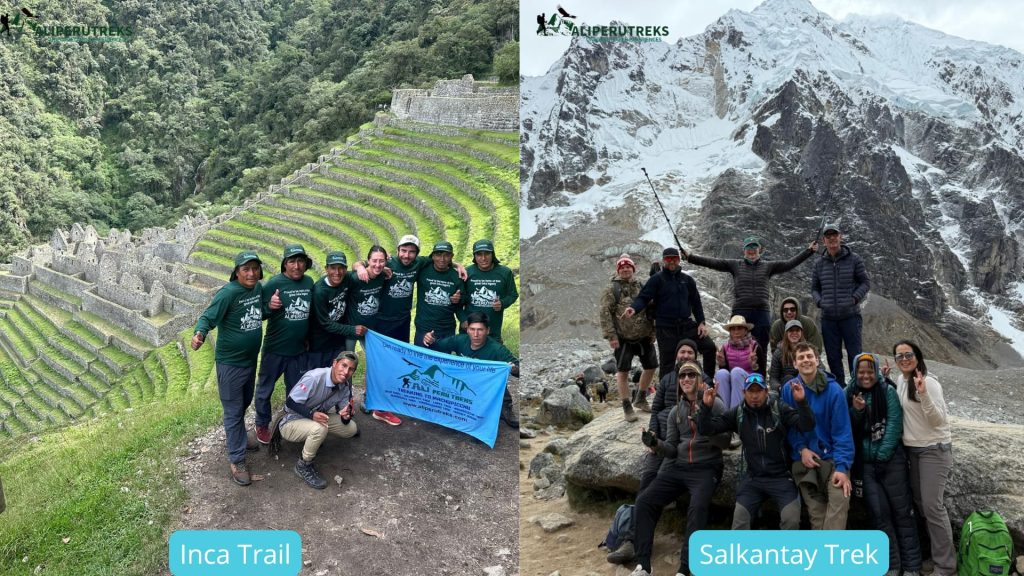
Your preference for scenery is a major factor in the salkantay trek vs inca trail decision. The Salkantay Trek is a journey of dramatic natural contrasts. It is defined by its epic alpine views. You will stand face-to-face with the towering Salkantay Peak. Its glaciers glisten in the Andean sun. You will also see the stunning turquoise waters of Humantay Lake. The trail descends from these icy heights into the lush cloud forest. This path is for those who crave wild, untamed landscapes. Nature is the main protagonist on this incredible trek.
The Inca Trail offers a different kind of beauty. It is a historical and ecological pilgrimage. You will walk on original stone paths laid by the Incas. The trail winds through lush cloud forests and subtropical jungle. You will see diverse flora and fauna along the way. While the mountain views are beautiful, the real magic is the history. The trail connects numerous archaeological sites. This creates a deep sense of connection to the past.
The Challenge: Difficulty and Acclimatization
Many travelers ask us about the difficulty of the salkantay trek vs inca trail. Generally, the Salkantay Trek is considered more physically demanding. The main reason is the higher altitude. The Salkantay Pass reaches an elevation of 4,630 meters. This is significantly higher than the Inca Trail’s highest point. The daily hiking distances can also be longer and steeper. It presents a greater test of endurance.
The Inca Trail is by no means easy. Its challenge comes from the relentless «up-and-down» nature of the path. The second day includes the infamous Dead Woman’s Pass. This is a long, steep ascent to 4,215 meters. The trail has thousands of stone steps which can be tough on the knees. However, the overall altitude is lower than Salkantay. Proper acclimatization in Cusco is essential for both treks. A good physical preparation guide is highly recommended.
Rules of the Road: Permits and Availability
Permits are the most critical logistical difference. Understanding this can make the salkantay trek vs inca trail choice for you. The Classic Inca Trail is strictly regulated by the Peruvian government. Only 500 permits are issued per day. This includes all guides, porters, and cooks. This means trekker spots are very limited. Permits go on sale for the entire next year around October. They often sell out 6 to 8 months in advance. Spontaneity is not an option for this world-famous hike.
The Salkantay Trek offers complete flexibility. It does not require special government permits to hike the trail. This means you can book it much closer to your travel dates. Sometimes just a few weeks in advance is possible. This makes it a fantastic alternative if the Inca Trail permits are sold out. It is also great for last-minute travel planners.
The History: Archaeological Sites
If your goal is Incan history, the salkantay trek vs inca trail comparison is very clear. The Inca Trail is unbeatable for archaeology. The path itself is an artifact. It leads you through multiple impressive ruins. You will explore sites like Sayacmarca, Phuyupatamarca, and Wiñay Wayna. These locations are largely inaccessible except via the trail. The trek culminates in the magical arrival to Machu Picchu through the Sun Gate. This is an experience no other trek can offer.
The Salkantay Trek focuses on nature’s majesty. The path does not pass through any major Incan ruins. Grand finale is your guided tour of the Machu Picchu citadel. You arrive at Aguas Calientes town on the penultimate day. Then you visit the sanctuary on the final day. The journey is about the wild Andes, not ancient stones.
So, Which Trek is Right for You?
Ultimately, there is no «best» trek, only the best trek for you.
Choose the Classic Inca Trail if:
- You are a history enthusiast who dreams of walking in the footsteps of the Incas.
- Seeing numerous, remote archaeological sites is a top priority.
- You want the iconic experience of arriving at Machu Picchu via the Sun Gate.
- You can plan and book your trip at least 6-8 months in advance.
Choose the Salkantay Trek if:
- You are a nature lover who craves epic, high-altitude mountain scenery.
- You want a more significant physical challenge with a higher altitude pass.
- You need more booking flexibility or Inca Trail permits are sold out.
- You want to see diverse landscapes, from alpine peaks to lush jungle.
Ready to make your choice? Ali Peru Treks is here to guide you. Our team of passionate local experts ensures a safe, authentic, and unforgettable adventure. We handle all the logistics so you can focus on the journey.Explore our detailed itineraries. Check availability for the trek that calls to you. Your path to Machu Picchu awaits. View our Classic Inca Trail to Machu Picchu. Or discover the wild beauty of the Salkantay trek to Machu Picchu.
High-Altitude Showdown: Salkantay vs. Inca Trail to Machu Picchu
High-Altitude Showdown: Salkantay vs. Inca Trail to Machu Picchu
When it comes to choosing a trekking route to the Inca citadel of Machu Picchu, two names stand out to adventurers: the famous Inca Trail and the challenging Salkantay Trek. While both offer spectacular landscapes and an unforgettable experience, one of their most significant differences is the altitude—a crucial factor that can define the level of difficulty and the preparation required. Here, we break down this «High-Altitude Showdown» to help you decide which path best fits your abilities and expectations.
Day-by-Day Altitude Guide: Acclimatization Profiles
Beyond just the maximum altitude, it’s essential to understand how the elevation is distributed throughout each trek, as this directly impacts the body’s acclimatization process.
Salkantay Trek:
The Salkantay Trek is known for a steep ascent during the first couple of days, followed by a descent into lower altitudes and warmer climates. A typical 5-day itinerary might look like this:
- Day 1: Begins at Soraypampa (approx. 12,795 ft) or Challacancha, with a hike to Humantay Lake (approx. 13,780 ft).
- Day 2: The big challenge day, ascending to the Salkantay Pass (15,190 ft) and then descending to Wayracmachay or Chaullay (approx. 9,514 ft).
- Day 3 and onward: The route continues downward through the cloud forest, with altitudes ranging from 6,500 to 9,200 feet, until reaching Aguas Calientes (6,692 ft).
This profile involves an intense effort on one main day, which then gives the body a break at lower altitudes, potentially making recovery easier for some hikers.
Inca Trail:
The Inca Trail, on the other hand, keeps hikers at high elevations for a larger portion of the journey. A classic 4-day itinerary has the following profile:
Day 1: Starts at Km 82 (approx. 8,924 ft) and gradually climbs to the Wayllabamba campsite (approx. 9,842 ft).
Day 2: This is the most demanding day, featuring the ascent to Dead Woman’s Pass (13,828 ft), followed by a descent to the Pacaymayo campsite (approx. 11,811 ft).
Day 3: Trekkers cross a second pass, Runkurakay (approx. 13,025 ft), before descending past impressive archaeological sites to the Wiñay Wayna campsite (approx. 8,694 ft).
Day 4: A relatively short and downhill hike to the Sun Gate (Inti Punku) for the first view of Machu Picchu (7,972 ft).

Frequently Asked Questions (FAQs)
Do I need to be in excellent physical shape for both treks?
Yes, both require a good level of physical fitness. We recommend preparing with regular hikes, especially on hills, for a few months before your trip.
What’s the best time of year to do these treks?
The dry season, from April to October, is ideal. It offers sunny days and clear skies, though the nights are cold.
Will I see Machu Picchu on both treks?
Absolutely! Both treks end with a full guided tour of the Machu Picchu citadel on the final day. The difference is how you get there.
