



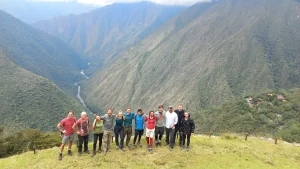
Inca Trail 4 Days
Inca Trail 4 Days 3 NightsThe Classic Inca Trail 4 Days to Machu Picchu
The Classic Inca Trail 4 Days to Machu Picchu is a legendary 4-day, 3-night guided hike covering approximately 42 to 44 kilometers (26 to 27.3 miles) through the Peruvian Andes. It follows original stone paths built by the Incas as part of the massive Qhapaq Ñan road network, leading hikers past ancient ruins, cloud forests, and high mountain passes before entering Machu Picchu through the Sun Gate (Inti Punku).
At Ali Peru Treks, we are a 100% locally owned and licensed travel agency specializing in the Inca Trail, located in Cusco. Our local guides, as well as our porters and cooks, are highly experienced and will take care of everything during the trek. We offer small-group tours, comfortable camping gear, and all-inclusive service so that all you have to worry about is enjoying the experience.
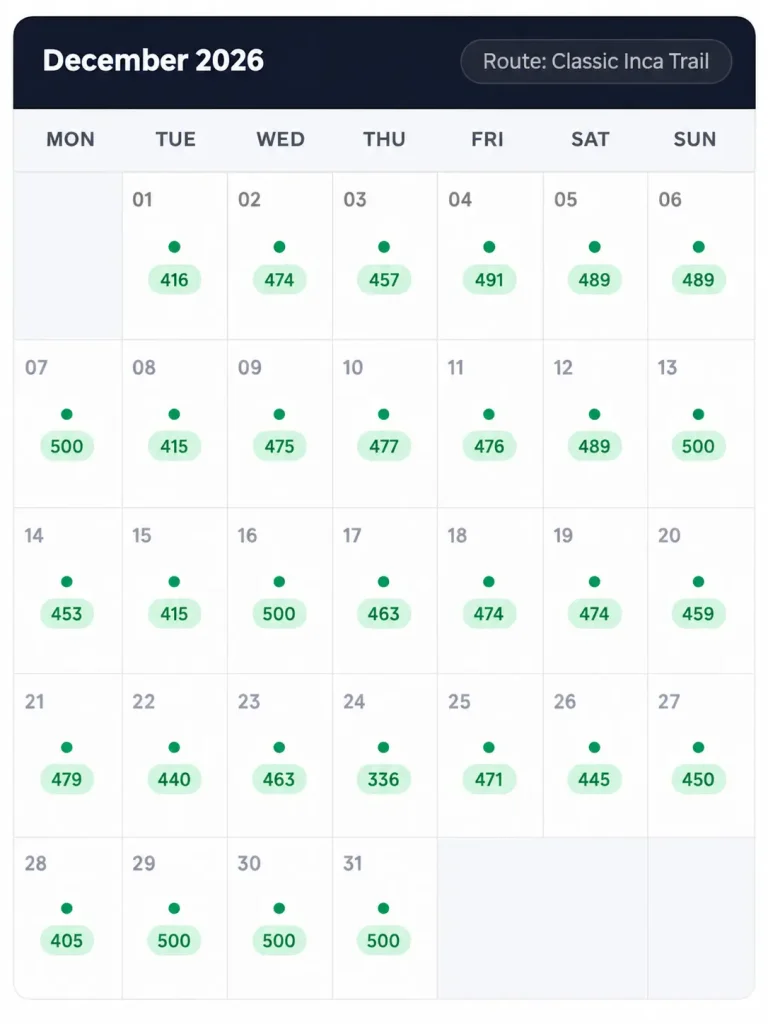
Inca Trail permits are limited and often sell out months in advance. Check availability first to confirm your preferred date before making your reservation. The earlier you plan, the better your chances of securing your ideal departure date.
Additional Special Services
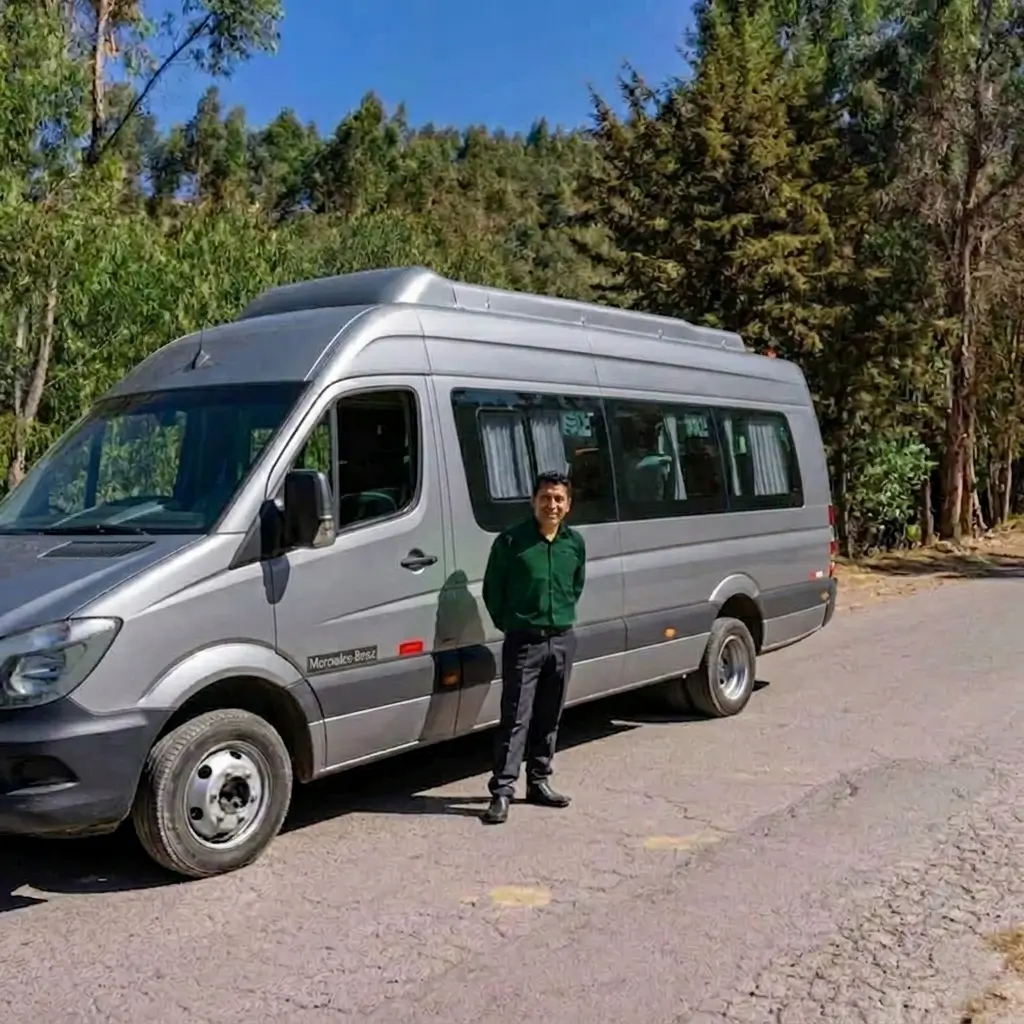
At Ali Perú Treks, we believe that an extraordinary adventure requires impeccable logistics. That is why we have designed a comprehensive, hotel-to-hotel transportation system that stays with you from the first light of day one until you are safely back at your destination. We guarantee safety, punctuality, and maximum comfort every mile of the way.
The Beginning: Direct Hotel Pickup
Your adventure starts stress-free. Regardless of where you are staying, our professional team will pick you up directly from your hotel doorstep.
- Rigorous Punctuality: We respect your time to ensure the start of your trek is smooth and unhurried.
- Luggage Assistance: Our staff handles all loading logistics from the very first moment, allowing you to focus on the excitement of the journey ahead.
On the Road: Safety and Comfort in Transit
The drive to the Inca Trail trailheads is conducted in modern, fully equipped vehicles driven by experts in high-altitude Andean routes.
- Modern Fleet: Our vehicles are maintained to the highest safety standards for your peace of mind.
- Professional Drivers: Our staff knows every curve of the road, always prioritizing your safety and well-being.
The Return: Total Flexibility and Guaranteed Rest
We know that after the physical intensity and emotion of Machu Picchu, the return journey should be the most relaxing part of your trip. Our return logistics are fully personalized and adapt to your post-tour plans:
- Direct Drop-off Service: Upon concluding your expedition, our private transport will be waiting to take you directly to your destination, with no unnecessary waits or transfers.
- Destinations of Your Choice: You decide where your journey with us ends. Whether it’s a restful return to your hotel in the Sacred Valley, a direct transfer to the airport for your next flight, or your accommodation in the city, we will get you there efficiently.
- Stress-Free Transition: While you relax in our comfortable seating and process the wonders you’ve just experienced, we handle the traffic and navigation, ensuring your final impression of the trip is one of total care and hospitality.
At Ali Perú Treks, we don’t just sell treks; we guarantee a complete mobility experience. We take pride in being the common thread of your adventure, looking after every detail of your transportation from hotel to hotel, so you can focus solely on living the legend.
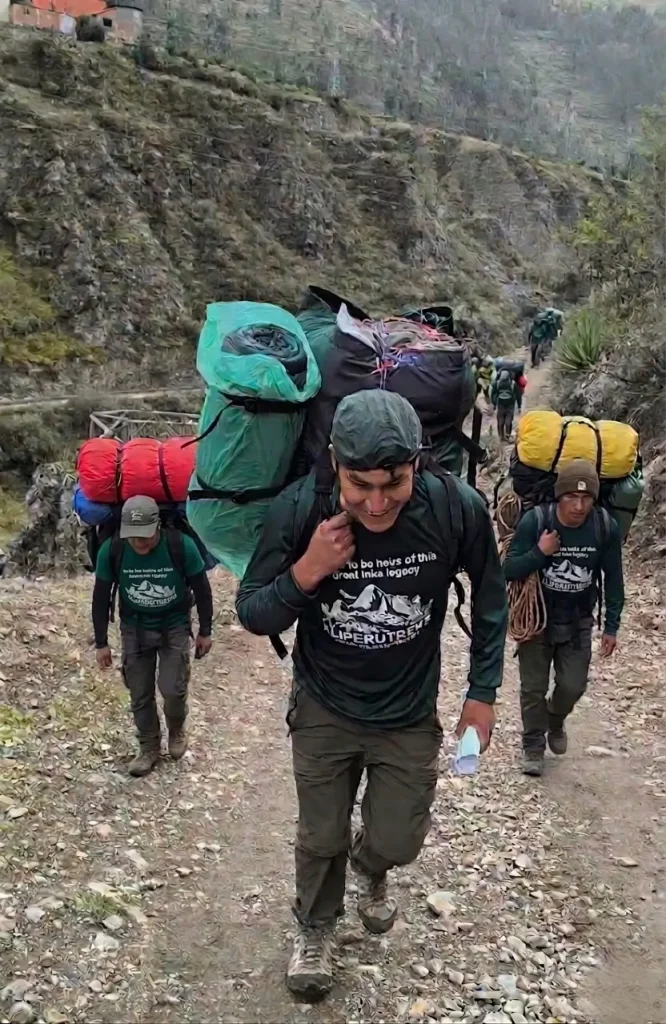
At Ali Perú Treks, our mission is for your attention to be focused exclusively on the breathtaking landscapes and the mystical history of the Andes, not on the weight on your shoulders. To guarantee you a pleasant expedition and agile mobility, we include a personal porter service in your reservation at zero cost, allowing you to enjoy the route with the lightness and distinction that every explorer deserves.
Preparatory Logistics: Duffel Bag Delivery
The excellence of our service begins before you even set foot on the trail. During your pre-trek briefing, our team will provide you with an exclusive Ali Perú Treks Duffel Bag. This bag is specifically designed to organize your belongings efficiently and securely, allowing our porter team to transport them with total care while you hike free from heavy loads.
Intelligent Gear Distribution (7 kg / 15.4 lbs)
We understand that restorative sleep and proper clothing are the pillars of a successful journey. Therefore, we have strategically organized the weight our team will transport for you at no additional charge:
- 4 kg for Personal Apparel & Gear: Perfect for your trekking layers, change of clothes, camp shoes, and toiletries.
- 2 kg for Your Sleeping Bag: We ensure your thermal gear is transported safely, ready to keep you warm during the crisp Andean nights.
- 1 kg for Your Inflatable Air Mattress: We prioritize your comfort by dedicating weight specifically for an ergonomic air mattress, guaranteeing restorative sleep after every day on the trail.
Ethical and Legal Commitment: Respecting Our Staff
At Ali Perú Treks, the safety and dignity of our porters are just as important as the satisfaction of our guests. We strictly adhere to the Porter’s Law and Peruvian Government Regulations, which mandate a maximum weight limit of 25 kg (55 lbs) per porter.
We ensure that every member of our team carries only the legal and fair amount of weight while providing them with dignified wages, high-quality nutrition, and professional mountain gear. By choosing us, you ensure your adventure follows the highest standards of responsible and humane tourism.
At Ali Perú Treks, we believe that the true essence of the Andes is discovered when we put away our devices and allow nature to speak to us. Hiking through remote trails is an invaluable opportunity to unplug from the daily grind, work, and screens, reclaiming that human and spiritual connection often lost in city life.
However, we understand that to fully enjoy that freedom, you need to feel secure. The depths of our mountains offer spectacular landscapes, but they also take us far from basic services. That is why safety is not an option for our expeditions; it is our structural priority.
Our Satellite Link Technology
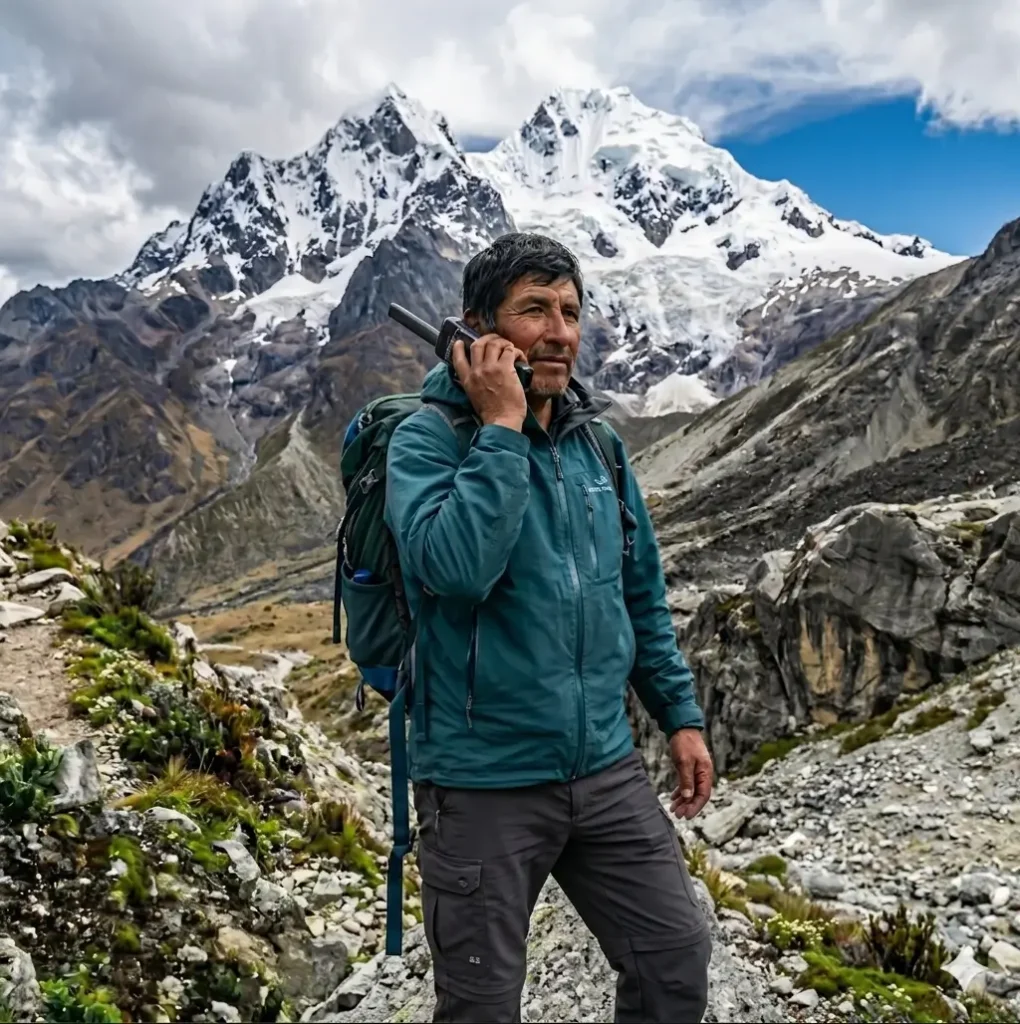
To guarantee an immediate response to any situation, especially regarding health or logistics in high-mountain areas, each of our lead guides carries a state-of-the-art satellite phone.
Unlike short-range radios, which we also use for internal team logistics, our satellite systems allow for real-time global communication from the most isolated points on the trail, where conventional networks simply do not exist.
Guest Usage: While our focus is on disconnecting, we understand that personal needs may arise. Our equipment is available for our clients to make private calls.
At Ali Perú Treks, we handle the technology and safety so that you only have to worry about having the most profound and authentic experience of your life. With us, you are never alone; you are protected by experts.
At Ali Perú Treks, we understand that personal comfort is essential to fully enjoying your expedition. We know that one of the most important concerns for our travelers is access to clean, private restroom facilities, especially on remote routes like the Inca Trail or Salkantay.
A Superior Standard of Hygiene
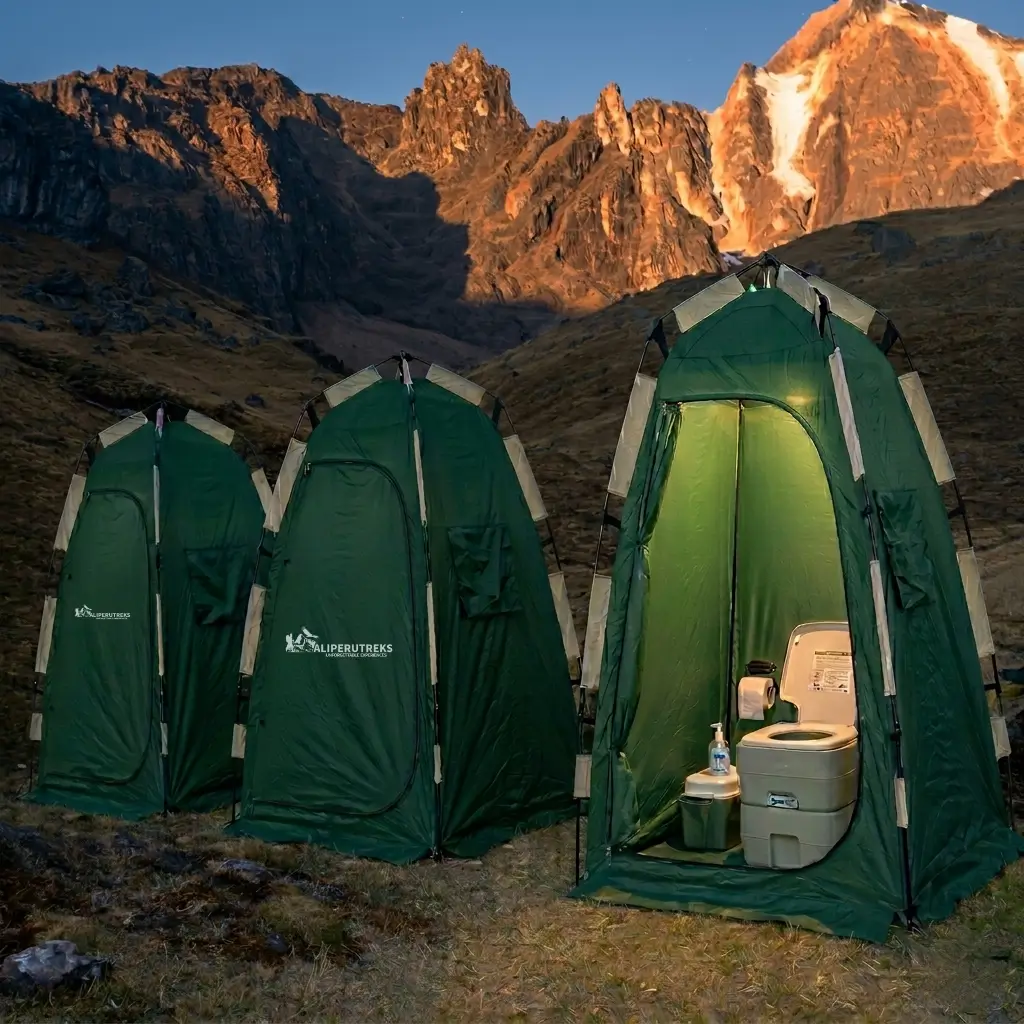
To enhance your trekking experience, we include private portable toilets at all our campsites and lunch spots. Unlike the public restrooms along the trail, which can often be crowded or poorly maintained, our portable stations provide you with:
- Total Privacy: A dedicated restroom tent reserved exclusively for our group.
- Controlled Hygiene: Constant cleaning and maintenance performed by our professional support staff.
- Strategic Availability: Set up and ready for use the moment you arrive at your meal site or camp.
Eco-Friendly Commitment
As a responsible operator committed to protecting Andean ecosystems and supporting local communities, we strictly follow a “Leave No Trace” policy. Preserving the environment is our top priority:
- Waste Management: All waste materials, such as toilet paper or wet wipes, must be placed in the specialized disposal bags we provide.
- Responsible Logistics: Our dedicated team of porters is responsible for carrying all waste out of protected areas to ensure proper disposal in compliance with government regulations.
Environmental Respect: By providing these facilities, we prevent the impact on natural areas, ensuring the trails remain pristine for future generations.
Overview
Inca Trail 4 Days Overview
The Classic Inca Trail 4 days to Machu Picchu, also known as the Classic Inca Trail, is a 43 km (27-mile) trek on original Inca stone paths from Km 82 in the Urubamba Valley to Machu Picchu. Instead of arriving by bus like most visitors, you walk into the citadel from above through Inti Punku, the Sun Gate, as Inca travelers once did. Over four days and three nights of camping, you cross Dead Woman’s Pass (Warmiwañusca) at 4,215 m (13,828 ft), descend from high Andean grassland into cloud forest, and explore Inca sites that can only be reached on foot, including Runkurakay, Sayacmarca, Phuyupatamarca, and Wiñay Wayna.
Ali Peru Treks is a locally owned Inca Trail operator based in Cusco, authorized by SERNANP to operate on the Inca Trail and in the Historic Sanctuary of Machu Picchu, and registered with DIRCETUR Cusco (see our official licenses and certifications). We run this trek in small groups of 2 to 12 hikers. The price includes your Inca Trail permit, your Machu Picchu entrance ticket, a 7 kg (15 lb) personal porter allowance, inflatable mattresses, private toilet tents, and a trekking chef. Group departures cost $775 USD per person.
The trek suits active travelers who are comfortable walking 5 to 10 hours a day on uneven stone steps during the first three days. You don’t need any climbing experience, but the altitude and the long climb on Day 2 are a real challenge, so it pays to train beforehand and spend at least two days acclimatizing in Cusco. Access is limited to 500 people per day (hikers, guides, and porters combined), and the trail closes every February, so dry-season dates sell out first.
Trip at a Glance
| Detail | Inca Trail 4 Days |
| Duration | 4 days / 3 nights (camping) |
| Route | Km 82 (Piscacucho) – Ayapata – Dead Woman’s Pass – Chaquicocha – Wiñay Wayna – Sun Gate – Machu Picchu |
| Distance | 43 km (27 miles) |
| Highest point | Dead Woman’s Pass, 4,215 m (13,828 ft) |
| Difficulty | Moderate to challenging |
| Group size | 2 to 12 hikers |
| Permits | The Inca Trail permit and Machu Picchu entrance ticket are included |
| Pickup and drop-off | Hotel pickup in Cusco, Urubamba, or Ollantaytambo; drop-off at your hotel in Cusco. |
| Return to Cusco | Train from Aguas Calientes to Ollantaytambo, then private transfer. |
| Season | Dry season: April to October; open all year except February |
| Price | $775 USD per person (group service) |
Tour Highlights
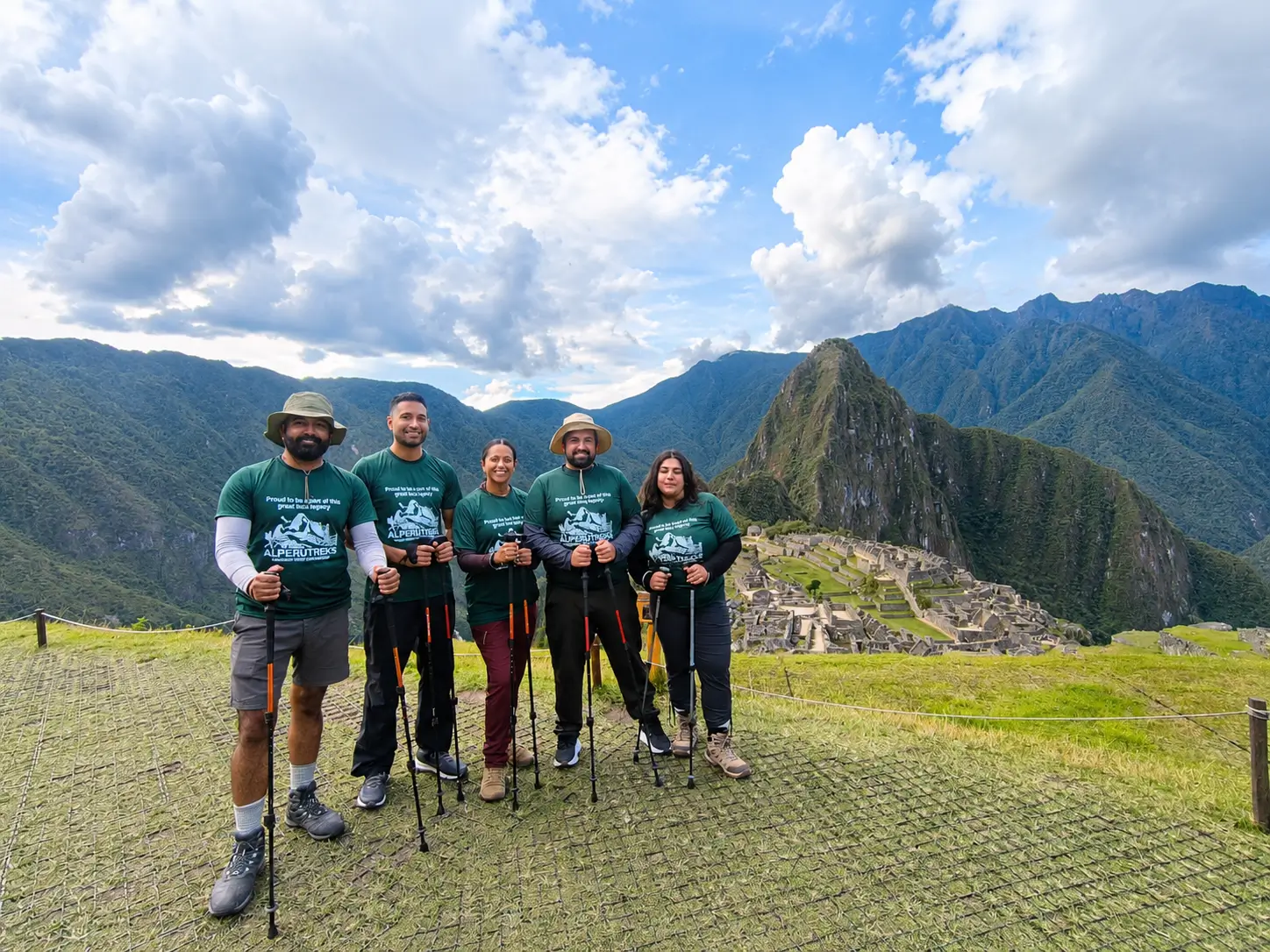
- Arrive through the Sun Gate. Walk into Machu Picchu from above in the early morning, then take the classic postcard photo from the upper terraces before your guided tour.
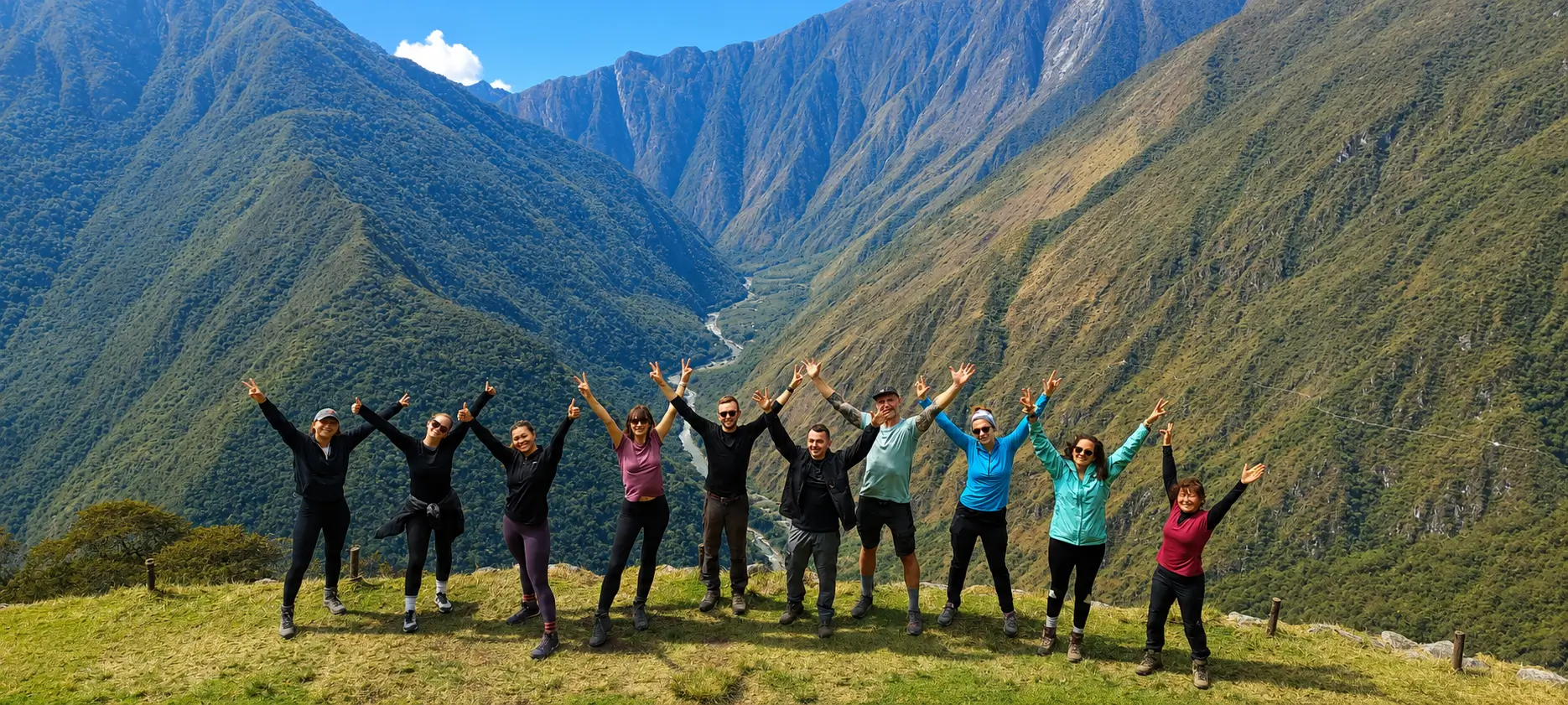
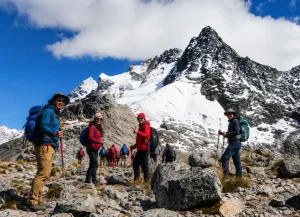
- Cross Dead Woman’s Pass. Day 2 takes you over the highest point of the trek, at 4,215 m (13,828 ft), with wide views over the surrounding Andean peaks.
- Visit Inca sites with no road access. Llactapata, Runkurakay, Sayacmarca, Phuyupatamarca, Intipata, and Wiñay Wayna are part of the trek itself.
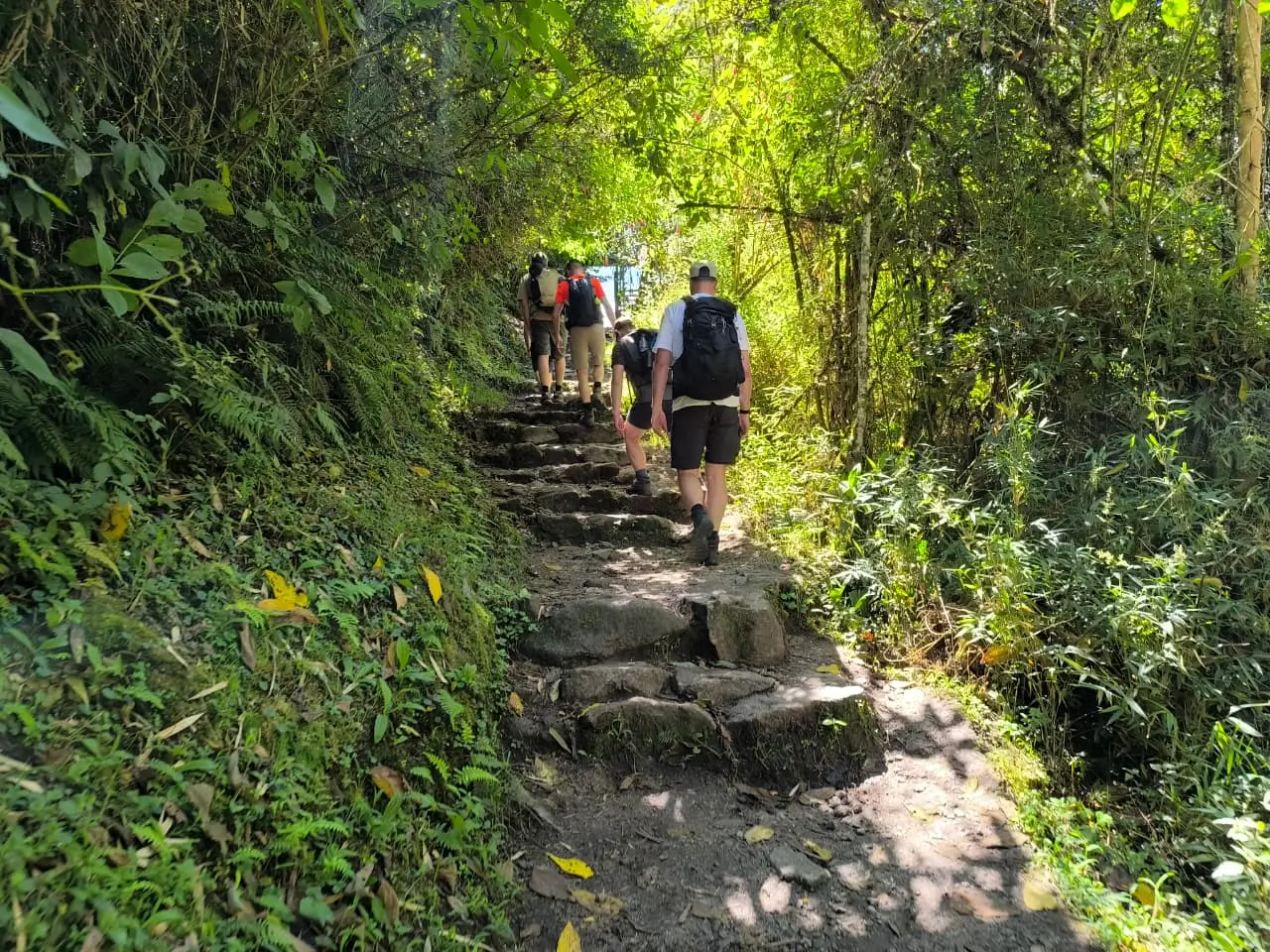
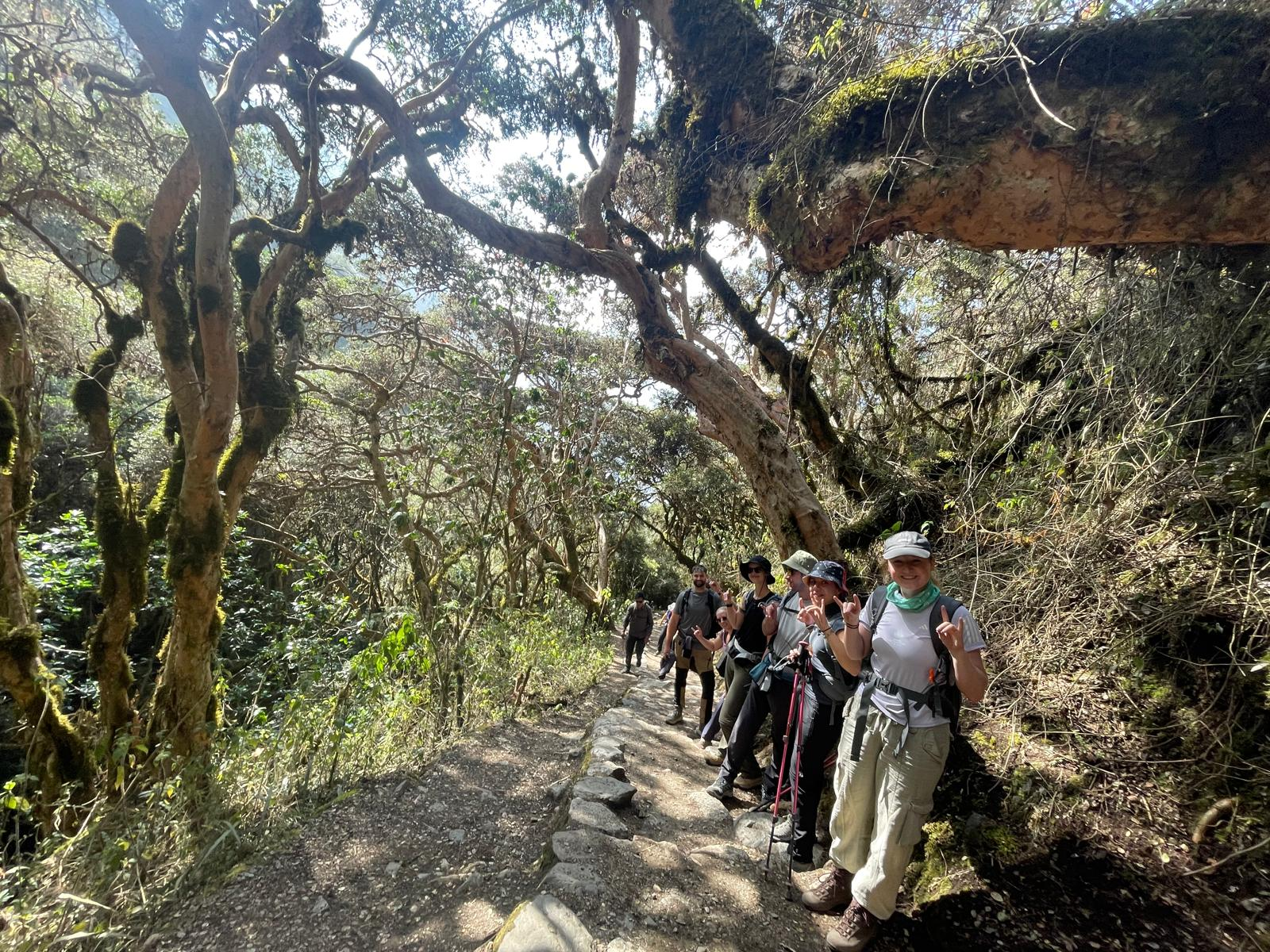
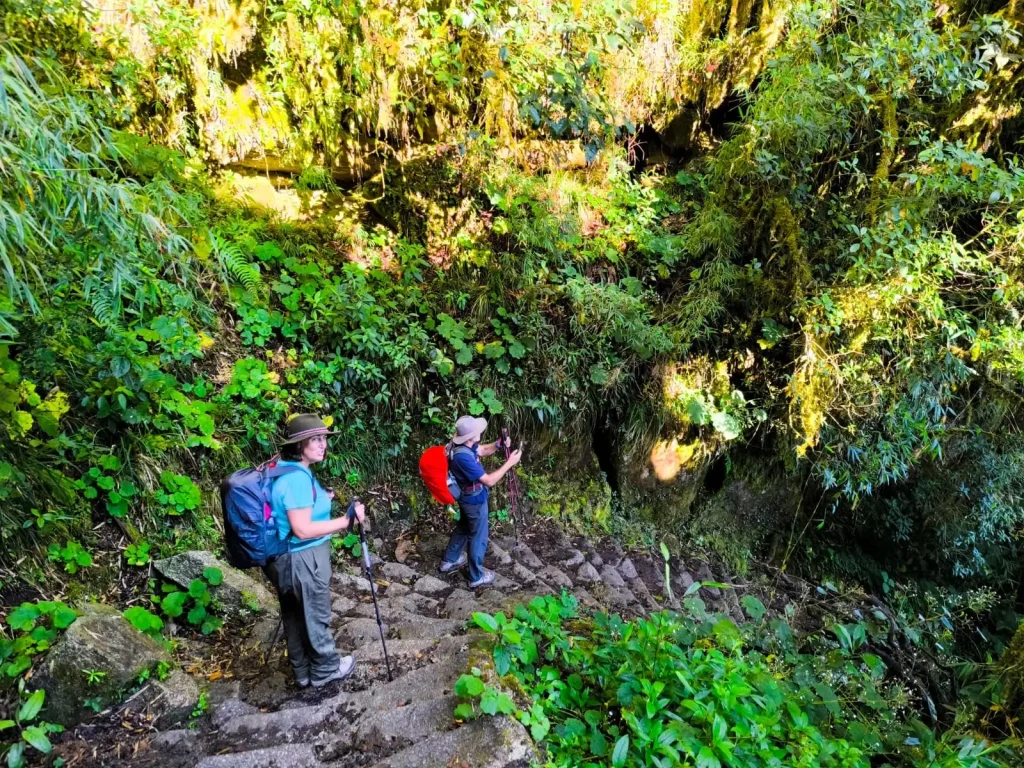
- Hike from Puna to Cloud Forest. The trail descends original Inca stairways and passes through a stone tunnel carved by the Incas.
- Carry only a daypack. Porters carry up to 7 kg (15 lb) of your personal gear plus all the camping equipment.
- Rest properly at camp. Two-person mountain tents with inflatable mattresses, a dining tent with table and chairs, and private toilet tents at campsites and lunch stops.
- Eat well on the trail. Hot, freshly cooked meals by our chef, with vegetarian, vegan, gluten-free, and allergy-friendly menus at no extra cost.
Why Hike the Inca Trail with Ali Peru Treks?
- Local and licensed. We are a 100% locally owned Cusco company, founded in 2023 by Ali Huamán, a university-educated guide from the Huayllaccocha community who speaks Quechua, Spanish, and English. Your booking directly supports Cusco guides, cooks, porters, and drivers.
- No outsourcing. Departures are guaranteed from two hikers. We never pass your booking to another agency or merge you into another company’s group.
- Small groups. A maximum of 12 hikers lets your guide manage pace, answer questions, and give each person proper attention.
- Hotel to hotel. We pick you up at your hotel on the morning of Day 1 and drop you back at your hotel in Cusco on the evening of Day 4.
- Camp comfort included. Inflatable mattresses, a pillow, a backpack rain cover, and a rain poncho come with every booking. See our camping comfort standard.
- An earlier return. We book an afternoon train from Aguas Calientes (usually departing between 2:55 and 3:55 PM), so you’re back in Cusco around 7:00 PM.
- A fairly treated crew. Guides, porters, cooks, and drivers are paid on time as soon as the trek ends, and we respect the legal 20 kg (44 lb) load limit for porters.
- Reviews from real hikers. Read what past travelers say about us on Tripadvisor.
Itinerary
Inca Trail 4 Days Itinerary: Day by Day
Day 1 – Cusco to Km 82 and Ayapata Campsite
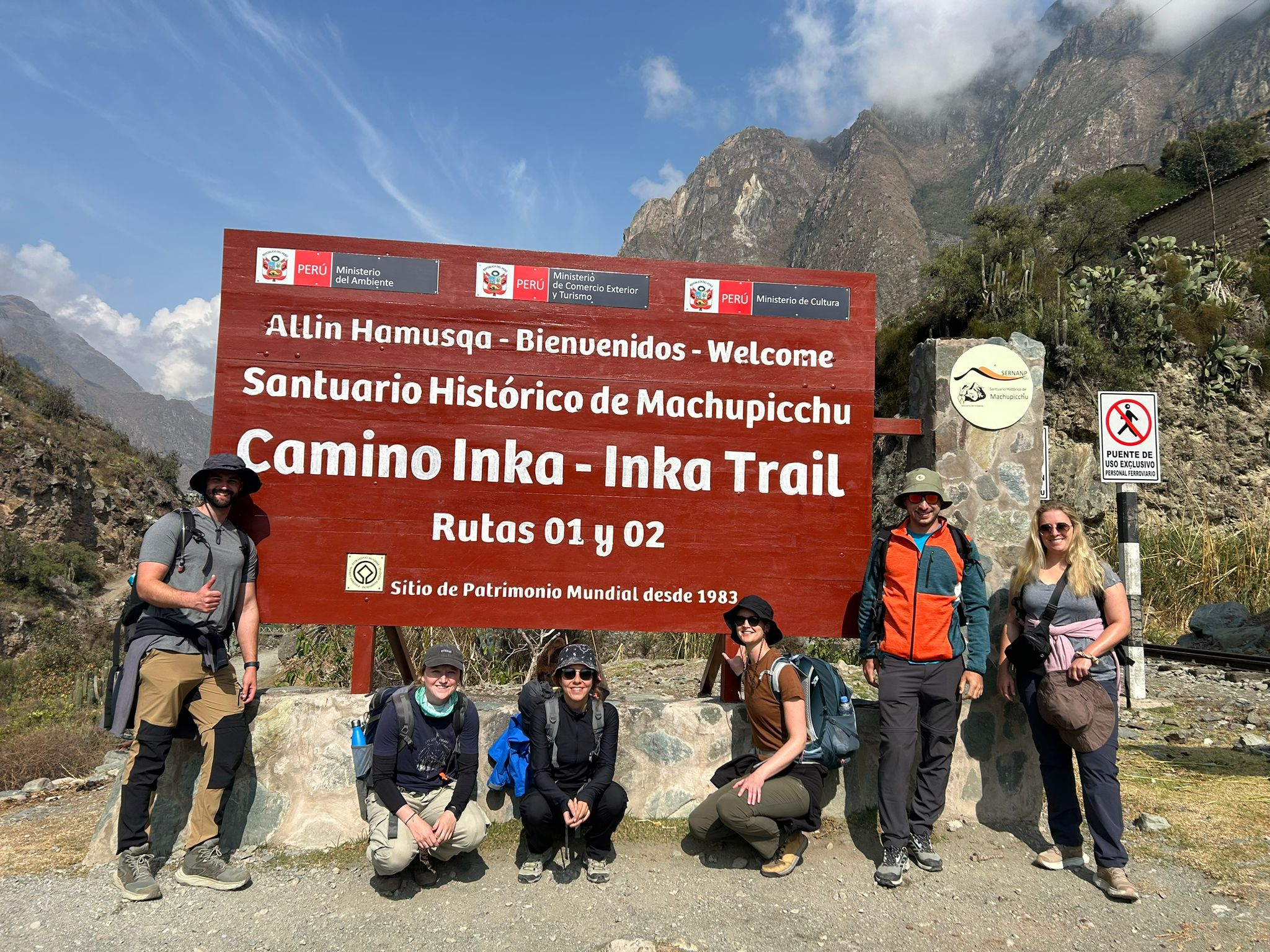
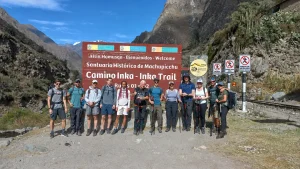
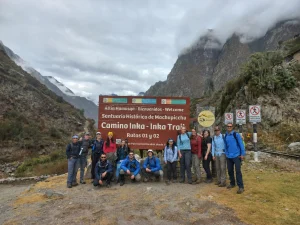
Your guide and our private transport pick you up from your hotel in Cusco, Urubamba, or Ollantaytambo at around 5:00 AM. We drive to Ollantaytambo for breakfast and final preparations, then continue to Km 82 (Piscacucho, 2,720 m / 8,923 ft), the official start of the Inca Trail. Here you meet the porters and the chef and pass the government checkpoint. Keep the original passport you used for your booking close at hand, as it is checked against your permit.
The first stretch follows the Urubamba River on a gently rolling path, which gives your body time to adjust to the altitude. Your guide stops at the small Inca site of Kanabamba and then at Llactapata, an agricultural center of terraces and buildings, where you’ll see how the Incas farmed these steep valleys. About two more hours of walking bring you to Hatunchaca (2,930 m / 9,612 ft) for lunch and a short rest.
In the afternoon you pass Wayllabamba, the last village on the trail and your final chance to buy snacks or extra drinks, before the steady climb to camp at Ayapata (3,300 m / 10,827 ft). Your tent and inflatable mattress are already set up when you arrive. The day ends with tea time and dinner under the Andean sky.
- Distance: 12 km (7.5 miles)
- Hiking time: about 6 hours
- Altitude: 2,720 m (8,923 ft) at Km 82 to 3,300 m (10,827 ft) at Ayapata; elevation gain 580 m (1,904 ft)
- Difficulty: moderate (acclimatization day)
- Inca sites: Kanabamba and Llactapata
- Typical conditions: warm and sunny in the valley
- Meals: breakfast, lunch, and dinner
- Overnight: camping at Ayapata
Guide tip: Walk more slowly than feels necessary and drink often. Day 1 is your first real test at altitude, and an easy pace today makes the climb on Day 2 noticeably easier.

Day 2 – Dead Woman’s Pass to Chaquicocha
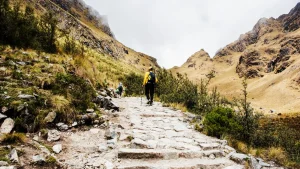
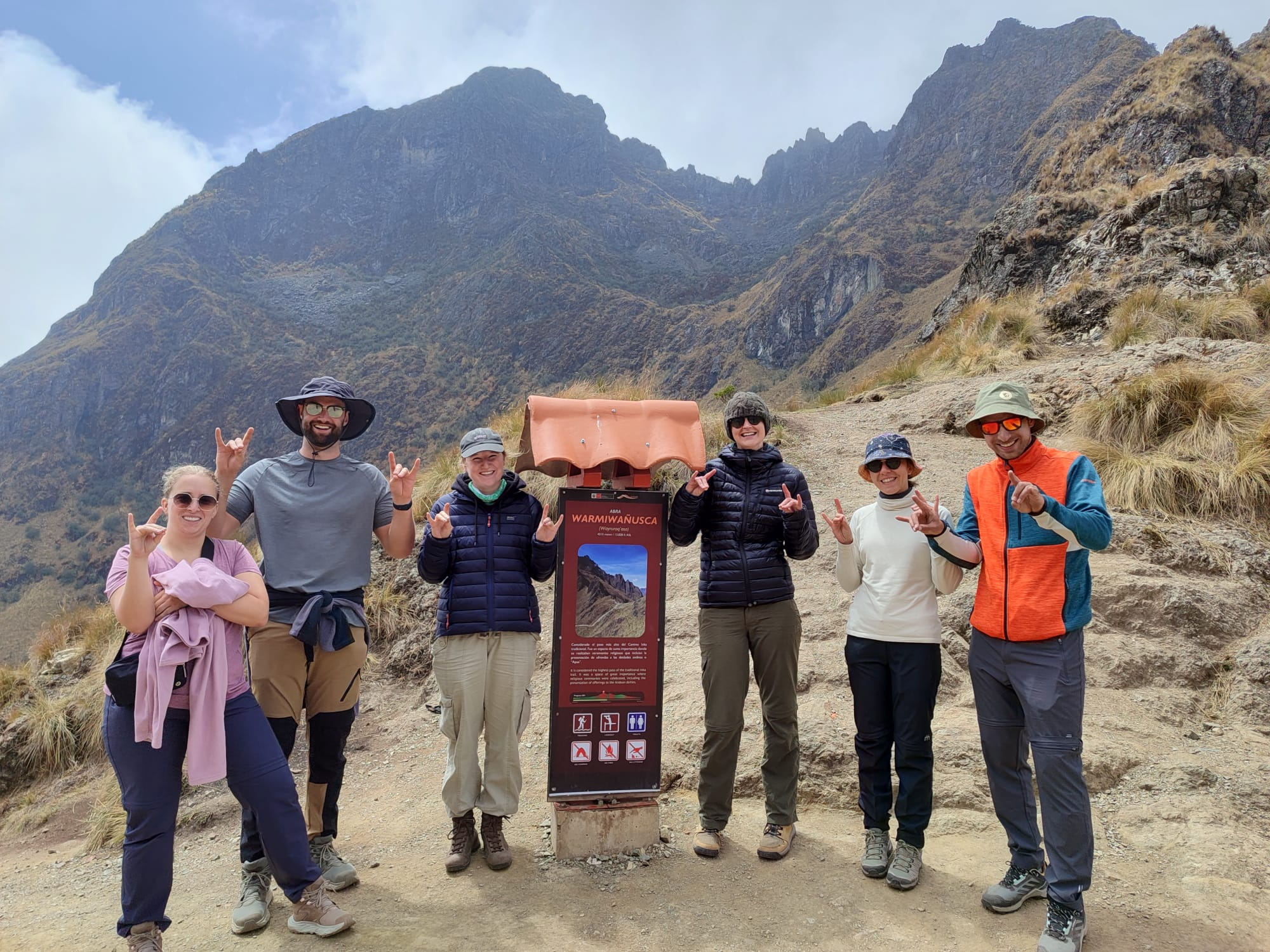
This is the hardest day of the trek and, for many hikers, the most satisfying. It starts with coca tea brought to your tent and a hearty breakfast, followed by an early departure for the long, steady climb through Llulluchapampa to Warmiwañusca, Dead Woman’s Pass (4,215 m / 13,828 ft). From camp to the pass you gain 915 m (3,001 ft), mostly on stone steps, and the air feels noticeably thinner near the top. Your guide sets a steady pace and plans regular rest stops.
After a break and photos at the pass, a steep stone staircase leads down to the Pacaymayo valley (3,590 m / 11,778 ft) for lunch. The afternoon brings a second, shorter climb to the Runkurakay Pass (4,000 m / 13,123 ft), with a stop at the circular ruins of Runkurakay along the way. On the far side, the trail descends to Sayacmarca, a compact Inca settlement built on the edge of a cliff and reached by a narrow stairway. For a closer look at this stage, read our Dead Woman’s Pass guide.
You arrive at camp in Chaquicocha (3,600 m / 11,811 ft) in time to watch the sunset over the Vilcabamba range. After tea time and dinner, if the sky is clear, your guide points out the Andean constellations and explains the role they played in Inca cosmology.
- Distance: 15 km (9.3 miles)
- Hiking time: 9–10 hours
- Highest point: Dead Woman’s Pass, 4,215 m (13,828 ft); second pass at Runkurakay, 4,000 m (13,123 ft)
- Altitude: 3,300 m (10,827 ft) at Ayapata to 3,600 m (11,811 ft) at Chaquicocha
- Difficulty: challenging; the most demanding day of the trek
- Inca sites: Runkurakay and Sayacmarca
- Typical conditions: cold at the pass, milder at camp
- Meals: breakfast, lunch and dinner
- Overnight: camping at Chaquicocha
Guide tip: Start the climb in light layers and add your warm jacket and rain gear at the pass, where wind and cold arrive quickly. Trekking poles help most on the steep staircase down to Pacaymayo.

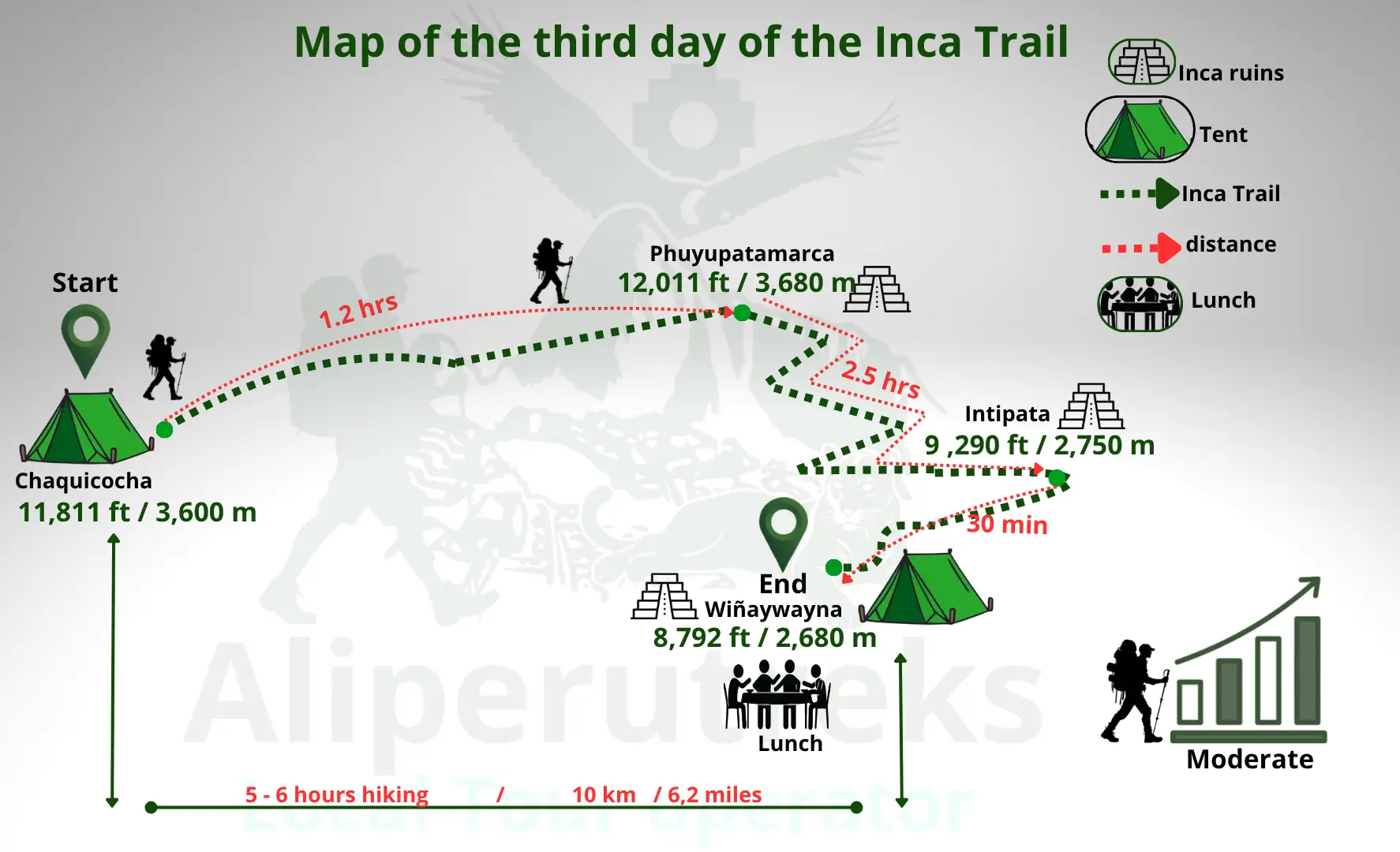
Day 3 – Phuyupatamarca and Wiñay Wayna Through the Cloud Forest
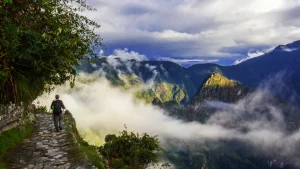
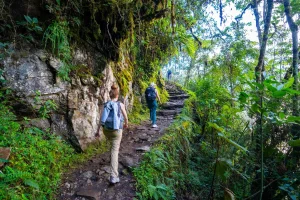
After the effort of Day 2, the third day is shorter, mostly downhill and, for many hikers, the most beautiful section of the Inca Trail. From Chaquicocha the path contours the mountainside into cloud forest, passing through an original Inca stone tunnel and plant life that changes noticeably as you lose altitude.
The first major stop is Phuyupatamarca (3,680 m / 12,073 ft), often translated as “town above the clouds.” On clear days it offers views of Mount Salkantay and the Urubamba Valley, and its ritual fountains still channel water today. From here, well-preserved Inca stairways descend 1,030 m (3,379 ft) to Wiñay Wayna, passing Intipata, a hillside of agricultural terraces overlooking the river and surrounding mountains.
You reach the Wiñay Wayna campsite (2,650 m / 8,694 ft) with time for a shower and a rest. Later in the afternoon your guide leads a visit to the Inca site of Wiñay Wayna, a complex of terraces, fountains and buildings stepping down the slope, and the most impressive site on the trail before Machu Picchu. The final dinner is also a farewell, when the group thanks the porters and chef who have supported the trek. Plan on an early night, as the wake-up call on Day 4 comes before dawn.
- Distance: 10 km (6.2 miles)
- Hiking time: 5–6 hours
- Altitude: 3,600 m (11,811 ft) at Chaquicocha, up to 3,680 m (12,073 ft) at Phuyupatamarca, then down to 2,650 m (8,694 ft) at Wiñay Wayna; descent 1,030 m (3,379 ft)
- Difficulty: moderate; a long descent on stone steps that is hard on the knees
- Inca sites: Phuyupatamarca, Intipata and Wiñay Wayna, plus an Inca tunnel
- Typical conditions: humid cloud forest
- Meals: breakfast, lunch and dinner
- Overnight: camping at Wiñay Wayna
Guide tip: On the steepest steps, shorten your stride and let your poles take some of the weight. Put on insect repellent before you reach the cloud forest.

Day 4 – Sun Gate to Machu Picchu and Return to Cusco
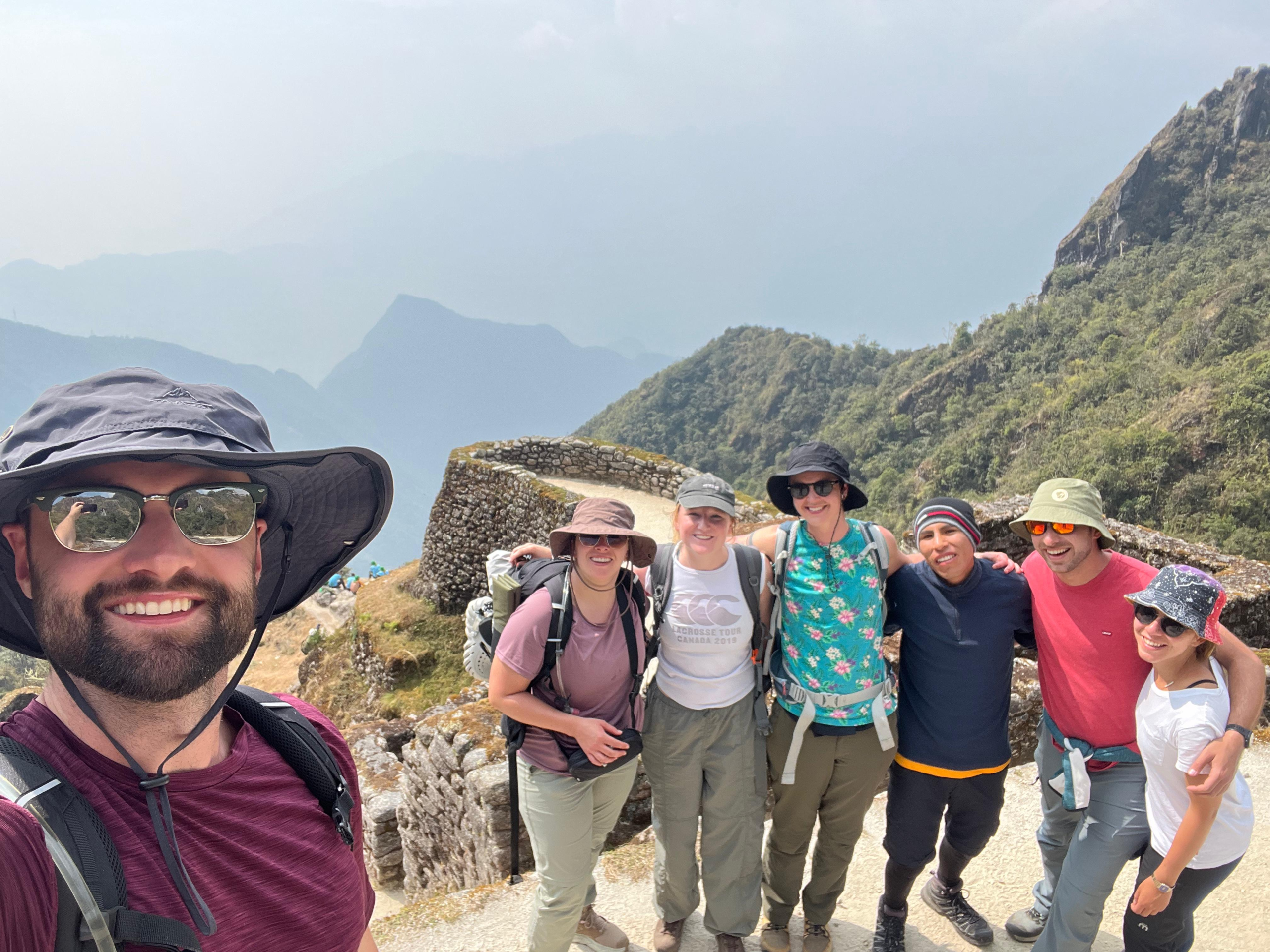
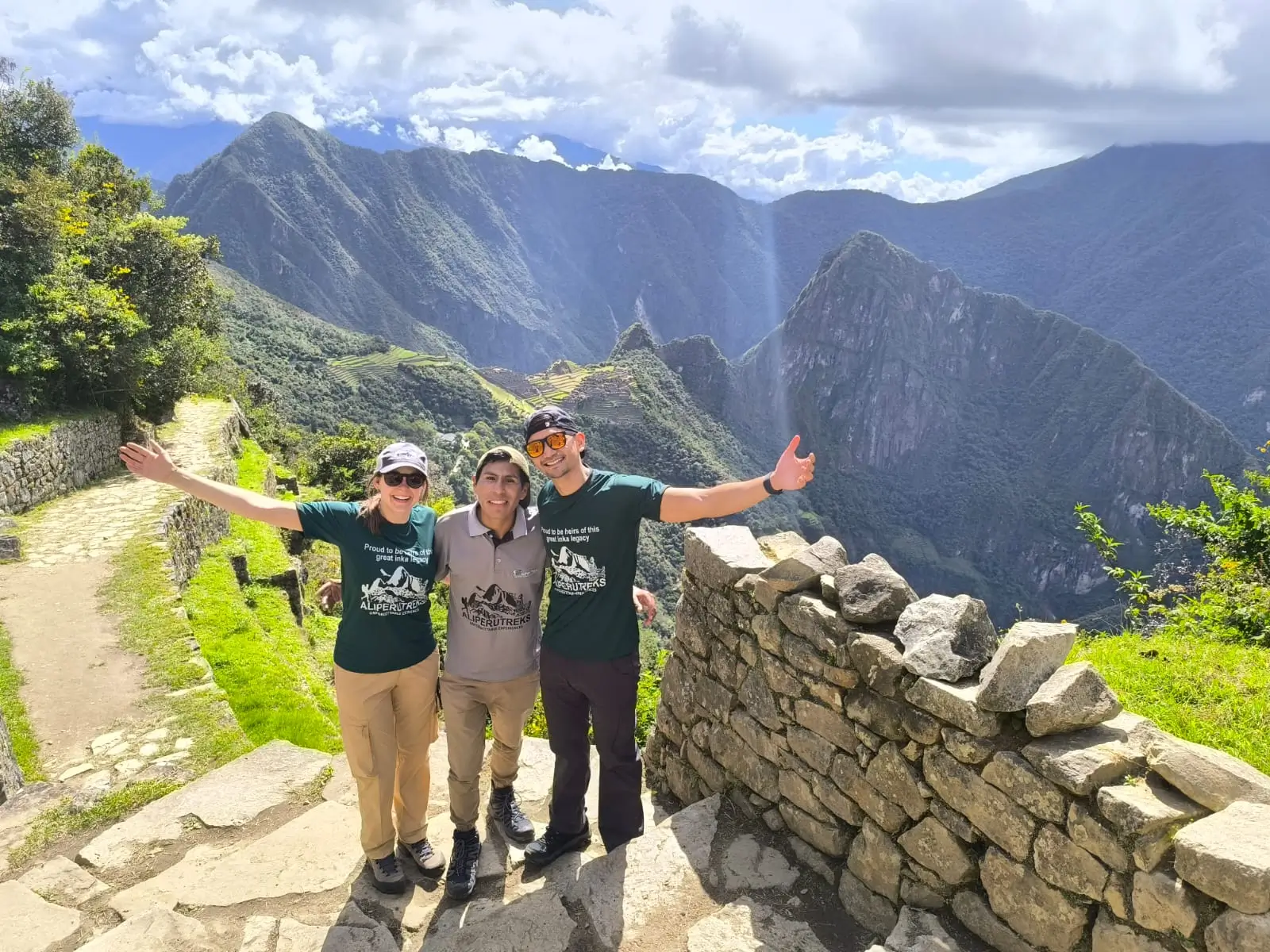
We wake up very early and have breakfast so the group can be among the first in line at the final checkpoint, which opens at 5:30 AM. From there it’s about an hour on a mostly level path along the mountainside to Inti Punku, the Sun Gate (2,730 m / 8,956 ft), which we usually reach around 6:30 AM. This is where you get your first view of Machu Picchu, laid out on the ridge below. When the sky is clear, the early light reaches the citadel while you’re on this last stretch of trail.
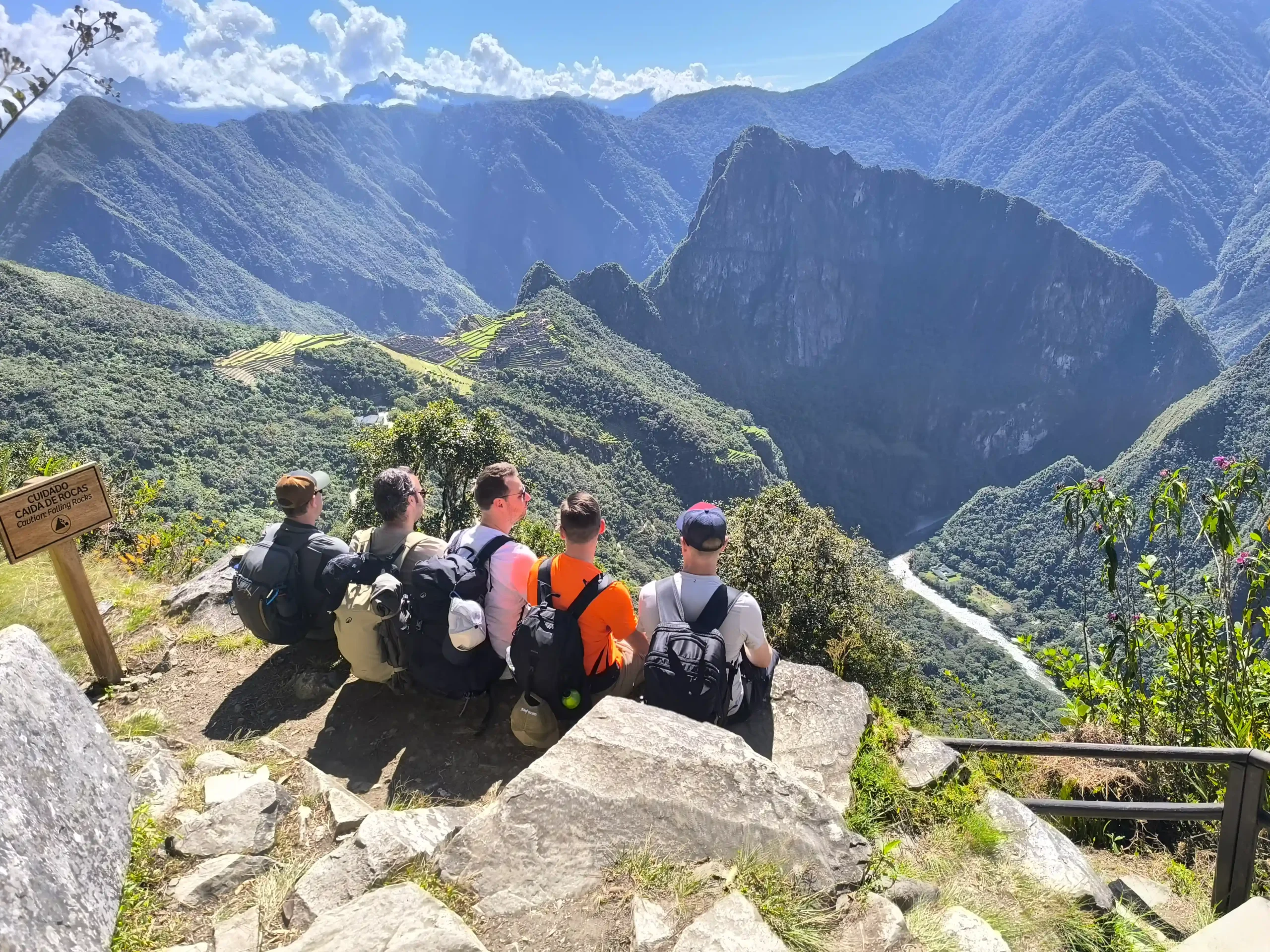
From the Sun Gate we walk down for about an hour to the upper terraces of Circuit 1, the viewpoint for the classic photo of the citadel. Because there are no restrooms inside the archaeological site, we then exit briefly to use the facilities at the entrance. We re-enter on Circuit 3 (the Royal Route) for a guided tour of about two hours, during which your Ali Peru Treks guide explains the history and purpose of the main sectors along the route.
Optional: Huayna Picchu. If you have booked a Huayna Picchu ticket in advance (extra cost, subject to availability), you can climb the peak behind the citadel after your tour: about one hour up and one hour down, with an aerial view of the whole site. Tickets are limited and need to be booked months ahead.
After your visit, take the shuttle bus down to Aguas Calientes, where you have time for lunch (not included). Your guide accompanies you to the train station for the afternoon train to Ollantaytambo, where our team meets you for the private transfer to your hotel in Cusco, arriving around 7:00 PM.
- Distance: 6 km (3.7 miles)
- Hiking time: about 1 hour to the Sun Gate, then about 1 hour down to the Circuit 1 viewpoint
- Altitude: 2,650 m (8,694 ft) at Wiñay Wayna, 2,730 m (8,956 ft) at the Sun Gate and 2,430 m (7,972 ft) at Machu Picchu
- Difficulty: easy, followed by a guided visit of the citadel
- Highlights: the Sun Gate, the classic view from Circuit 1, the guided tour on Circuit 3 and the optional Huayna Picchu climb
- Typical conditions: warm and humid, often misty early in the morning
- Meals: breakfast
- Return: shuttle bus to Aguas Calientes, train to Ollantaytambo and private transfer to your hotel in Cusco
Guide tip: Keep your passport in an easy-to-reach pocket, because it is checked again at the final checkpoint, and carry a light rain jacket for the morning mist at the Sun Gate.

Included
What’s Included
Before the trek
- Pre-trek briefing at our office in Cusco at 6:00 PM the evening before departure, where you meet your guide, review the itinerary and receive your duffel bag.
Permits and entrance tickets
- Inca Trail permit.
- Machu Picchu entrance ticket, including the Circuit 1 viewpoint and the Circuit 3 guided tour described in the itinerary.
Guide and trekking crew
- Professional, university-accredited trekking guide who speaks fluent English.
- Professional chef and cooks.
- Porters who carry all group equipment for the entire trek.
- Personal porter allowance of 7 kg (15 lb) per hiker. This includes your sleeping bag and mattress (see the Packing List).
Camping equipment
- Two-person high-mountain tents (double-wall, four-season).
- Inflatable sleeping mattresses for all three nights.
- Sleeping pillow.
- Dining tent with table and chairs.
- All cooking equipment.
- Private toilet tents with water-pump toilets at every campsite and lunch stop.
Meals and drinking water
- 4 breakfasts, 3 lunches and 3 dinners (from breakfast on Day 1 to breakfast on Day 4), plus afternoon tea time at camp.
- Vegetarian, vegan, gluten-free and allergy-friendly menus at no additional cost when requested at the time of booking.
- Boiled and filtered drinking water from the first lunch to the last breakfast.
Transport
- Private transport from your hotel to Ollantaytambo and the trailhead at Km 82 (Piscacucho).
- Bus from Machu Picchu down to Aguas Calientes.
- Train from Aguas Calientes to Ollantaytambo (PeruRail Expedition or Inca Rail The Voyager).
- Private transport from Ollantaytambo to your hotel in Cusco.
Safety
- Emergency oxygen carried by every group.
- Complete first aid kit with over-the-counter medicines and emergency supplies.
Extras
- Backpack rain cover and rain poncho for each hiker.
- Free luggage storage for your main bags at our Cusco office during the trek.
What’s Not Included
- Sleeping bag (rental available for $20 USD).
- Trekking poles (rental available for $15 USD per pair).
- Huayna Picchu or Machu Picchu Mountain ticket ($80 USD per person, subject to availability).
- Lunch in Aguas Calientes on Day 4.
- Drinking water for the first morning of Day 1 (bring your own until lunch).
- Tips for guides, cooks and porters.
- Travel insurance.
- Flights and hotels in Cusco before or after the trek.
- Personal expenses, such as snacks and drinks bought on the trail.
Packing List
Inca Trail 4 Days Packing List
On the Inca Trail you’ll walk through a warm valley floor, a freezing high pass and humid cloud forest, sometimes in a single day. You’ll also only see your duffel bag at camp each evening, so plan carefully what goes in your daypack and what goes with the porters.
How Your Luggage Works
- Daypack (you carry it): a 25–30 L backpack is ideal. Large backpacks are not allowed inside Machu Picchu, where the limit is 40 × 35 × 20 cm (16 × 14 × 8 in).
- Duffel bag (the porters carry it): we give it to you at the briefing. It can weigh up to 7 kg (15 lb), including your sleeping bag and mattress, and you can only access it at the campsites.
- The rest of your luggage: leave it at our Cusco office, free of charge, until you return.
- Why 7 kg: the limit protects our porters, whose total load is capped at 20 kg (44 lb) under Peruvian regulations.
Essentials to Carry in Your Daypack
- Original passport (essential): the same document you used to book. It’s checked at the trail checkpoints.
- Valid physical university ID (essential if you booked with a student discount).
- Water (essential): 2–3 liters of capacity in reusable bottles or a hydration bladder. Bring your own water for the first morning; we provide boiled and filtered water from the first lunch onward.
- Rain gear (essential): a rain jacket or poncho (a poncho and backpack cover are included).
- Headlamp (essential): for moving around camp at night and for the pre-dawn start on Day 4.
- Warm layer (essential): a fleece or light jacket for rest stops and the high passes.
- Sun protection (essential): high-SPF sunscreen, a sun hat and sunglasses.
- Snacks (recommended): energy bars, chocolate or dried fruit.
- Camera and power bank (recommended): there is no electricity on the trail.
- Insect repellent (recommended): you’ll need it in the cloud forest on Days 3 and 4.
- Small trash bag (recommended): we follow Leave No Trace principles.
- Cash in small soles notes (recommended): for tips and snacks along the trail.
Clothing and Footwear in Your Duffel
- Hiking boots (essential): comfortable, broken-in and with good ankle support. Wear them on Day 1.
- Hiking clothes (essential): 2 t-shirts, 2 pairs of hiking pants, 4 sets of underwear and 3 pairs of hiking socks.
- Warm layers (essential): thermal base layers, a fleece and a warm down jacket. Night temperatures at Chaquicocha, the second campsite, can drop to 3°C (37°F).
- Waterproof gloves (essential): for cold mornings and the passes.
- Camp shoes (recommended): sneakers or sandals to rest your feet in the evening.
Sleeping
- Sleeping bag (essential): rated to at least -15°C (5°F). Bring your own or rent one of our down sleeping bags.
- Mattress and pillow: included.
Toiletries and Health
- Medication (essential): your personal prescriptions and a small first aid kit with plasters, moleskin for blisters and pain relief.
- Hygiene (essential): toothbrush, toothpaste, hand sanitizer and wet wipes.
- Quick-dry towel (recommended): for washing and the shower at Wiñay Wayna.
- Skin care (recommended): lip balm and moisturizer; the Andean air is very dry.
Optional
- Trekking poles: helpful on the long descents of Days 2 and 3. Ours come with rubber tips to protect the Inca stonework.
For brands, fabrics and what to rent versus buy, see our Peru trekking gear list.
Travel Info
Important Information Before Hiking the Inca Trail
How Difficult Is the Inca Trail 4 Days?
The Classic Inca Trail is rated moderate to challenging. The trek is not technical, but three things make it demanding: the altitude, with two nights camped at 3,300 m (10,827 ft) and 3,600 m (11,811 ft) and a pass at 4,215 m (13,828 ft); the stone steps, which make up long sections of the climbs and descents; and Day 2, which involves 9–10 hours on the trail. Day 3 is shorter but descends 1,030 m (3,379 ft) on stairways, which can be tiring on the knees.
Most reasonably fit hikers complete it comfortably with some preparation. Because porters carry the heavy gear, you’ll only hike with a light daypack.
How to Train for the Hike
Start preparing 6 to 8 weeks before your trip. The goal is to get used to long days on your feet and to climbing and descending steps.
- Cardio: three or four sessions a week of hiking, stair climbing, cycling or running.
- Long hikes: one hike of 4 to 6 hours on weekends, ideally with steep uphill and downhill sections.
- Stairs: practice going up and down stairs, since much of the trail is built from stone steps.
- Gear: train in the boots and with the daypack you’ll use on the trail, so both are broken in before Day 1.
Altitude and Acclimatization
Cusco itself sits at 3,399 m (11,152 ft), so spending time there before the trek is the best preparation. We ask all hikers to arrive in Cusco at least two days (48–72 hours) before departure. Common signs of altitude sickness include headache, nausea, tiredness and shortness of breath; let your guide know straight away if you feel unwell.
Our lead guides are trained in Wilderness First Aid, and every group carries emergency oxygen and a full first aid kit. If you’re considering altitude medication, discuss it with your doctor before you travel.
Weather and the Best Time to Hike
The Cusco region has two main seasons:
- Dry season (April to October): mostly clear skies and sunny days, with cold nights at the higher camps. This is the most popular time to hike, and May to August permits sell out first.
- Rainy season (November to March): heavy but usually brief showers, greener landscapes, more flowers and fewer hikers on the trail.
The Inca Trail closes every February for maintenance and conservation. Conditions also change within a single trek: expect warm weather in the valley on Day 1, cold at Dead Woman’s Pass and humidity in the cloud forest on Days 3 and 4. For a closer look, see our guide to Inca Trail weather and the Inca Trail by month.
Inca Trail Permits and How Far Ahead to Book
Peru’s Ministry of Culture limits the Classic Inca Trail to 500 people per day, and that number includes guides, cooks and porters, so hiker places are far fewer. You cannot hike the trail independently: permits are only sold through licensed operators, and every group must be accompanied by a licensed guide.
Under Ministerial Resolution 000333-2026-MC, published in September 2026, permits are issued in each hiker’s name and passport number, cannot be transferred, and dates can only be rescheduled in documented cases of force majeure. For that reason, we need your exact passport details when you book.
For May to August departures, we recommend booking at least six months in advance. The Ministry of Culture releases permits for the following year once a year, usually in October or November; as of mid-October 2026, the release date for 2027 permits had not yet been announced.
As soon as we receive your passport details and deposit, we request your permit, subject to availability; if your date is sold out, we’ll suggest the nearest available alternatives. You can check open dates on our Inca Trail availability page.
Pre-Trek Briefing
The evening before the trek, at 6:00 PM, you meet your guide at our office in Cusco for a mandatory briefing. You’ll go through the itinerary and route details, receive your 7 kg (15 lb) duffel bag, leave any luggage you won’t need on the trail and have time to ask questions.
Getting to Km 82 and Back to Cusco
Hotel pickup is at around 5:00 AM on Day 1 from Cusco, Urubamba or Ollantaytambo, with a breakfast stop in Ollantaytambo before the trailhead. On Day 4, the bus takes you from Machu Picchu down to Aguas Calientes, and an afternoon train (usually departing between 2:55 and 3:55 PM) takes you to Ollantaytambo, where our private transport drives you back to your hotel in Cusco, arriving around 7:00 PM.
Machu Picchu Circuits and Timing on Day 4
Machu Picchu is visited on fixed circuits. Inca Trail hikers arrive through the Sun Gate and walk down to the upper terraces of Circuit 1 for the classic view, then leave the site briefly and re-enter through the lower entrance on Circuit 3 (the Royal Route) for the guided tour.
Visits on each route are time-limited, and you cannot wander freely between circuits. Huayna Picchu and Machu Picchu Mountain need a separate ticket that must be booked in advance. Read more in our guide to the new Machu Picchu circuits.
Campsites, Toilets and Facilities
Our standard campsites are Ayapata, Chaquicocha and Wiñay Wayna, subject to the allocation that comes with your permit. When you arrive at camp each afternoon, your tent is already set up with your mattress inside. Instead of relying on the public toilets along the trail, which can be poorly maintained, we set up private toilet tents at every campsite and lunch stop.
There is no electricity on the trail, so bring a power bank. At Wiñay Wayna you’ll have time to shower before the last evening.
Food on the Trail
Our trekking chef cooks every meal fresh on site. Breakfasts include fresh fruit, Andean cereals and eggs made to order, and lunches and dinners are three-course meals made with local ingredients and served in the dining tent. Afternoon tea time with hot drinks and snacks is part of every day at camp.
We cater for vegetarian, vegan, gluten-free and allergy requirements at no extra cost; just tell us when you book. See a sample of our trekking menu.
Porters and Responsible Travel
Many of our team members come from Huayllaccocha and other high-Andean communities. We pay fair wages, provide insurance, technical uniforms and proper footwear for our porters, and keep every load within the 20 kg (44 lb) limit. Part of our profits goes to education and health projects in the communities where our team lives. Learn more about our local team and guides and our responsible tourism commitments.
Inca Trail 4 Days vs 2 Days vs 5 Days
All three treks end at Machu Picchu, but they differ in distance, altitude and pace.
| Short Inca Trail 2 Days | Inca Trail 4 Days | Inca Trail 5 Days | |
| Starting point | Km 104 (Chachabamba) | Km 82 (Piscacucho) | Km 82 (Piscacucho) |
| Hiking distance | 12 km (7.5 mi) | 43 km (27 mi) | Same route as the 4-day trek, in shorter stages |
| Nights | 1 night in a hotel in Aguas Calientes | 3 nights camping | 3 nights camping + 1 night in a hotel in Aguas Calientes |
| Highest point | 2,730 m (8,956 ft), Sun Gate | 4,215 m (13,828 ft), Dead Woman’s Pass | 4,215 m (13,828 ft), Dead Woman’s Pass |
| Difficulty | Moderate | Moderate to challenging | Moderate to challenging, at a slower pace |
| Group price from | $500 USD | $775 USD | $850 USD |
| Best for | Limited time or a first taste of the trail | The full classic experience in four days | More time at Inca sites and for acclimatization |
- Less time or less hiking: the Short Inca Trail 2 Days starts at Km 104 and also arrives at Machu Picchu through the Sun Gate.
- A slower pace: the Inca Trail 5 Days adds an extra day on the trail.
- Just your group: the Private Inca Trail 4 Days follows this route with only your companions.
- Traveling in February or no permits left: the Salkantay Trek and the Lares Trek don’t need Inca Trail permits and run with the same service standards.
Map
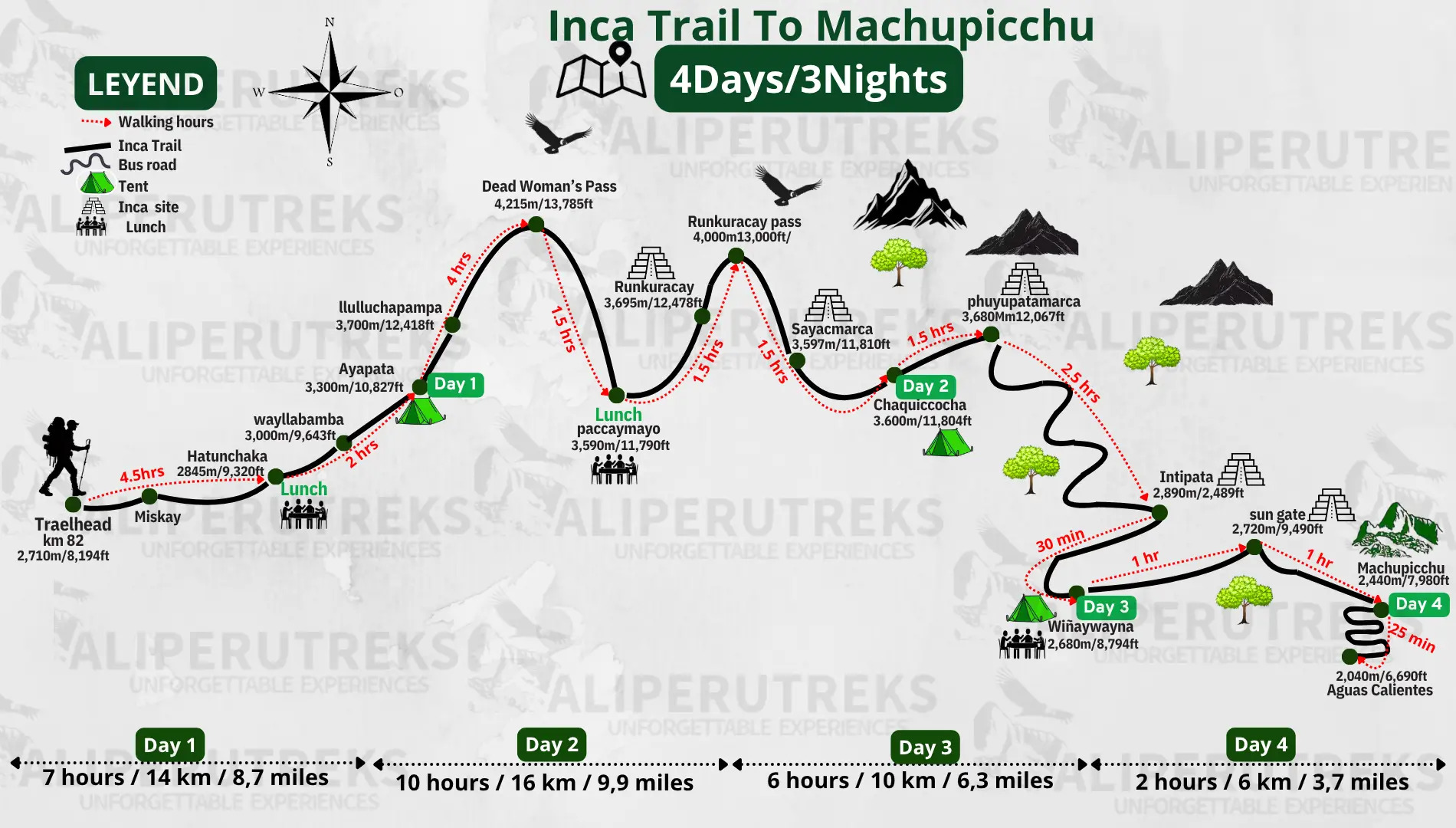
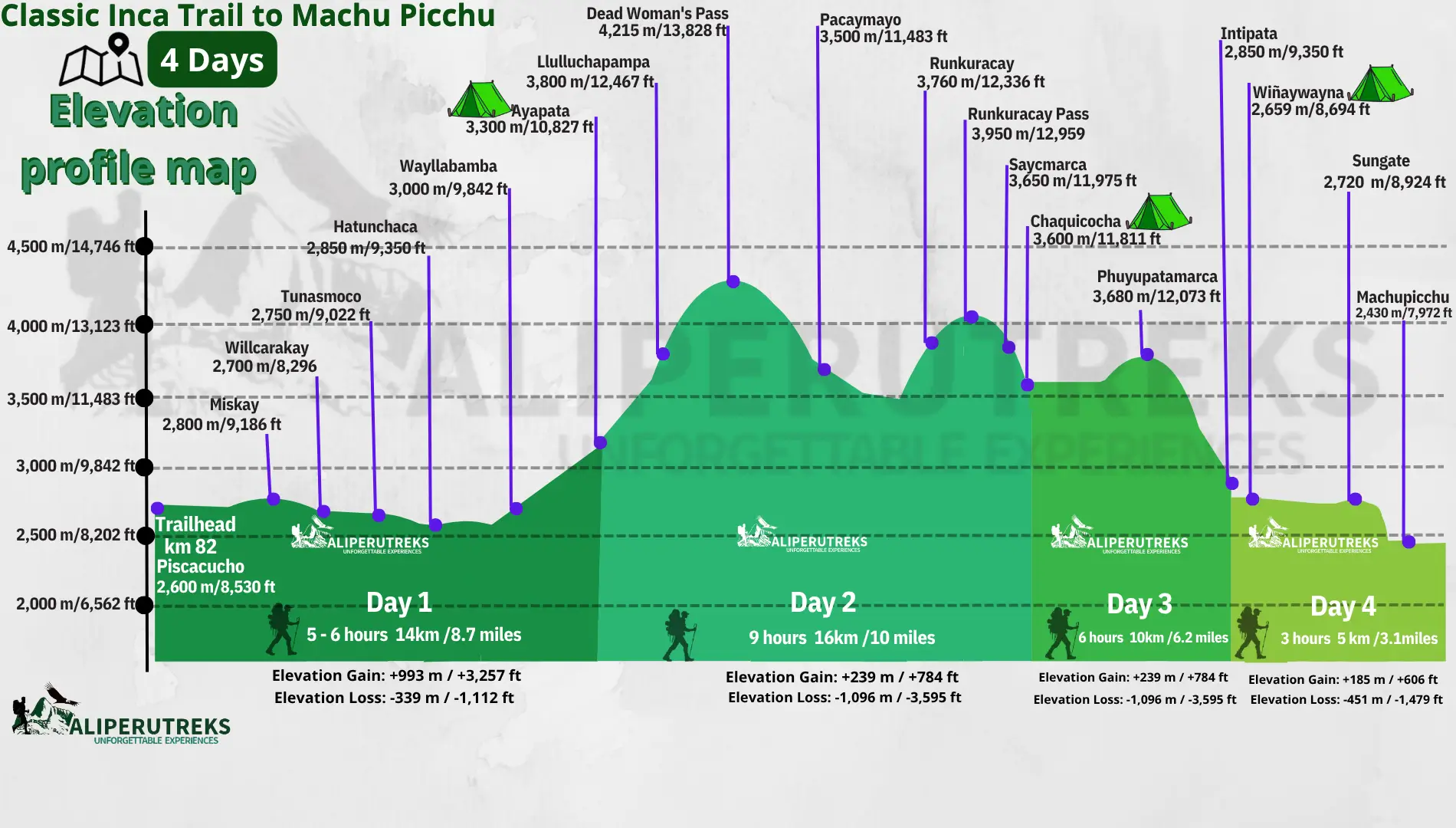
Inca Trail 4 Days Map
Below are two maps of the 4-day Inca Trail. The first shows the entire route, from start to finish, including the railroad tracks, Inca trails, and archaeological sites. The second is an elevation profile that includes the distance walked, the daily walking time, the elevation gain, and the daily elevation.
If you’re wondering how to reach the trailhead, see where the Inca Trail begins and ends.


Price
Inca Trail 4 Days Price 2027
We guarantee that we will obtain your legal permits for the classic 4-day hike along the Inca Trail 2027 from the relevant authorities immediately after you make your reservation. With us, your spot is guaranteed from the very beginning.
Group Service Price
| Detail | Description |
|---|---|
| Service type | Shared group departure |
| Group size | 2–12 hikers |
| Price per person | $775 USD |
Private Inca Trail 4 Days Prices
| Private group size | Price per person |
|---|---|
| 2–3 hikers | $900 USD |
| 4–5 hikers | $850 USD |
| 6–7 hikers | $800 USD |
| 8 or more hikers | $775 USD |
- Your own private group
- Rate depends on party size
See our Private Inca Trail Tour for more details.
Student and Youth Discount
Eligible students and travelers aged 17 or younger receive a $30 USD discount per person, subject to eligibility requirements.
| Eligible traveler | Discount per person | Required documentation |
|---|---|---|
| Eligible university students | $30 USD off | Current physical university ID card |
| Travelers aged 17 or younger | $30 USD off | Passport or valid age-verification document |
Email a copy of your university ID or passport to info@aliperutreks.com when booking. Bring the original document on the trek, as it may be checked.
Optional Extras and Additional Costs
| Optional extra | Additional cost |
|---|---|
| Sleeping bag rental | $20 USD per person |
| Trekking poles rental (pair) | $15 USD |
| Huayna Picchu entrance ticket | $80 USD per person |
| Machu Picchu Mountain entrance ticket | $80 USD per person |
| Lunch in Aguas Calientes | Not included |
| Tips | Not included |
| Travel insurance | Not included |
Huayna Picchu and Machu Picchu Mountain tickets are subject to availability.
Booking and Permit Conditions
A $200 USD deposit is required to proceed with your booking. Inca Trail permits are non-transferable and non-refundable once issued. Review the applicable booking and permit-change conditions before confirming your departure.
Ready to plan your trek? Check Inca Trail availability or contact our team in Cusco.
Faqs
Inca Trail 4 Days FAQs
The Classic Inca Trail covers 43 km (27 miles) from Km 82 to Machu Picchu. Day 2 is the longest stage at 15 km (9.3 miles), and Day 4 is the shortest at 6 km (3.7 miles).
With Ali Peru Treks, the group departure costs $775 USD per person, including your permit, Machu Picchu ticket, guide, porters, meals, camping gear, and transport. Private departures cost $775 to $900 USD per person, depending on group size. Budget separately for tips, lunch in Aguas Calientes, and any rentals.
For May to August, book at least six months ahead; these dates often sell out first. For other months, booking several months ahead is still advisable, because the daily limit of 500 people (including staff) applies all year. We request your permit as soon as we receive your passport details and deposit.
The Ministry of Culture releases Inca Trail permits for the following year once a year, usually in October or November. As of mid-October 2026, the 2027 release date had not been announced.
You can send us your passport details and deposit before the release, and we’ll request your permit as soon as sales open. Our Inca Trail permits 2027 page has the latest information.
No. Permits are only sold through licensed tour operators, and every group must hike with a licensed guide. Your permit, guide, and crew are all included in this tour.
It’s moderate to challenging. You don’t need to be an athlete, but you should be comfortable hiking for several hours a day on steep stone steps at altitude. Day 2 is the hardest, with 9–10 hours of hiking and the climb to 4,215 m (13,828 ft). Cardiovascular training and a couple of days of acclimatization in Cusco make a big difference.
Dead Woman’s Pass (Warmiwañusca), at 4,215 m (13,828 ft), which you cross on Day 2. The second pass that day, Runkurakay, reaches 4,000 m (13,123 ft).
The dry season, from April to October, brings the most stable weather; May to August are the most popular months and sell out first. From November to March you’ll find more rain, greener landscapes, and fewer hikers. The trail is closed in February. Our Inca Trail by month guide compares each month.
At least two days (48–72 hours). Cusco is at 3,399 m (11,152 ft), so time there helps your body adjust before you climb higher on the trail.
The final checkpoint at Wiñay Wayna opens at 5:30 AM. We usually reach the Sun Gate around 6:30 AM and the Circuit 1 viewpoint over the citadel about an hour later, before most visitors arrive by train and bus.
Possibly, but we can’t promise it. The hike from the checkpoint to the Sun Gate takes about an hour (up to 80 minutes, depending on the group), and the light changes over Machu Picchu while you’re on this stretch or once you arrive.
Clouds and mist are common, especially in the rainy season, and the checkpoint opening time is set by the authorities.
Your ticket covers the Circuit 1 upper terraces, where you take the classic photo after arriving from the Sun Gate, and Circuit 3 (the Royal Route), where your guide leads the tour of about two hours.
Yes, subject to availability, for $80 USD per person. Tickets are limited, so request them when you book, ideally months in advance. The Huayna Picchu climb takes about one hour up and one hour down.
No. Inca Trail permits are non-transferable and non-refundable, and names and dates cannot be changed once the permit is issued. Except in documented cases of force majeure, changing your date means buying a new permit, subject to availability, at an additional cost of $100 USD.
Your porter allowance is 7 kg (15 lb), packed in the duffel bag we give you at the briefing. About 3 kg (6.6 lb) of that is your sleeping bag and mattress, which leaves around 4 kg (8.8 lb) for clothes and personal items. You carry a small daypack with your passport, water, rain gear, and camera.
No. The trail closes every February for maintenance and conservation. If you’re traveling that month, consider the Salkantay Trek or the Lares Trek, which also end with a visit to Machu Picchu.
Around 7:00 PM. After Machu Picchu, you take an afternoon train (usually departing between 2:55 and 3:55 PM) from Aguas Calientes to Ollantaytambo, where our private transport takes you to your hotel.
Yes. Students with a current physical university ID and travelers aged 17 and under receive $30 USD off per person. Send a clear copy of your ID or passport when you book.
Choose the 4-day trek if you want the full experience: Dead Woman’s Pass, three nights of camping, and the chain of Inca sites from Llactapata to Wiñay Wayna. The Short Inca Trail 2 Days is a good option if you have less time or prefer a shorter hike; it also enters Machu Picchu through the Sun Gate.
Check Inca Trail 4 Days Availability 2027
Featured Tours & Treks
Discover hand-picked tours and treks to Machu Picchu and Peru’s most unforgettable destinations.
What Our Travelers Say About Ali Perú Treks
Discover the experiences of travelers who have explored Peru with Ali Perú Treks. From the legendary Inca Trail to the breathtaking landscapes of the Andes and the wonders of Machu Picchu, our guests share their stories, honest feedback, and unforgettable moments. Their reviews reflect our commitment to personalized service, knowledgeable local guides, and meaningful adventures crafted with care from start to finish.
Our Blogs
Blogs that provide information and tips for planning the perfect trip to Peru and Machu Picchu.