
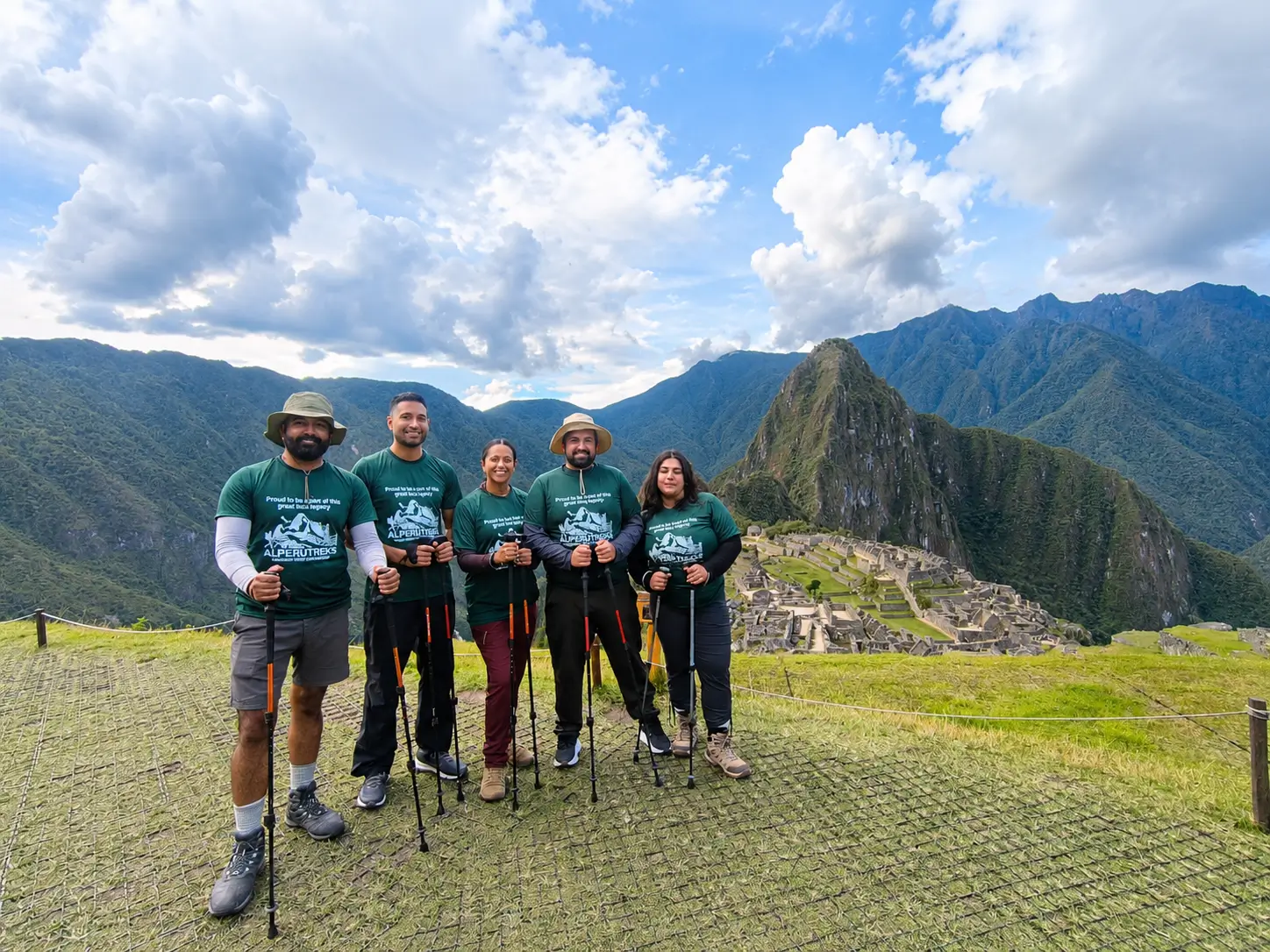
Planning a trek to Machu Picchu and feeling lost in a maze of route names, campsites and mountain passes? You’re not alone. Most travelers start their research staring at an Inca trail map with no idea where the trailhead is, how high they’ll climb, or which version fits their fitness and schedule.
This guide fixes that. At Ali Peru Treks, we’ve walked every one of these routes hundreds of times, and below we break down each Inca trail map — the Classic 4-day, the Short 2-day, the relaxed 5-day, and the epic Salkantay combination — with real altitudes, distances, difficulty and the insider tips that only a local Cusco agency can give you.
Understanding the Inca Trail Network
Before comparing routes, it helps to know that the “Inca Trail” isn’t a single path. It’s a protected network of original Inca stone roads inside the Historic Sanctuary of Machu Picchu, controlled by Peru’s Ministry of Culture.
A few facts that shape every inca trail route map:
- Only 500 permits per day are released, and that number includes guides, cooks and porters — so roughly 200 trekker spots exist daily.
- Permits are non-refundable and non-transferable, and must match your passport name and number exactly.
- The trail closes every February for maintenance and reopens on March 1.
- As of the latest regulations, your Inca Trail permit no longer includes the Machu Picchu entrance ticket — that’s now a separate timed-entry ticket your operator arranges for you.
Keep these in mind: they explain why booking 4–6 months ahead for peak season isn’t us being pushy — it’s simply how the system works.
The Classic Inca Trail Map (4 Days)
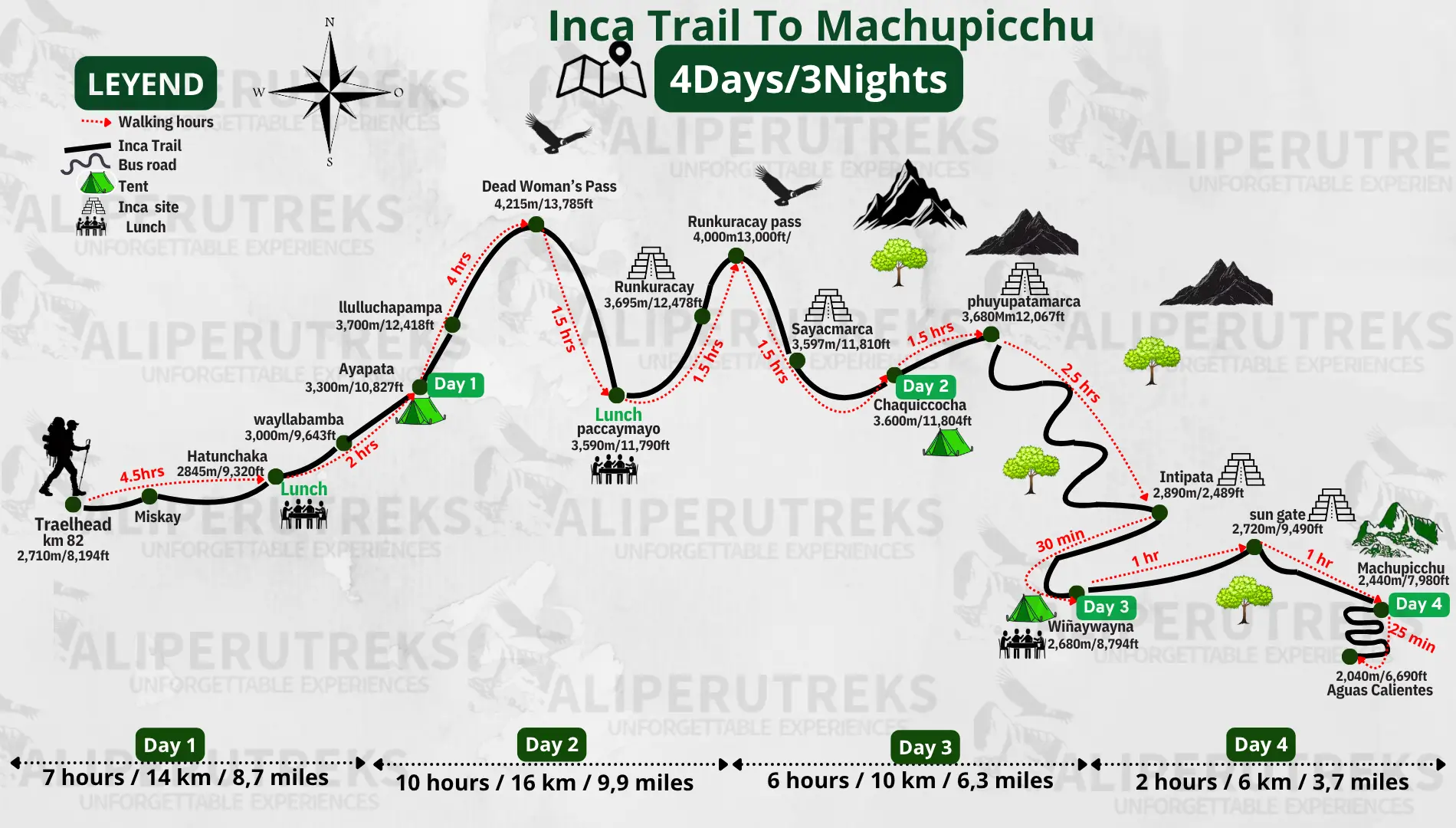
The classic inca trail map is the one most people picture: four days on foot, three nights camping, arriving at Machu Picchu through the Sun Gate at dawn on day four.
The route, stop by stop:
- Km 82 – Piscacucho (2,600 m / 8,530 ft): The official trailhead where you cross the first checkpoint.
- Wayllabamba (3,000 m): First campsite, a gentle warm-up day along the Urubamba River.
- Dead Woman’s Pass – Warmiwañusca (4,215 m / 13,828 ft): The highest and hardest point of the whole trek. This is the day that tests you.
- Runkurakay Pass (3,950 m) and Phuyupatamarca (3,650 m): Day three’s “up-and-over” passes, threaded with cloud-forest ruins.
- Wiñay Wayna (2,650 m): The last and most beautiful campsite, right beside stunning agricultural terraces.
- Inti Punku – Sun Gate → Machu Picchu (2,430 m): Your first, unforgettable view of the citadel.
Classic Inca Trail — Key Data
- Distance: 42 km (26 miles)
- Duration: 4 days / 3 nights
- Max altitude: 4,215 m (Dead Woman’s Pass)
- Difficulty: Moderate to challenging (the altitude, not the terrain, is what gets people)
- Best season: Dry season, May to September
- Permit: Required — book early
If you can only choose one route and you’re reasonably fit, this is the classic for a reason: it’s the only trek that enters Machu Picchu on foot through the Sun Gate.
The Short Inca Trail Map (2 Days)
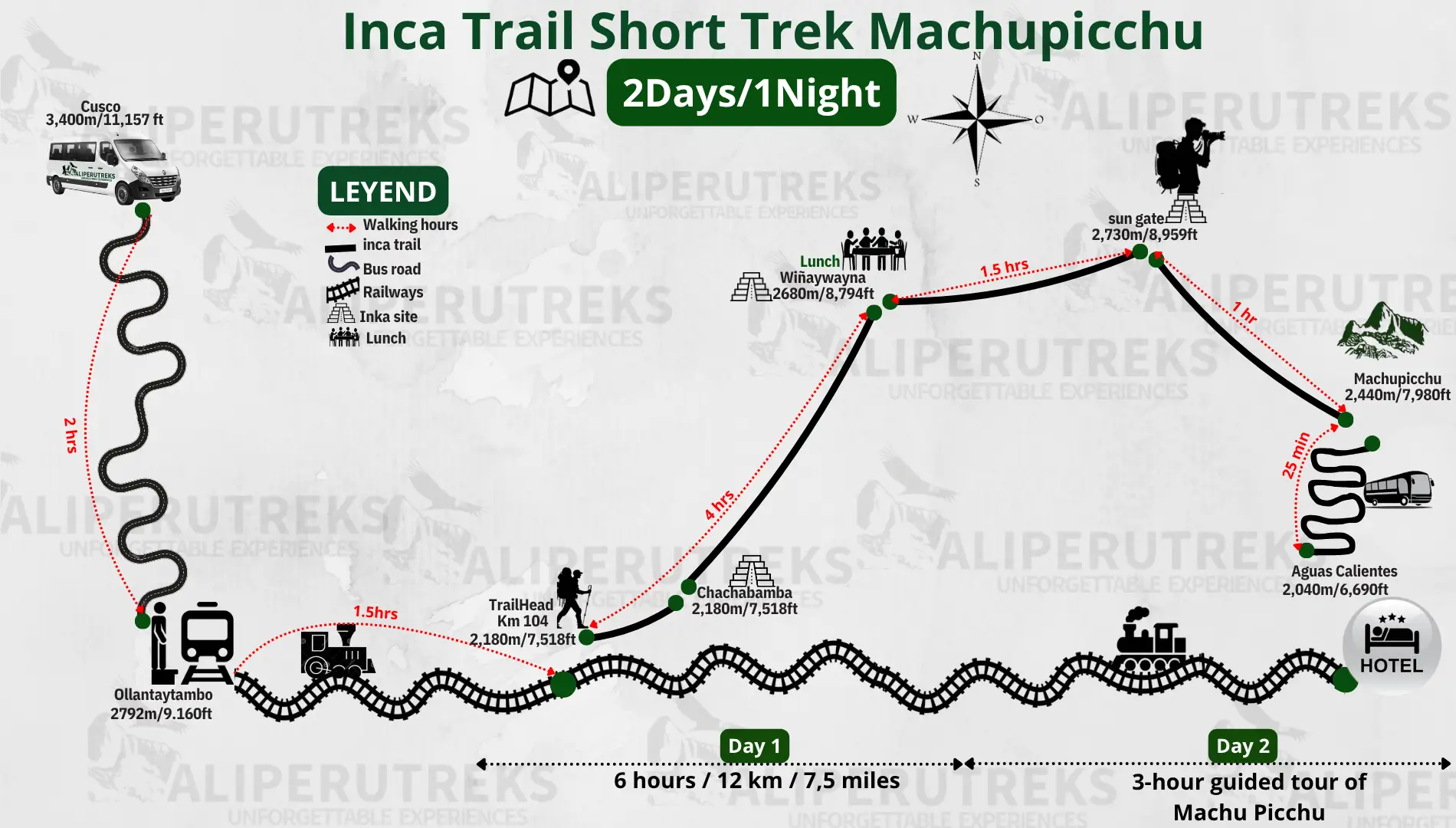
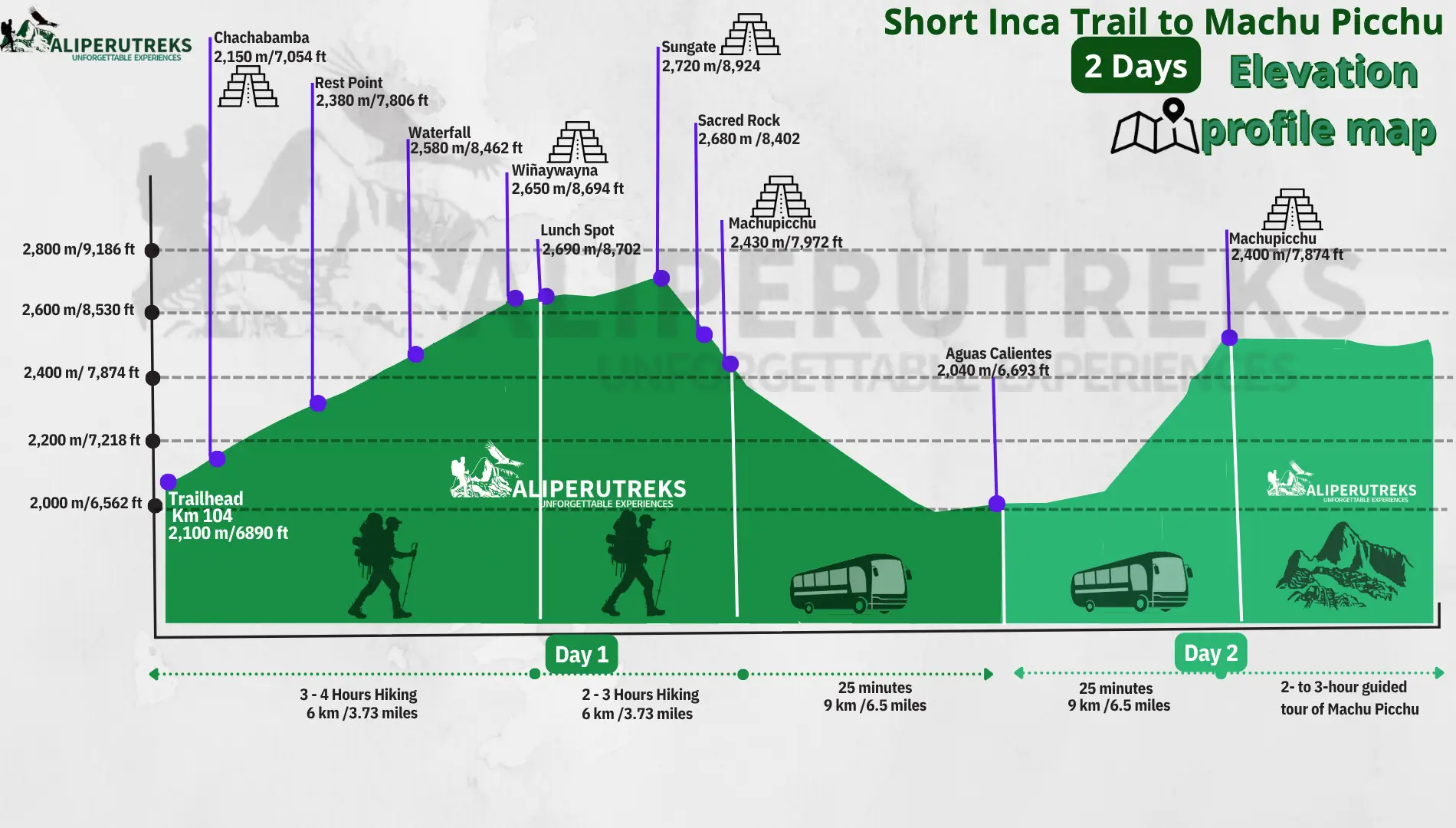
Short on time, or want the authentic experience without three nights of camping? The short inca trail map is your answer. This route is also known as the 2 day inca trail map, and it’s the only “official” Inca Trail that doesn’t require camping.
How it works:
- Km 104 (2,100 m): You take the train from Ollantaytambo and disembark at this trailhead.
- Wiñay Wayna: A steady uphill climb brings you to the same spectacular terraces the 4-day trekkers camp beside.
- Inti Punku – Sun Gate → Machu Picchu: You arrive at the citadel in the afternoon, then overnight in the town of Aguas Calientes.
- Day 2: A full guided tour of Machu Picchu, fresh and rested.
Short Inca Trail — Key Data
- Distance: 12 km (7.5 miles) of hiking on day one
- Duration: 2 days / 1 night (in a hotel, not a tent)
- Max altitude: 2,700 m — noticeably gentler on your lungs
- Difficulty: Moderate — one solid day of walking
- Permit: Still required, but availability is often better than the 4-day
Best for: Families, travelers with limited days in Cusco, or anyone who wants to walk through the Sun Gate without a multi-day expedition.
The Inca Trail 5 Days Map
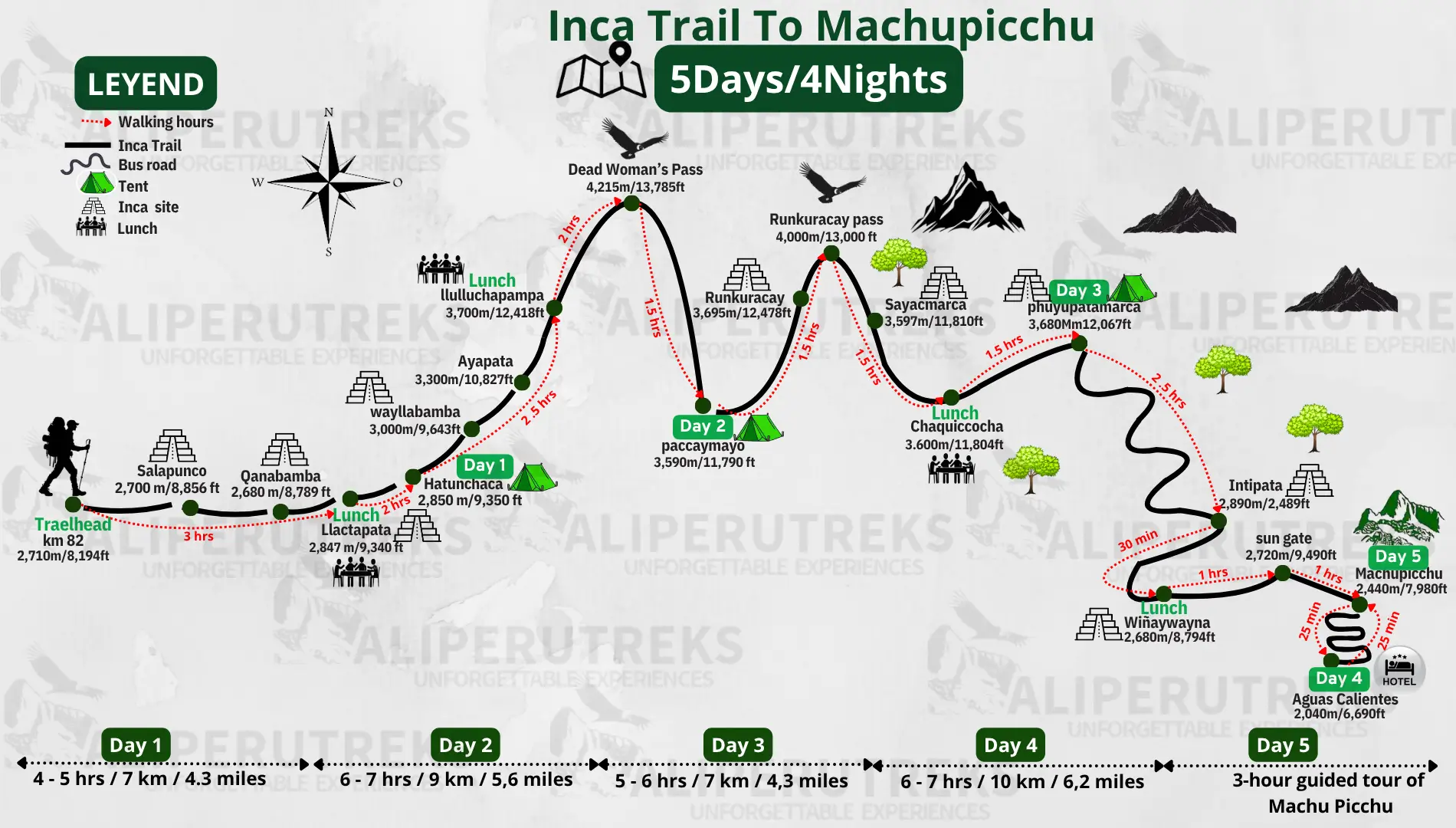
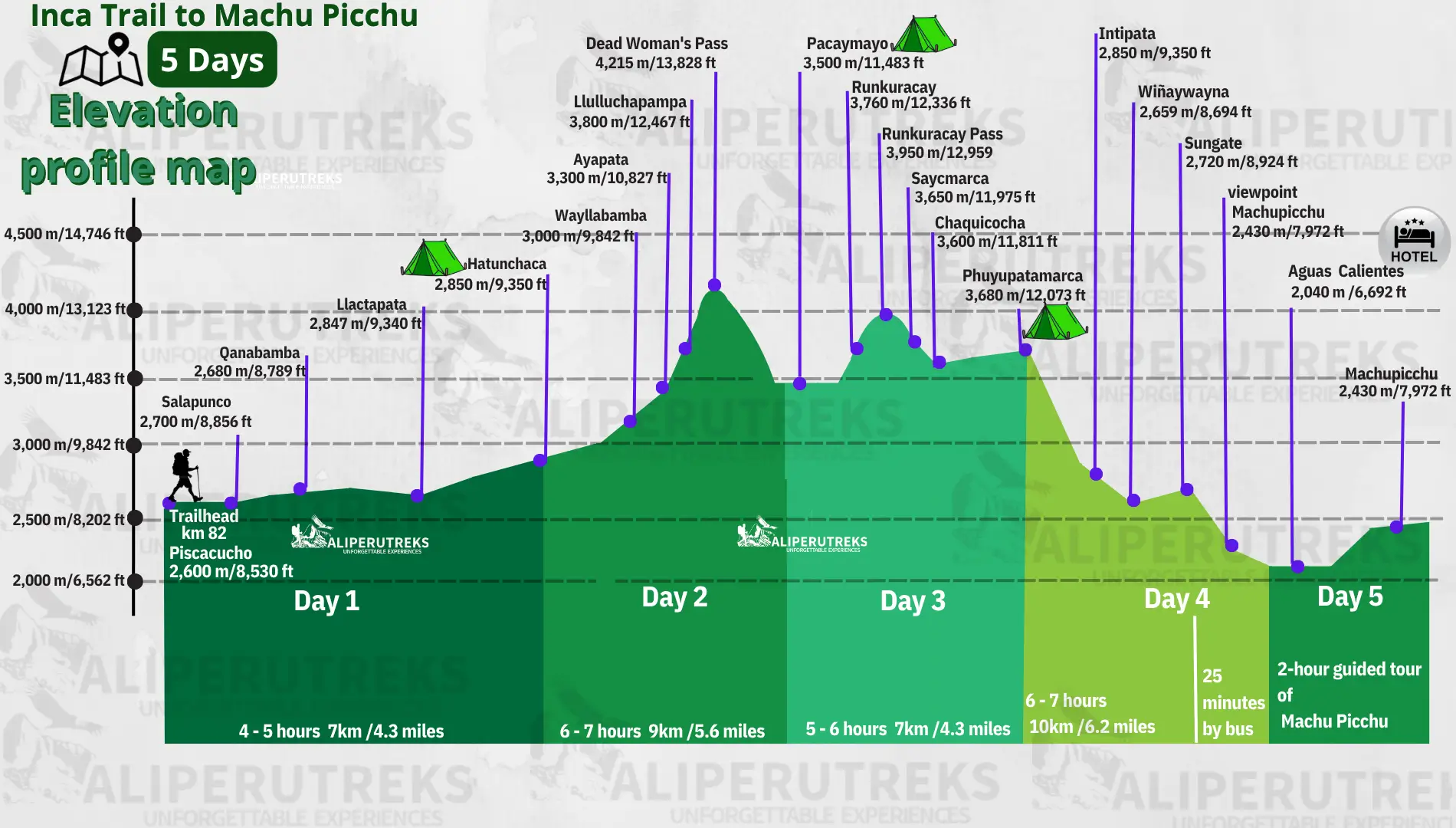
The 5-day Inca Trail is the version that follows exactly the same classic route as the 4-day trek but includes one additional night and a more relaxed pace.
Why choose it?
- Shorter daily distances mean more time for photos, ruins and simply breathing.
- Better acclimatization, since you’re not rushing the high passes.
- Fewer crowds at viewpoints, because your timing differs from the main 4-day groups.
If your priority is enjoying the journey rather than racing the finish, the 5-day route is the most comfortable way to experience the original trail. Data is nearly identical to the classic: 42 km, max 4,215 m, dry-season best, permit required.
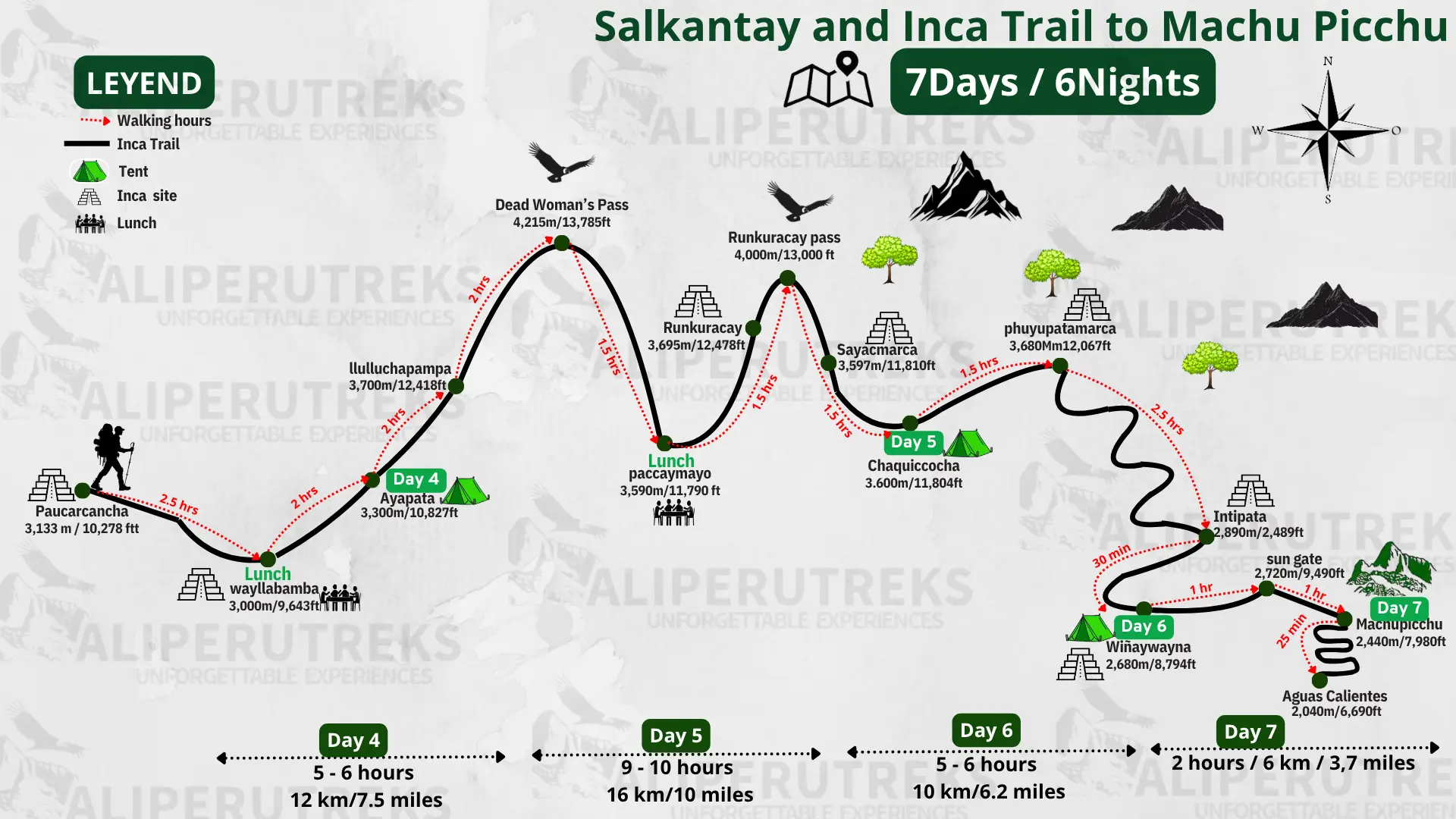
The Salkantay to Inca Trail Map (7 Days)
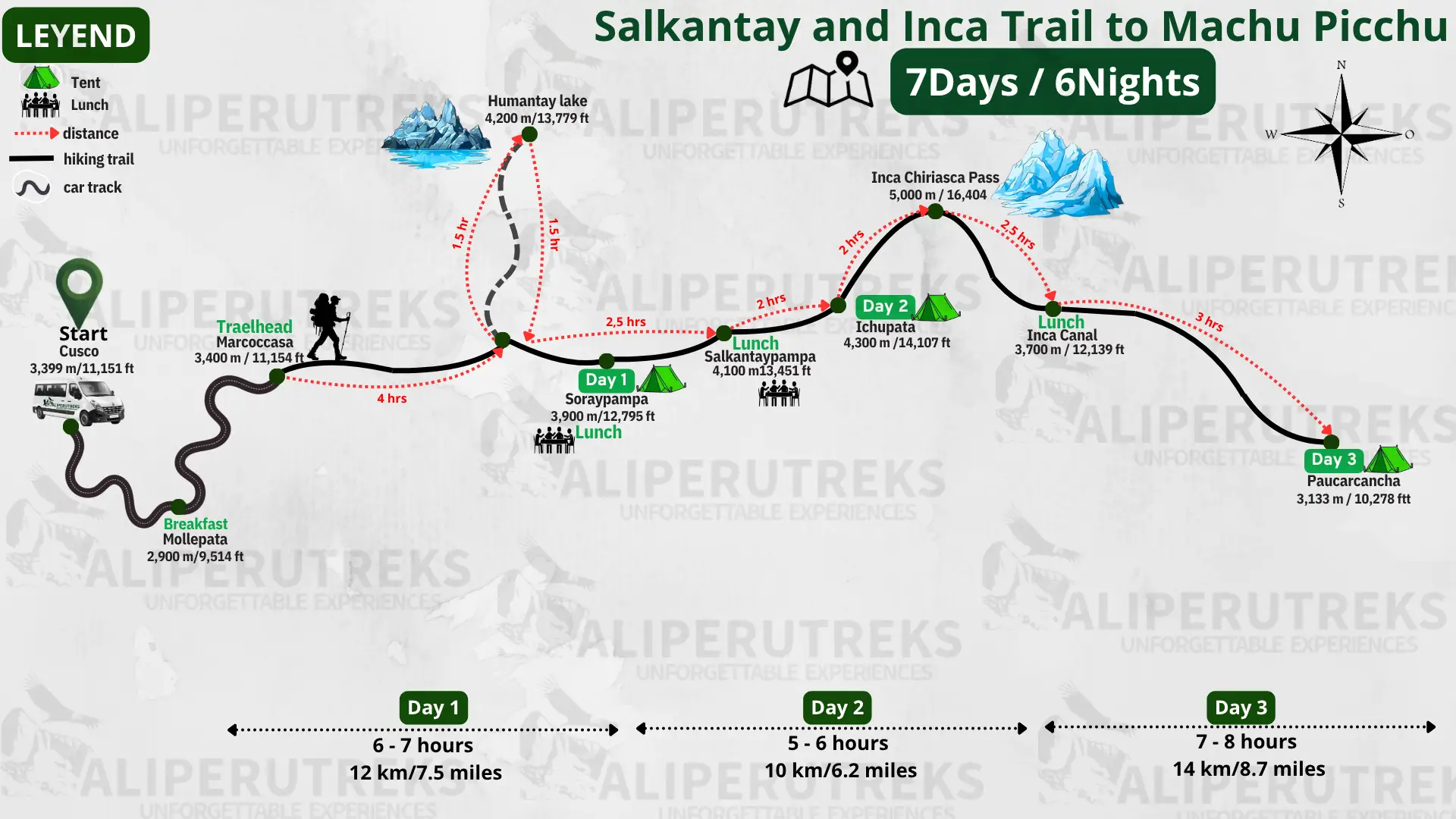
For serious trekkers who can’t decide between two of the world’s best hikes, the salkantay to inca trail map combines them into one grand journey — often called the “best of both worlds.”
The route in brief:
- Mollepata / Challacancha (3,300–3,700 m): The Salkantay section begins with a drive from Cusco.
- Salkantay Pass (4,600 m / 15,090 ft): The dramatic high point beneath the sacred, glacier-capped Apu Salkantay (6,271 m).
- Descent to Paucarcancha: Here horses hand over to porters as you join the classic Inca Trail network near Wayllabamba.
- The full Inca Trail: Dead Woman’s Pass, cloud-forest ruins, Wiñay Wayna and, finally, the Sun Gate into Machu Picchu.
Salkantay & Inca Trail — Key Data
- Distance: 75 km (47 miles) total
- Duration: 7 days / 6 nights
- Max altitude: 4,600 m (Salkantay Pass)
- Difficulty: Challenging — for fit hikers with multi-day experience
- Permit: Required for the Inca Trail portion — book well in advance
You get the high-alpine glaciers and turquoise lagoons of Salkantay and the archaeological drama of the Inca Trail, all ending at the Sun Gate. It’s demanding, but few treks on Earth deliver this much variety.
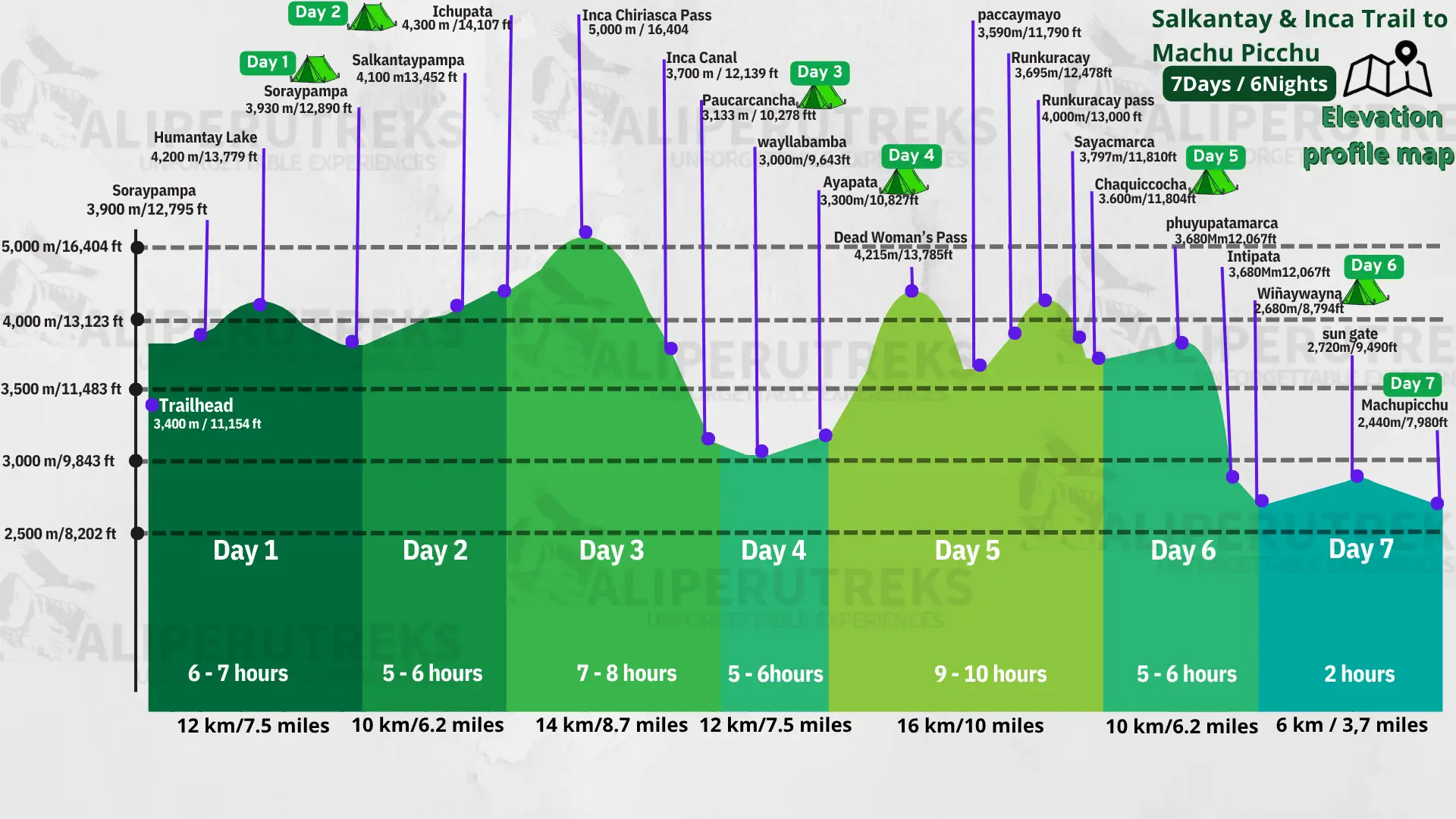
Inca Trail Elevation Map: Reading the Ups and Downs
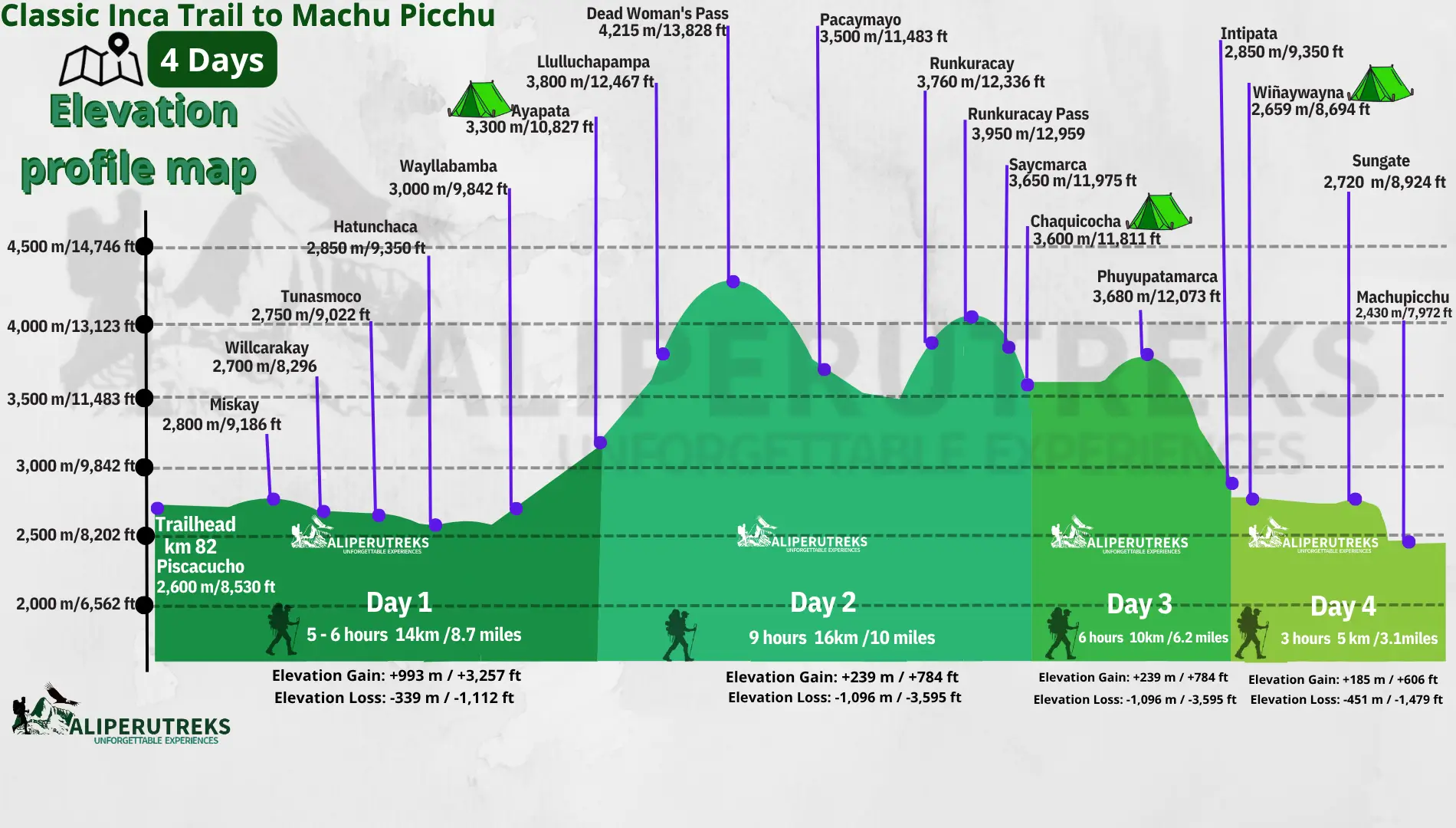
The single most useful tool for setting expectations is an inca trail elevation map. The trail doesn’t climb steadily — it rolls up and over a series of passes, and understanding that profile is how you avoid nasty surprises.
Here’s the shape of the Classic route’s elevation:
- Start low at Km 82 (2,600 m) along the river.
- Climb hard to Dead Woman’s Pass (4,215 m) — the biggest, longest ascent.
- Drop and climb again over Runkurakay and Phuyupatamarca on day three.
- Descend through cloud forest to Machu Picchu (2,430 m).
The lesson every inca trail elevation map teaches: the challenge is altitude and the up-down rhythm, not technical climbing. There’s no rock scrambling — just stone steps and thin air. Train your legs on stairs, and give your body time to adjust to Cusco’s altitude first.
Machu Picchu Trail Map: The Final Approach
Every route above converges on the same triumphant ending, and this is where a machu picchu trail map matters most.
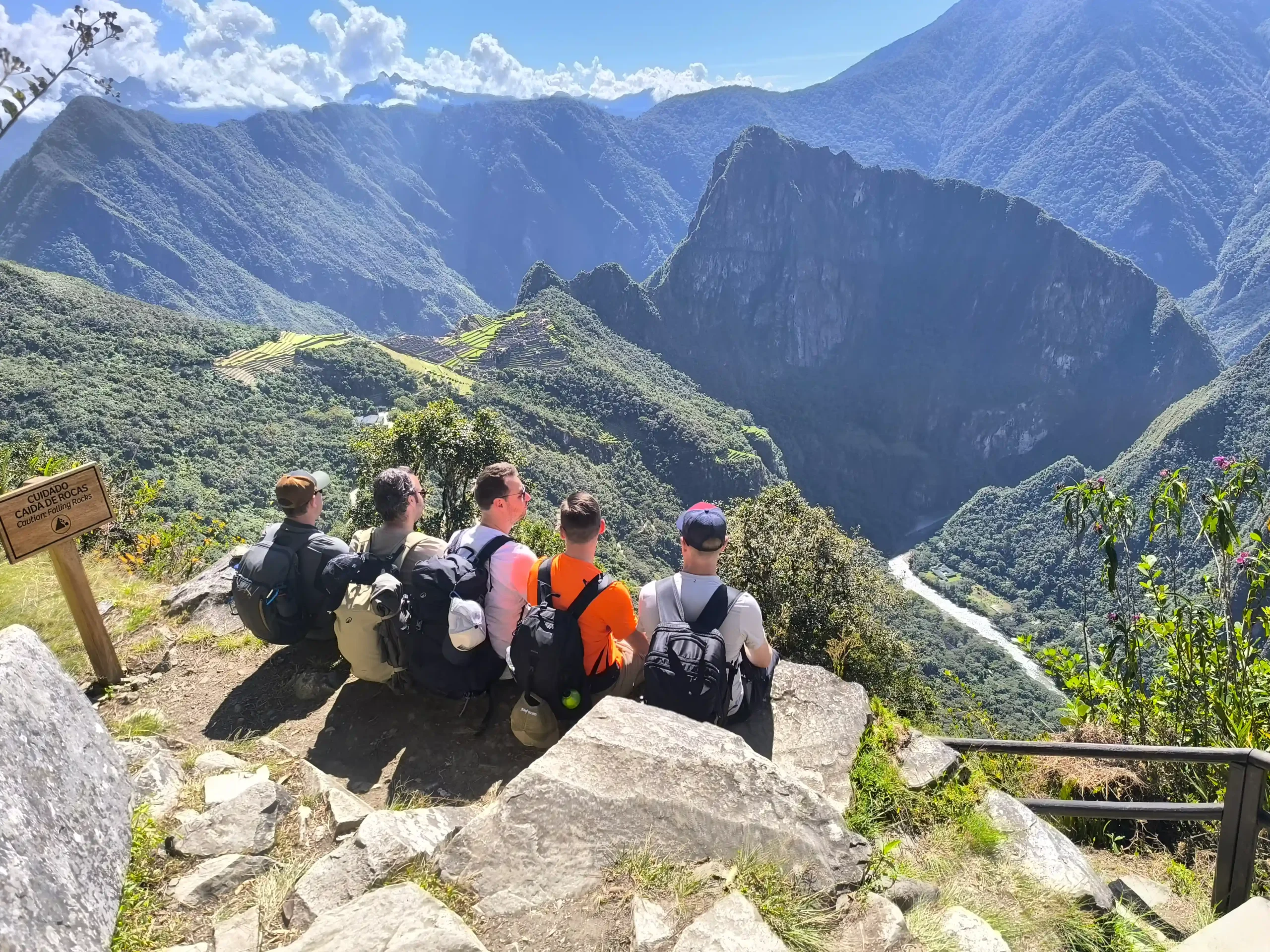
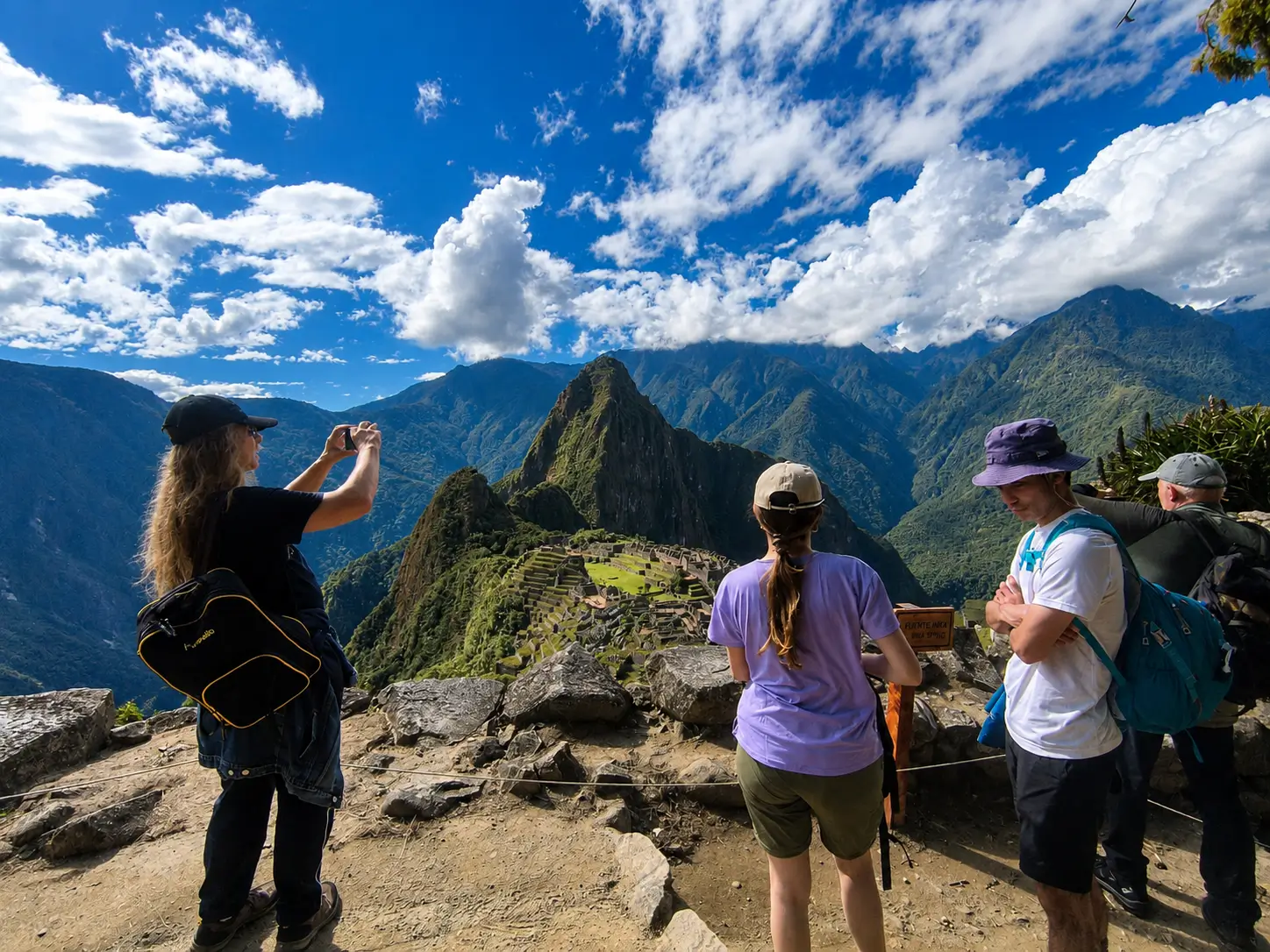
Trekkers on the Classic, 5-day and Salkantay routes arrive via Inti Punku (the Sun Gate) — the iconic first glimpse of the citadel from above. Short Inca Trail hikers also pass through the Sun Gate on day one.
Once inside, note that Machu Picchu now uses a circuit system with timed entry. Your guide will walk you through the designated circuit for your ticket, which determines which viewpoints and sectors you’ll see. Because the Inca Trail permit and the Machu Picchu ticket are now separate, a good operator coordinates both so your citadel visit lines up perfectly with your arrival.
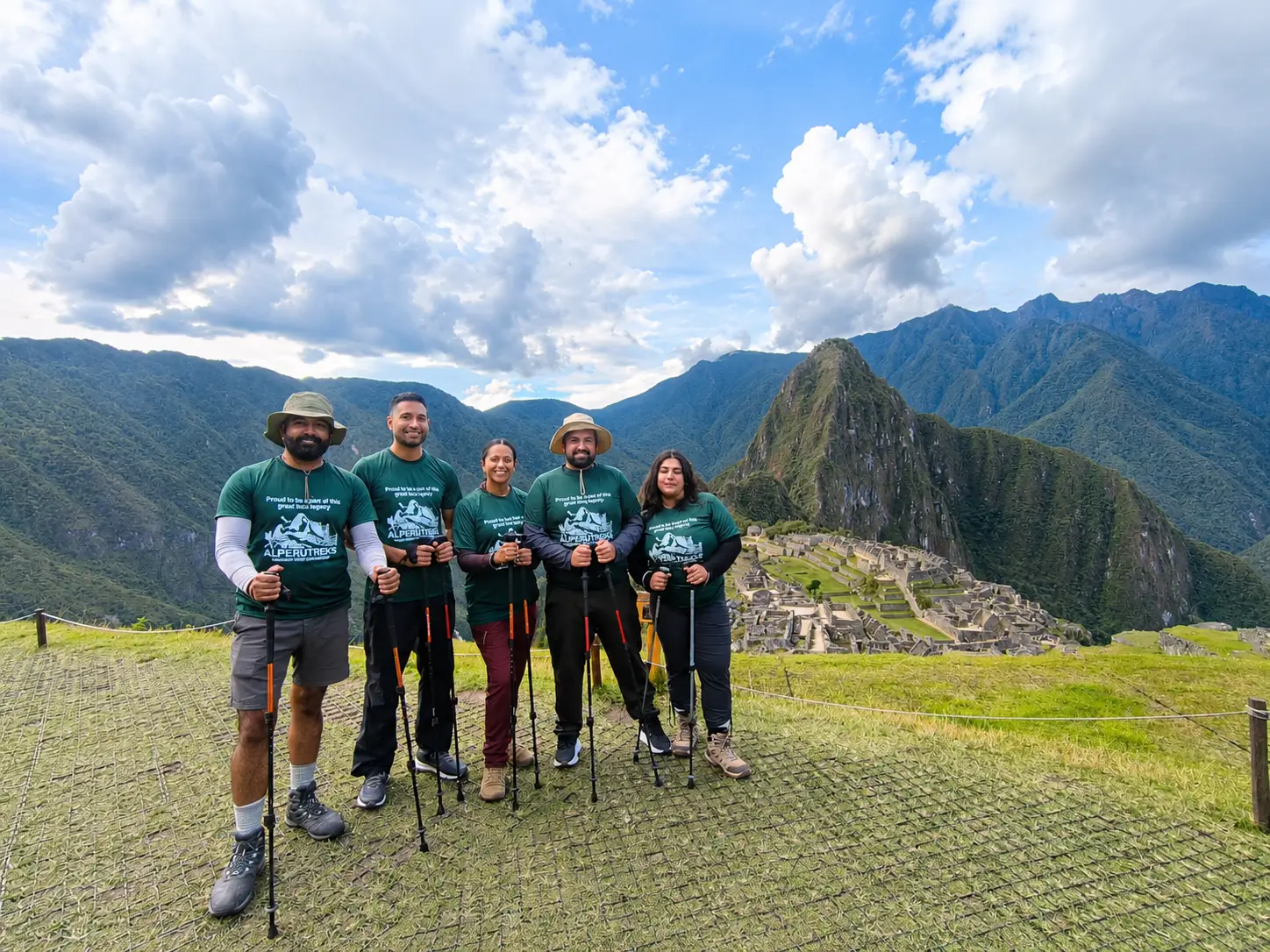
Expert Tips from Ali Peru Treks
Here’s the advice we give our own clients — the practical knowledge that turns a hard trek into an unforgettable one:
- Acclimatize first. Spend at least 2–3 nights in Cusco or the Sacred Valley (the Valley, at 2,800 m, is gentler than Cusco) before you start. Altitude sickness ruins more treks than fitness ever does.
- Book permits early. For June–August, reserve 4–6 months ahead. Peak dates sell out within weeks of release.
- Start hydrating and chewing coca. Drink more water than feels necessary, and don’t dismiss coca tea or leaves — they genuinely help with the altitude.
- Pack smart, pack light. Porters carry a limited weight, so bring only essentials: broken-in hiking boots, layers for cold nights and hot afternoons, a rain jacket (even in dry season), a headlamp, sunscreen, a hat, and a refillable water bottle.
- Respect trail hours. Hiking is not allowed between 6 PM and 5 AM inside the network — plan campsites accordingly (your operator handles this).
- Avoid February entirely. The trail is closed, no exceptions. If February is your only window, ask us about alternative routes like Salkantay’s standalone trek or Lares.
- Choose a licensed local operator. Only licensed operators can secure permits and guides. Local Cusco teams also mean fair porter treatment and guides who know the stories behind every stone.
What to Pack: Quick Checklist
- Original passport (required at every checkpoint)
- Broken-in hiking boots + camp shoes
- Layered clothing (thermal base, fleece, waterproof shell)
- Sun protection: hat, sunglasses, SPF 50+
- Headlamp, refillable water bottle, personal snacks
- Small first-aid kit, blister plasters, personal medication
- Insect repellent (essential in the cloud forest sections)
- Cash in soles for tips and small purchases
Conclusion: Choose Your Route with Confidence
Whether you’re drawn to the classic inca trail map and its Sun Gate sunrise, the accessible short inca trail map, the unhurried 5-day route, or the epic salkantay to inca trail map, the right choice comes down to your time, fitness and sense of adventure.
The good news: once you understand the Inca trail map — the trailheads, the passes, the altitudes and the arrival at Machu Picchu — the decision becomes clear. And you don’t have to make it alone.
Ready to walk it? At Ali Peru Treks, our local Cusco guides handle every permit, campsite and Machu Picchu ticket so you can focus on the trek of a lifetime. Explore our Inca Trail packages or request a free custom quote today, and let’s map out your journey to Machu Picchu together.
Have questions about permits, availability or which route suits you best? Contact the Ali Peru Treks team — we’re locals, and we’re happy to help you plan.