
How to Train for the Inca Trail: An 8-Week Plan
To train for the Inca Trail, start 8 to 10 weeks out and build up to long hikes with a loaded daypack. A workable routine is two or three walks a week of 45 to 60 minutes, two short strength sessions focused on legs and core, and one long weekend hike that grows from about 90 minutes to 4 or 5 hours. Practice stairs and downhill walking, wear your hiking boots, and taper in the last week. The 8-week plan below follows that structure.
This guide explains what the trek actually demands, gives a week-by-week schedule, and lists the common mistakes. It is general fitness guidance, not medical advice. If you have an injury, a heart or lung condition, or altitude concerns, talk to your doctor before you start.
What the Inca Trail Actually Demands
The trek is rated moderate to challenging and is non-technical, which means you do not need climbing skills. The challenge is volume, stairs and altitude. On our 4-day itinerary:
| Day | Distance | Hiking time | What makes it hard |
|---|---|---|---|
| 1 | About 12 km | About 6 hours | Steady climb from 2,720 m to a camp at 3,300 m |
| 2 | 15 km | 9-10 hours | Gain of about 915 m to Dead Woman’s Pass (4,215 m), then more climbing |
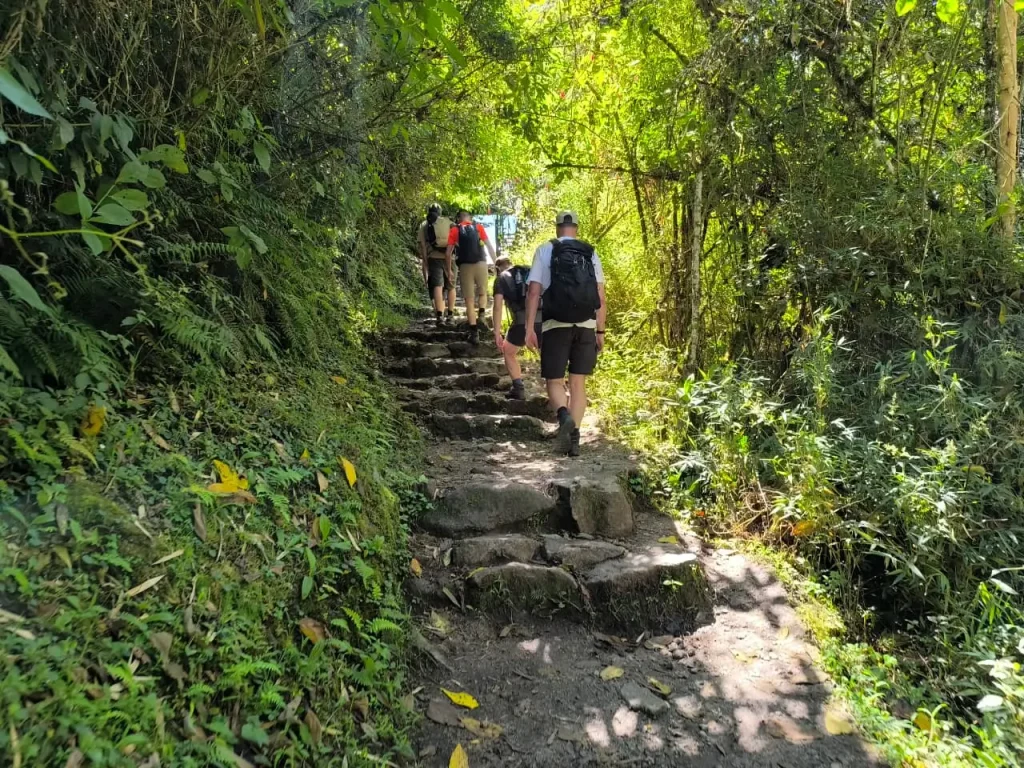
| 3 | 10 km | 5-6 hours | Long, steep stone staircases, with a descent of about 1,030 m |
| 4 | 6 km | About 2 hours | Early start; Sun Gate and descent to Machu Picchu |
Training should therefore prepare you for three things: long days on your feet, climbing at altitude and descending stairs. See our Inca Trail difficulty guide and the Dead Woman’s Pass guide for more detail on the hardest sections.
A Fitness Target to Aim For
Operators suggest a few practical benchmarks:
- Be able to walk 10-12 km (6-8 miles) over hills and stairs without being exhausted.
- Complete a weekend hike of 3-5 hours carrying a small backpack.
- Be comfortable walking 45-60 minutes several times a week.
If you can already do that, you are in good shape for the trek. If not, the plan below builds up to it.
The 8-Week Training Plan
This plan combines published guidance from several Inca Trail operators. Adapt it to your starting fitness, and cut a week of load if you feel pain, not just fatigue.
Weekly structure: 2-3 walks, 2 strength sessions, 1 long hike and 1-2 rest days.
| Week | Weekday walks | Strength | Long hike (weekend) | Focus |
|---|---|---|---|---|
| 1 | 3 walks of 45 min | 2 short sessions | 60-90 min on easy ground | Build a base and find a comfortable pace |
| 2 | 3 walks of 45-60 min | 2 sessions | About 2 hours | Add gentle hills |
| 3 | 3 walks of 60 min, one with stairs or hills | 2 sessions | 2-2.5 hours with a light daypack | Start practicing stairs |
| 4 | 2-3 shorter walks | 1-2 light sessions | About 90 min | Recovery week; let your body adapt |
| 5 | 3 walks of 60 min with hills | 2 sessions | About 3 hours with a daypack | Add elevation and uneven ground |
| 6 | 3 walks of 60 min, stairs once | 2 sessions | 3.5-4 hours | Practice downhill and stair descents |
| 7 | 3 walks of 45-60 min | 2 sessions | 4-5 hours with your planned daypack, in your trail boots | Peak week; a dress rehearsal |
| 8 | 2-3 easy walks of 30-45 min | 1 light session | None; travel and rest | Taper; arrive in Cusco early |
Strength Work: What to Do and Why
Strength sessions of 20-30 minutes, twice a week, are enough. Focus on legs, core and stability:
- Squats and lunges build the quads that absorb descents.
- Step-ups mimic the stone staircases.
- Planks support your back when carrying a pack.
- Calf raises and balance work help on uneven stone.
Bodyweight exercises are sufficient for most people. If you have weights, add them gradually.
Cardio: Pick Something You Will Actually Do
Walking and hiking are the most specific training. For extra cardio, cycling, swimming or running two or three times a week works well, and any of them will improve your aerobic base. Keep most sessions at an easy to moderate effort. You should be able to speak in short sentences.
Train for Stairs and Descents
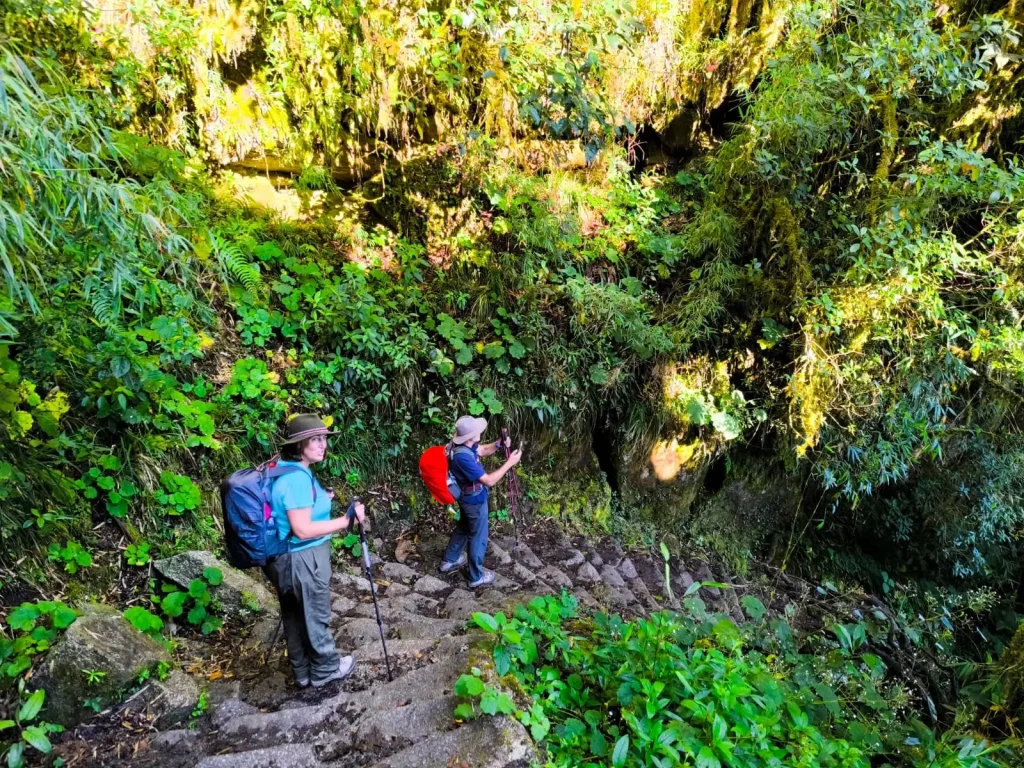
Stairs are the part many hikers underestimate. Our Inca Trail elevation gain guide explains where the climbing happens. To prepare:
- Climb real stairs, a stair machine or a steep hill once or twice a week from Week 3 onward.
- Practice walking down slowly with short, controlled steps. Descending loads the knees and quads differently from climbing, so it needs its own practice.
- Use trekking poles in training if you plan to use them on the trail. Poles must have rubber tips on the Inca Trail.
Train With the Right Load and Gear
- Daypack. Our packing list suggests keeping your daypack light, around 10-15 lbs. Train with a similar weight, and build up gradually.
- Duffel. Porters carry a duffel with a small allowance, so you do not need to train with that weight. See our Inca Trail porters guide.
- Boots and socks. Break in your boots during Weeks 5-7. Do not start a multi-day Andean hike with new boots.
- Hydration and food. Practice eating and drinking on long hikes.
Altitude: Training Cannot Fully Replace Acclimatization
Even a well-trained hiker can get altitude sickness. Fitness helps, but it does not prevent it. Plan to spend at least two full days in Cusco or the Sacred Valley before the trek, and more if you can. Our acclimatization guide and altitude sickness guide explain how to prepare, and a doctor can discuss medication options before you travel.
The Last Week: Taper
In the week before travel, reduce training. Take easy walks, stretch, sleep well and hydrate. Do not try to make up missed sessions. Arriving rested is more useful than squeezing in one more hard session.
Common Training Mistakes
- Starting too late. Eight weeks is the short end of what operators suggest. Twelve gives more room.
- Only doing flat cardio. Add stairs, hills and downhill work.
- Skipping the long hike. It is the closest rehearsal for Day 2.
- Overtraining in the final week. Taper instead.
- Wearing new boots. Blisters can end a trek faster than weak legs.
- Ignoring pain. Persistent joint pain is a reason to reduce load and see a professional.
If You Have Less Time or Lower Fitness
If you cannot train for 8 weeks, a shorter route may suit you better. The Short Inca Trail is a moderate 2-day hike, and our 2-day Inca Trail difficulty guide explains what to expect. When you are ready for the full route, see the 4-day Classic Inca Trail.
FAQ: Training for the Inca Trail
Operators suggest starting 8 to 10 weeks before the trek, and some recommend 12 weeks. If you already walk regularly, 8 weeks is enough to build up to long hikes.
Hiking with a daypack, stair climbing and downhill walking, plus squats, lunges, step-ups and planks twice a week.
You should be able to walk 10-12 km over hills and stairs, and complete a 3-5 hour hike carrying a small pack.
Not really. Fitness helps you hike comfortably, but it does not prevent altitude sickness. Plan at least two days in Cusco before the trek.
Reduce training, take easy walks, rest, hydrate and avoid new activities.