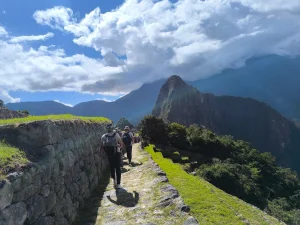
Choquequirao Trek 8 Days to Machu Picchu
Walk all the way from Choquequirao to Machu Picchu on a long, varied trek through the Vilcabamba range. Over eight days, you’ll descend into the Apurímac Canyon and explore the remote Inca site of Choquequirao. Then you’ll cross the Vilcabamba range over two high passes, up to about 4,660 m (15,290 ft) at the Yanama Pass. The last days take you down through cloud forest and coffee farms to Llactapata, where you first see Machu Picchu across the valley. You finish with a night in Aguas Calientes and a guided tour of Machu Picchu.
This is an expedition-style trek for experienced, fit hikers. Expect long days, huge climbs and descents, and big changes in climate, from the hot canyon floor to cold nights at Yanama. In return, you’ll see two great Inca sites and walk through some of the least-visited mountain country between Cusco and Machu Picchu.
Overview
Choquequirao Trek 8 Days Overview
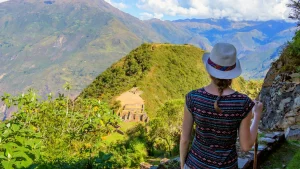
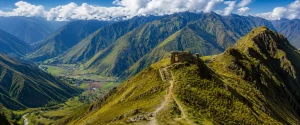
Choquequirao sits on a ridge about 3,050 m (10,010 ft) high above the Apurímac River. It is linked to the Vilcabamba region, where the last Incas held out after the Spanish conquest, and only an estimated 30 to 40 percent of the site has been cleared. The only way in is on foot. Most visitors hike in and back out the same way.
This route continues instead: it climbs out of the Choquequirao valley, crosses the San Juan Pass and the Yanama Pass, and descends to the Santa Teresa valley. There it joins the last section of the Salkantay route to Llactapata and Machu Picchu.
You’ll camp for six nights at small campsites along the trail, and spend the seventh night in a hotel in Aguas Calientes. Horses and our horsemen (arrieros) carry the camping equipment and your duffel bag, so you only carry a daypack.
Tour Highlights
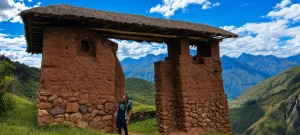
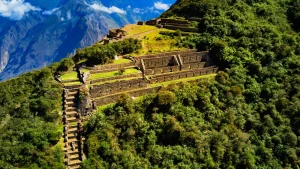
- Choquequirao with very few visitors. Explore the main plaza, the usnu ceremonial platform and the llama terraces, where more than 20 llama figures in white stone decorate the terrace walls.
- The Apurímac Canyon. Hike down to the river and up the far side of the canyon on the first two days.
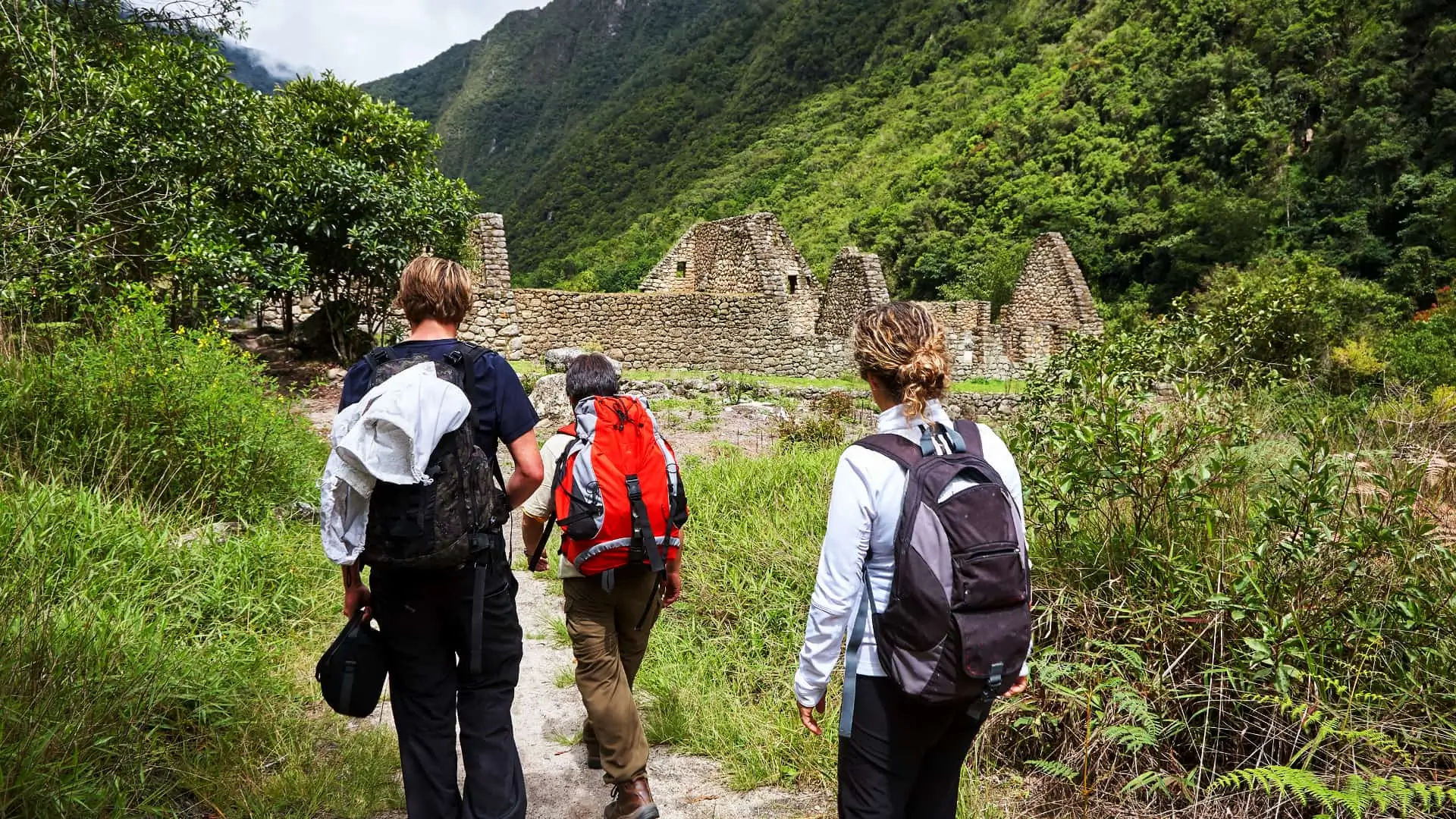
- Pinchiunuyoc. Stop at the terraces and water channels of this smaller Inca site below Choquequirao.
- Two high passes. Cross the San Juan Pass, about 4,150 m (13,620 ft), past the old Victoria mines, and the Yanama Pass, about 4,660 m (15,290 ft), the highest point of the trek.
- Cloud forest and coffee country. Descend to Lucmabamba and visit a family coffee farm.
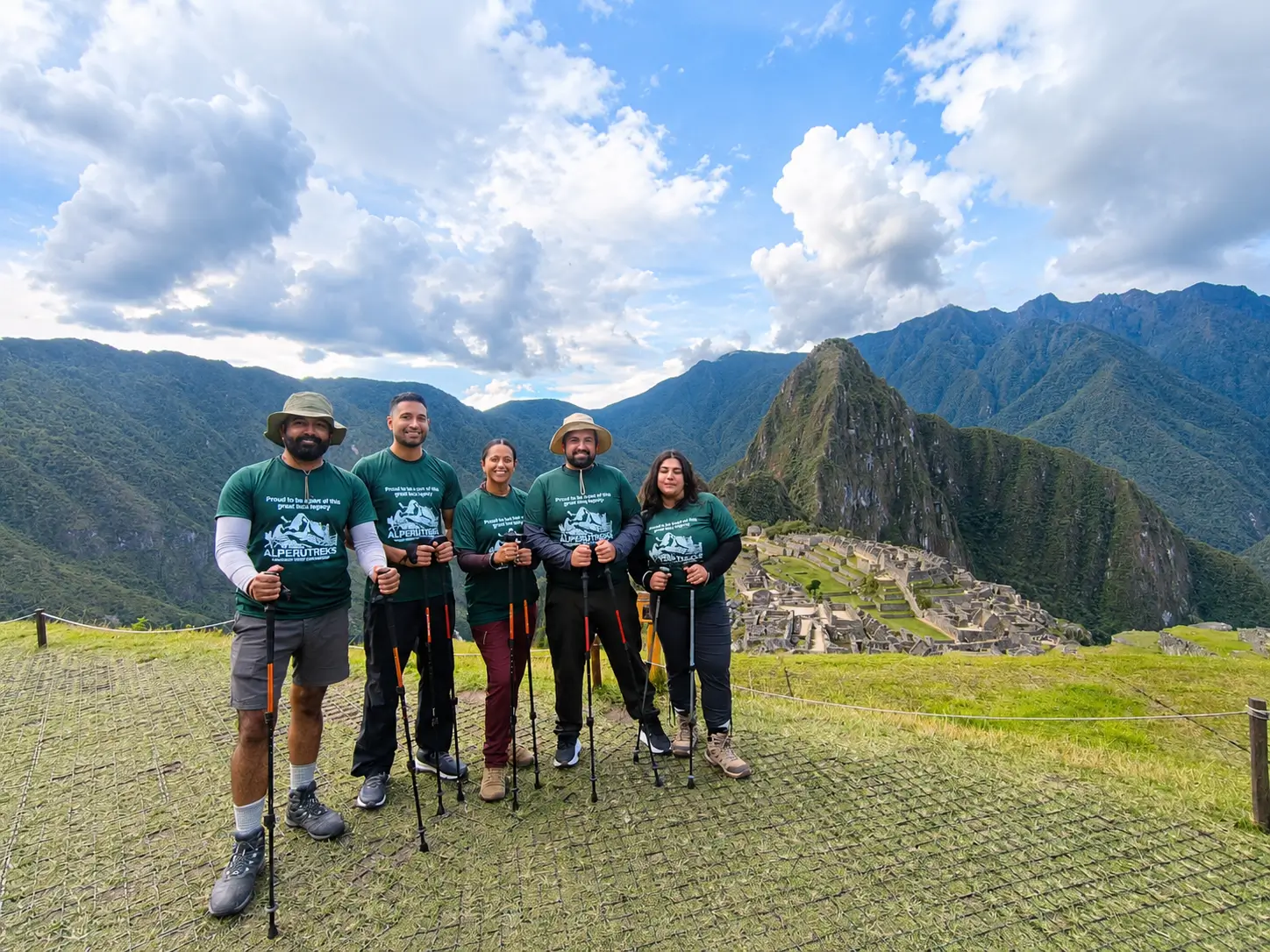
- Machu Picchu from Llactapata. Follow an Inca path to Llactapata for your first view of Machu Picchu across the valley, then enter the citadel on Day 8 with your guide.
Trip Facts at a Glance
| Detail | Choquequirao Trek 8 Days to Machu Picchu |
| Duration | 8 days, 7 nights (6 nights camping, 1 night in a hotel) |
| Trekking distance | About 105 to 110 km (65 to 68 mi) |
| Highest point | Yanama Pass, about 4,660 m (15,290 ft) |
| Other passes | Choquequirao Pass, about 3,300 m (10,800 ft); San Juan Pass, about 4,150 m (13,620 ft) |
| Lowest point | Apurímac River at Playa Rosalina, about 1,550 m (5,085 ft) |
| Camps | Santa Rosa, Choquequirao, Maizal, Yanama, Colpapampa and Lucmabamba |
| Hotel | 3-star hotel in Aguas Calientes (Day 7) |
| Difficulty | Very challenging (long days, big climbs and descents, high passes) |
| Start and finish | Hotel pickup and drop-off in Cusco |
| Pack animals | Horses carry the camping gear and your duffel bag |
| Group size | Small groups of up to 12 travelers |
| Meals | 8 breakfasts, 7 lunches and 7 dinners |
| Machu Picchu | Guided tour, Circuit 2 (Machu Picchu Classic) |
| Best season | May to September |
| Price | From US$1,100 per person |
Who This Trek Is For
This trek suits strong hikers with multi-day trekking experience who want a remote route and are comfortable with long, demanding days. You’ll hike up to nine or ten hours on the hardest days, on steep stone and dirt trails, and you’ll cross a pass at about 4,660 m (15,290 ft). You don’t need technical skills, but you do need good fitness, healthy knees and time to acclimatize in Cusco first. Our recommended minimum age is 12. Travelers over 65 should have recent high-altitude trekking experience.
How This Trek Compares
| Choquequirao Trek 8 Days | Choquequirao Trek 6 Days | Salkantay Trek 5 Days | |
| Route | Choquequirao, then on foot over the Yanama Pass and via Llactapata | Out and back to Choquequirao, then road and train to Machu Picchu | Salkantay Pass, then cloud forest and Llactapata |
| Highest point | About 4,660 m (Yanama Pass) | About 3,050 m (Choquequirao) | About 4,630 m (Salkantay Pass) |
| Time at Choquequirao | Afternoon of Day 2 and morning of Day 3 | Full day | None |
| Reaches Aguas Calientes | On foot | By train | On foot |
| Price from | US$1,100 | US$840 | See tour page |
Want Choquequirao without the high passes? See the Choquequirao Trek 6 Days to Machu Picchu. For a shorter high-mountain trek, see the Salkantay Trek 5 Days to Machu Picchu. To walk the original Inca road into Machu Picchu, see the Classic Inca Trail 4 Days.
Why Hike Choquequirao to Machu Picchu with Ali Peru Treks
- Locally owned and operated. We are a Cusco-based company and run our own departures with our own guides, cooks and horsemen.
- Fair treatment for our field team. We respect weight limits for our horses, which is why your duffel bag is limited to 7 kg (15 lb).
- Roomy camps. Four-season tents designed for four people are used by two, with foam sleeping pads and pillows, a dining tent with tables and chairs, and a private toilet tent.
- Good food for long days. Our cook prepares fresh, hot meals every day. Vegetarian, vegan and gluten-free diets are covered at no extra cost.
- Prepared for a remote route. There is almost no mobile signal until Aguas Calientes. Every group carries a satellite phone, emergency oxygen and a full first aid kit.
- Machu Picchu handled for you. We book your Circuit 2 ticket, bus tickets, return train and hotel, subject to official availability.
Itinerary
Choquequirao Trek 8 Days Itinerary
Day 1: Cusco to Capuliyoc, Playa Rosalina and Santa Rosa
Your 8-day Choquequirao expedition begins early in the morning. At 4:30 a.m., your professional Ali Perú Treks guide will pick you up directly from your hotel in Cusco to board our private transport. We will embark on a scenic 3-hour drive through the Andes until reaching Capuliyoc (9,680 ft / 2,950 m), the starting point of our trek.
Upon arrival, you will be greeted by the first breathtaking views of the imposing Apurímac Canyon, one of the deepest and most dramatic gorges on the planet. While contemplating this majestic landscape, you will enjoy a nutritious, gourmet breakfast freshly prepared by our expedition chef.
After breakfast, we will begin our adventure by venturing into this geographical wonder. We will start a technical and scenic descent, leaving behind the crisp air of the peaks to gradually enter the warm microclimate of the valley floor. We will reach Playa Rosalina (5,085 ft / 1,550 m), the perfect spot to recharge with a restoring lunch and refill our water bottles.
In the afternoon, we will cross the historic bridge over the Apurímac River (“the Speaking River”). It is at this point where the true essence of Andean trekking reveals itself: we will begin a rigorous 2.5-hour vertical ascent that will test your determination and adventurous spirit.
Our first day of conquest culminates at the Santa Rosa campsite (7,218 ft / 2,200 m). Strategically located to offer unparalleled panoramic views of the valley, this camp will be our haven for the night. Here, you can unwind with a comforting hot tea time, followed by a dinner specially designed for your physical recovery, all while taking in the vastness of the Andean sky with the mark of excellence and comfort provided by Ali Perú Treks.
| Day 1 | Details |
| Hiking distance | About 12 km (7.5 mi) |
| Hiking time | 6 to 7 hours |
| Elevation change | About 1,400 m (4,600 ft) of descent, then about 650 m (2,130 ft) of climbing |
| Lowest point | Playa Rosalina, about 1,550 m (5,085 ft) |
| Camp | Santa Rosa, about 2,200 m (7,220 ft) |
| Meals | Breakfast, lunch, dinner |
| Difficulty | Challenging |
Day 2: Santa Rosa to Marampata and Choquequirao
The day begins at daybreak with a revitalizing Andean breakfast at our Santa Rosa camp. Today’s journey is defined by a legendary ascent: leaving the depths of the canyon behind, we tackle the rhythmic switchbacks toward the Marampata plateau (9,350 ft / 2,850 m). This segment of the trek is a true test of endurance, rewarded at every step by breathtaking panoramic views of the Apurímac River’s emerald curves disappearing into the Andean mist.
Upon arriving at the picturesque village of Marampata, you will enjoy a satisfying lunch paired with a spectacular panoramic view of the Choquequirao Inca citadel, taking in from afar the first glimpses of its terraces clinging defiantly to the jagged mountain ridges. After a well-deserved rest, we continue our trek toward the archaeological heart of the legendary “Cradle of Gold.”
The Last Refuge of the Incas: Unlike the crowded trails of more commercial ruins, Choquequirao offers the rare and invaluable luxury of silence and mystery. Your expert Ali Perú Treks guide will lead you through an in-depth exploration of the main plaza, the workshops, the elite residences, and the iconic Sun Terraces featuring llama motifs unique stone mosaics that showcase the unparalleled artistic soul of the Inca civilization. Standing here, amidst the cloud forest and ancient stone, you will understand why this citadel is revered as the final stronghold of an empire.
As the sun begins to set, casting a golden hue over the peaks of the Vilcabamba Range, we settle into our exclusive campsite, strategically located near the archaeological site. This privileged proximity allows for an intimate, spiritual connection with the energy of the location that few travelers ever experience. To conclude this memorable day of historical discovery, our team will serve a restorative dinner under a blanket of stars: the perfect end to a journey through the footsteps of Inca royalty.
| Day 2 | Details |
| Hiking distance | About 10 km (6.2 mi) |
| Hiking time | 6 to 7 hours, including the afternoon visit |
| Elevation change | About 750 m (2,460 ft) of climbing to Marampata |
| Highest point | Choquequirao, about 3,050 m (10,010 ft) |
| Camp | Choquequirao campsite, about 2,850 m (9,350 ft) |
| Meals | Breakfast, lunch, dinner |
| Difficulty | Challenging (sustained climb) |
Day 3: Choquequirao, Pinchiunuyoc, Río Blanco and Maizal
This is the day of maximum cultural reward and the spiritual heart of our expedition. We begin the morning with a private, in-depth tour of the majestic Choquequirao citadel. While most travelers only see a fraction of the site, our expert guides will lead you through its most significant sectors. You will stand in the Huaqaypata (Main Plaza), feeling the architectural precision of the Inca elite, and ascend to the Ushnu, a ceremonial platform offering a 360-degree view of the surrounding glaciers and the Apurímac abyss.
Beyond the Citadel: After absorbing the mysteries of the “Cradle of Gold,” we begin our journey into the heart of the Vilcabamba Range. We face a rigorous ascent toward the Choquequirao Pass (10,892 ft / 3,320 m), the highest point of the day. From this vantage point, the scale and power of the Andes become truly humbling.
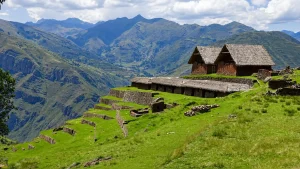
Our descent brings us to the fascinating archaeological site of Pinchuyniyoc, an agricultural outpost of Choquequirao that seems to hang dramatically over the valley. Here, amidst the cloud forest, we witness the perfect harmony between Inca engineering and the wild natural environment. After a satisfying lunch in this remote setting, we continue our descent to the Río Blanco before tackling a final, steady climb toward our secluded campsite at Maizal (9,514 ft / 2,900 m).
| Day 3 | Details |
| Hiking distance | About 14 km (8.7 mi) after the site visit |
| Hiking time | About 8 hours, plus the morning at Choquequirao |
| Highest point | Choquequirao Pass, about 3,300 m (10,800 ft) |
| Camp | Maizal, about 3,000 m (9,840 ft) |
| Meals | Breakfast, lunch, dinner |
| Difficulty | Very challenging (steep descent and climb) |
Day 4: Maizal, San Juan Pass and Yanama
Our journey continues as we leave the lush cloud forest of Maizal behind to face one of the most visually stunning days of the entire expedition. Today’s ascent takes us toward the legendary San Juan Pass (13,615 ft / 4,150 m). This segment of the trek follows ancient trails used by miners, winding through high-altitude landscapes where the vegetation thins to reveal the raw, mineral-rich heart of the Vilcabamba Range.
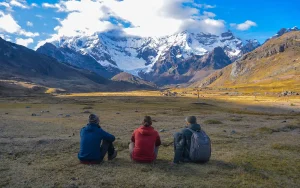
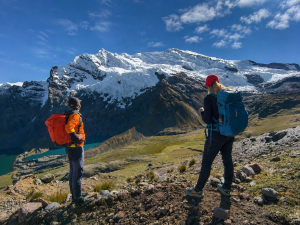
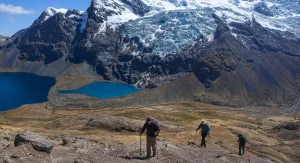
As we climb, we pass the historic Victoria Mines, where veins of silver were once extracted directly from the earth. The air turns crisp, and the scenery transforms into a dramatic alpine tundra. Upon reaching the summit of San Juan Pass, you will be rewarded with a spectacular 360-degree panorama: the majestic Salkantay and Humantay glaciers dominate the horizon, standing as silent sentinels over the deep valleys we have conquered.
After a satisfying lunch served with views of the surrounding peaks, we begin a scenic descent toward the remote village of Yanama (11,483 ft / 3,500 m). The trail leads us through high Andean meadows where local shepherds tend to their flocks of llamas and alpacas. This is a region where time seems to have stopped, offering an authentic glimpse into the lifestyle of high-altitude communities.
We reach our campsite in Yanama just as the golden hour illuminates the glacial peaks. This picturesque Andean village provides a serene backdrop for our evening. Here, our team will have your camp completely prepared for a night of deep recovery, where you will enjoy a dinner specifically designed for high-altitude nutrition—reflecting on a journey that has taken you from the jungle-fringed ruins of Choquequirao to the glaciated heights of the central Andes.
| Day 4 | Details |
| Hiking distance | About 10 km (6.2 mi) |
| Hiking time | 6 to 8 hours |
| Elevation change | About 1,150 m (3,770 ft) of climbing, then about 650 m (2,130 ft) of descent |
| Highest point | San Juan Pass, about 4,150 m (13,620 ft) |
| Camp | Yanama, about 3,500 m (11,480 ft) |
| Meals | Breakfast, lunch, dinner |
| Difficulty | Very challenging (long climb to altitude) |
Day 5: Yanama Pass, Totora and Colpapampa
Our journey reaches its atmospheric peak today. We begin early in the morning with a nutritious breakfast before tackling a steady ascent through the Yanama Valley, a remote corridor where the presence of the modern world completely vanishes. As we gain altitude, the lush vegetation of the lower valleys gives way to the raw, majestic beauty of the high-alpine “Puna,” characterized by dramatic rock formations and the soaring presence of the Andean Condor.
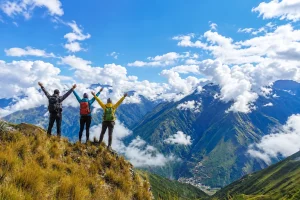
The highlight of the day and the entire expedition is reaching the Yanama Pass (15,288 ft / 4,660 m). At this altitude, you will stand at the highest point of your journey. The silence is profound, and the views are truly breathtaking. You will be surrounded by the towering, ice-clad peaks of the Salkantay, Sacsarayoc, and Pumasillo massifs, offering a unique perspective of the Andes that very few travelers ever witness.
Descent into the Lush Valley: After a celebratory moment at the summit and a reconfortant lunch to regain our energy, we begin a long, scenic descent. The landscape undergoes a rapid transformation as we lose altitude, transitioning from the chilly glaciated heights to the vibrant green of the Totora valley. The trail follows the course of the Yanama River, leading us through small Andean hamlets and agricultural terraces where locals cultivate high-altitude native potatoes.
Our day concludes at Colpapampa (9,317 ft / 2,840 m), a strategic point where our remote Choquequirao route connects with the famous Salkantay Trail. The air here is warmer and oxygen-rich, providing an ideal environment for physical recovery. After completing a 14-mile (22 km) journey, our team will welcome you to the campsite with a restorative dinner, marking the successful completion of the most rugged and remote portion of our odyssey.
| Day 5 | Details |
| Hiking distance | About 25 km (15.5 mi) |
| Hiking time | 8 to 10 hours |
| Elevation change | About 1,150 m (3,770 ft) of climbing, then about 1,800 m (5,900 ft) of descent |
| Highest point | Yanama Pass, about 4,660 m (15,290 ft) |
| Camp | Colpapampa, about 2,850 m (9,350 ft) |
| Meals | Breakfast, lunch, dinner |
| Difficulty | Very challenging (the hardest day) |
Day 6: Colpapampa to Lucmabamba
After several days of conquering high-altitude passes, today offers a refreshing change of scenery as we descend into the lush, vibrant environment of the Peruvian cloud forest. We begin our trek along the banks of the Santa Teresa River, where the landscape is transformed by the heat and humidity of the lower valley.
The trail takes us through a paradise of biodiversity. As we walk, you will be surrounded by blooming orchids, giant ferns, and the constant song of exotic birds. We will pass through local family farms where the air is scented by plantations of organic coffee, passion fruit, and avocados. This segment is a celebration of the earth’s fertility and a stark, beautiful contrast to the rugged stone of the high Andes.
Our journey leads us to the picturesque village of Lucmabamba (6,561 ft / 2,000 m). This area is world-renowned for producing some of the finest high-altitude coffee. To enhance your experience, we have arranged a visit to a local plantation, where you can learn about the traditional harvesting and roasting process—a true sensory immersion into the local culture.
We reach our campsite at Lucmabamba in the early afternoon, allowing for a well-deserved period of relaxation in a much warmer and oxygen-rich climate. Surrounded by lush vegetation and the tranquility of the countryside, you will enjoy a gourmet dinner featuring fresh, local ingredients. This evening provides the perfect atmosphere to recharge before our final approach to the hidden view of Machu Picchu tomorrow.
| Day 6 | Details |
| Hiking distance | About 16 km (9.9 mi) |
| Hiking time | 5 to 6 hours |
| Elevation change | Mostly downhill, about 850 m (2,790 ft) of descent |
| Activity | Coffee farm visit at Lucmabamba |
| Camp | Lucmabamba, about 2,000 m (6,560 ft) |
| Meals | Breakfast, lunch, dinner |
| Difficulty | Moderate |
Day 7: Lucmabamba, Llactapata and Aguas Calientes
The penultimate day of our odyssey begins with a shift into a vibrant, lush world. We embark on a journey through the high rainforest, where the air is filled with the sweet scents of the tropics. As we traverse thriving plantations of avocado, passion fruit, and organic coffee, you will experience the “bean-to-cup” process at a local farm, supporting the sustainable livelihoods of the families who partner with Ali Perú Treks.
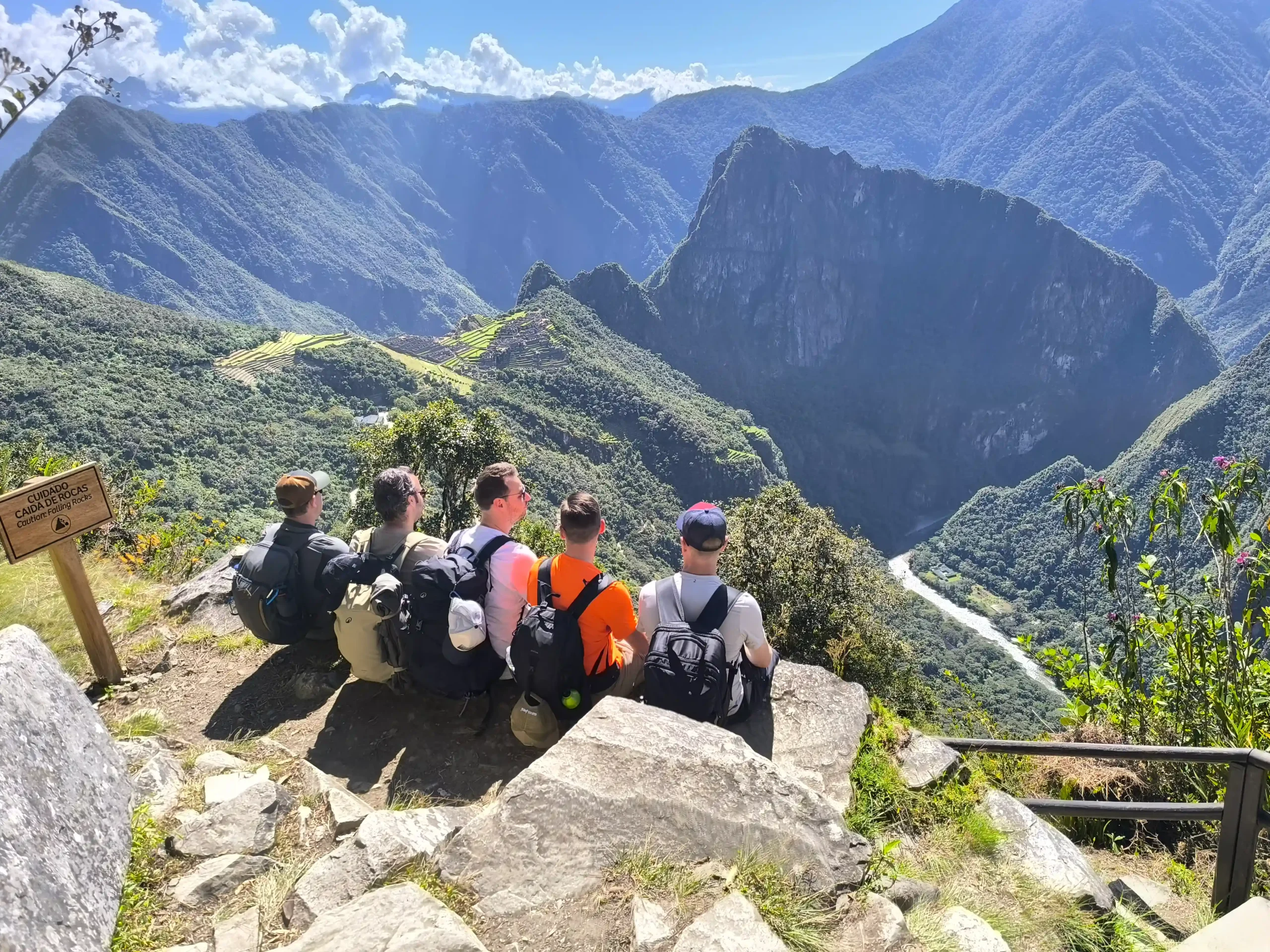
The adventure reaches a new level of excitement as we ascend an original Inca trail to the archaeological site of Llactapata (10,170 ft / 3,100 m). This is a moment of pure magic: from this secluded vantage point, you will experience your first view of Machu Picchu standing proudly on the opposite mountain ridge.
While most visitors approach the citadel from below, you will witness the sanctuary in its true geographical context, framed by the Vilcanota River and the imposing Huayna Picchu peak. This is a visual reward reserved only for those who have dared to traverse the high passes of the Vilcabamba Range.
The Gateway to the Wonder: After a scenic descent to the Hydroelectric station for a high-energy gourmet lunch, we begin the final stretch along the banks of the Urubamba River. A three-hour walk through dense jungle and beneath towering cliffs leads us to Aguas Calientes (Machu Picchu Pueblo). Upon arrival, you will check into a premium 3-star hotel to enjoy the luxury of a hot shower and modern comfort after your week in the wilderness. The day concludes with a celebratory dinner at a top-tier local restaurant, where we toast to the incredible journey shared and the grand finale awaiting us tomorrow.
| Day 7 | Details |
| Hiking distance | About 24 km (15 mi) |
| Hiking time | 7 to 9 hours |
| Elevation change | About 750 m (2,460 ft) of climbing to Llactapata, then about 950 m (3,120 ft) of descent |
| Highest point | Llactapata, about 2,750 m (9,020 ft) |
| Overnight | 3-star hotel in Aguas Calientes, about 2,040 m (6,690 ft) |
| Meals | Breakfast, lunch, dinner at a restaurant |
| Difficulty | Challenging (long day) |
Day 8: Machu Picchu and Return to Cusco
The moment you have been working toward for seven days has finally arrived. After an early breakfast at your hotel, we leave our heavy luggage stored in the town of Machu Picchu Pueblo and carry only our essentials. After conquering the remote “Sister City” of Choquequirao, today we complete the legendary duo by entering the world-renowned sanctuary: Machu Picchu. To maximize our experience and beat the heavy crowds, we board one of the first buses up to the citadel (a 25-minute scenic ascent), arriving just as the morning light begins to illuminate the mystical stone masonry.
While yesterday provided a distant, magical glimpse from Llactapata, today we immerse ourselves fully in the energy of the site. Your expert Ali Perú Treks guide will lead you on a professional, three-hour in-depth tour of the most significant sectors. You will explore the Temple of the Sun, the Intihuatana, and the elite residential quarters, comparing the architectural styles to those you studied at Choquequirao. This expert-led journey provides a comprehensive understanding of the Inca Empire’s history, spirituality, and engineering genius, all while you stand at the most iconic viewpoints for that perfect, well-earned photograph.
Following the tour and some personal time to absorb the sanctuary’s atmosphere, we descend back to Aguas Calientes. You will have time to enjoy lunch (not included) in town before your guide personally escorts you to the train station. We will board the scenic train to Ollantaytambo, a stunning two-hour journey following the picturesque Urubamba River. Upon arrival, the Ali Perú Treks team will be waiting for you promptly to provide a private, comfortable transfer back to Cusco, dropping you off directly at your hotel door and bringing your unforgettable 8-day odyssey through the heart of the Inca world to a triumphant close.
| Day 8 | Details |
| Activity | Guided tour of Machu Picchu, Circuit 2 |
| Tour length | About 2 to 3 hours, plus time for photos |
| Machu Picchu altitude | About 2,430 m (7,970 ft) |
| Return | Bus to Aguas Calientes, Expedition train to Ollantaytambo, private van to your hotel in Cusco |
| Meals | Breakfast (lunch is not included) |
Included
What’s Included in the Choquequirao Trek 8 Days
Included
- Pre-trek briefing with your guide at your hotel at 6:00 PM the evening before departure
- Professional English-speaking guide for the trek and the Machu Picchu tour
- Cook preparing all meals on the trek, with vegetarian, vegan and gluten-free options at no extra cost
- Horsemen (arrieros) and horses to carry the camping equipment, food and your duffel bag
- Duffel bag for up to 7 kg (15 lb) of personal gear, including your sleeping bag
- Four-season tents for four people, used by two
- Foam sleeping pad and pillow
- Dining tent with tables and chairs, and a kitchen tent
- Private toilet tent at the campsites
- Meals: 8 breakfasts, 7 lunches and 7 dinners (Day 7 dinner at a restaurant in Aguas Calientes)
- Drinking water, boiled and filtered, from lunch on Day 1 to breakfast on Day 7
- Rain poncho and backpack rain cover
- Entrance ticket to the Choquequirao archaeological park
- Machu Picchu entrance ticket (Circuit 2) and guided tour
- Round-trip bus between Aguas Calientes and Machu Picchu
- Expedition train from Aguas Calientes to Ollantaytambo
- One night in a 3-star hotel in Aguas Calientes
- Private transport from your hotel in Cusco to Capuliyoc, and from Ollantaytambo to your hotel in Cusco
- Emergency oxygen and first aid kit
Not Included
- Sleeping bag (available to rent)
- Trekking poles (available to rent)
- Inflatable sleeping pad (available to rent)
- Lunch on Day 8 in Aguas Calientes
- Huayna Picchu or Machu Picchu Mountain tickets
- Travel insurance (required)
- Tips for your guide, cook and horsemen
- Snacks, drinks and personal expenses
Optional Extras
- Sleeping bag rental: US$30
- Trekking poles: US$25
- Inflatable sleeping pad: US$25
- Huayna Picchu or Machu Picchu Mountain ticket: US$80 per person, subject to availability. These are separate ticket types with their own routes through the citadel and sell out months ahead, so ask when you book.
- Train upgrade: a higher class of train for the return to Ollantaytambo is available on request.
Packing List
Choquequirao Trek Packing List
Pack for a hot canyon, cold nights at Yanama and Maizal, humid cloud forest and possible rain. Your daypack stays with you on the trail. Your duffel bag (7 kg / 15 lb, provided at the briefing) travels with the horses, and you have access to it every afternoon at camp. For more detail, see our trekking gear list.
Your Daypack
Use a 25 to 30 L pack with a rain cover.
- Original passport. It must be the same document you used to book.
- Water: 2 to 3 liters in reusable bottles or a hydration bladder. We don’t use single-use plastic bottles.
- Rain jacket or poncho (we provide a poncho)
- Sun protection: SPF 30+ sunscreen, lip balm with SPF, a sun hat and UV sunglasses
- Insect repellent. Biting sandflies are common in the canyon on Days 1 and 2 and in the cloud forest on Days 6 and 7.
- Warm layer for the passes and breaks
- Energy snacks such as bars, dried fruit, nuts and electrolytes for the long climbs
- Toilet paper in a waterproof bag
- Cash in Peruvian soles. There are no ATMs on the trail. About S/600 to S/800 in small bills covers drinks, souvenirs and tips.
Your Duffel Bag (Carried by Horses)
Your 7 kg limit includes your sleeping bag (about 2 kg), so pack light.
- Sleeping bag rated to about –15°C (5°F), if you aren’t renting ours
- Clothes for eight days: 5 quick-dry T-shirts, 2 to 3 pairs of hiking pants, underwear and about 8 pairs of wool hiking socks
- Warm layers: thermal base layers, a thick fleece and a down jacket for the nights at Maizal and Yanama
- Wool hat and waterproof gloves
- Camp shoes: sandals or light sneakers
- Toiletries: biodegradable soap, toothbrush, toothpaste, hand sanitizer, wet wipes and a quick-dry towel
- Power bank. There is no electricity on most of the route.
Health and Personal Care
- Personal medication, plus anything your doctor recommends for altitude
- Ibuprofen and a blister kit (moleskin or tape)
- Lip balm and moisturizer for the dry air at altitude
Footwear and Equipment
- Waterproof hiking boots, broken in, with good ankle support for steep descents
- Trekking poles, highly recommended to protect your knees (available to rent)
- Headlamp with spare batteries, required for camp at night and early starts
For Your Machu Picchu Day
Inside Machu Picchu, bags may be no larger than 40 × 35 × 20 cm (about 16 × 14 × 8 in), and trekking poles and food are not allowed. Leave your duffel and poles at the hotel in Aguas Calientes.
Travel Info
Travel Information for the Choquequirao Trek 8 Days
Pre-Trek Briefing
Attendance is mandatory. The briefing takes place directly at your hotel in Cusco the day before your departure. You will meet your guide, review the route, safety protocol, and weather forecast, receive your duffel bag, and confirm your exact pickup time for the trek.
How Difficult Is the Choquequirao Trek 8 Days
We rate this trek as very challenging. It combines the big canyon climbs of the Choquequirao route with two high passes and several long days. Days 3, 4 and 5 are the hardest, and Day 5 alone covers about 25 km (15.5 mi) over a pass at about 4,660 m (15,290 ft). Expect seven to nine hours of hiking on most days.
Train with long hikes that include big ascents and descents, plus stair climbing, for at least four to six weeks before your trip. For a closer look, read our Choquequirao trek difficulty guide.
Altitude and Acclimatization
The route reaches about 4,660 m (15,290 ft) at the Yanama Pass and spends a night at about 3,500 m (11,480 ft) in Yanama. Arrive in Cusco, at about 3,400 m (11,150 ft), at least two to three days before the trek. Drink plenty of water, avoid alcohol and talk to your doctor about altitude medication such as acetazolamide.
Our guides carry emergency oxygen, and if symptoms don’t improve, the first response is to descend. See our guides to acclimatizing in Cusco and altitude sickness.
Weather and Best Time to Go
You’ll pass through several climate zones, so dress in layers.
- Apurímac Canyon (Days 1 and 2): dry and hot, with temperatures around 27 to 30°C (80 to 86°F) near the river.
- High passes and Yanama (Days 4 and 5): cold, with temperatures around freezing or below at night.
- Cloud forest (Days 6 and 7): warm and humid, with frequent showers.
The best season is May to September, when the trails are driest. In the rainy season, landslides can damage the trails. Peru’s Ministry of Culture closed Choquequirao to visitors from March 10 to April 17, 2025, and closed it again from February 1, 2026, as a preventive measure during heavy rains. If you plan to travel between November and April, check with us before booking.
Safety and Emergencies
There is almost no mobile signal from Day 1 until Aguas Calientes on Day 7. Each group carries a satellite phone to stay in contact with our Cusco office, along with emergency oxygen and a full first aid kit. If a hiker needs to leave the trail, we arrange a horse to the nearest road and a private vehicle to Cusco.
In serious cases, we coordinate a helicopter evacuation with your insurance company.
Travel Insurance
Travel insurance is required for this trek. Your policy must cover trekking up to at least 5,000 m (16,400 ft) and emergency evacuation.
Camps, Toilets and Showers
We set up a private toilet tent at the campsites. Some campsites have basic cold showers. The next hot shower is at your hotel in Aguas Calientes on Day 7. Drinking water is boiled and filtered by our cook.
Responsible Travel
- We follow Leave No Trace principles and pack out all trash.
- We don’t use single-use plastic bottles. Please bring reusable bottles or a hydration bladder.
- We respect fair wages and weight limits for our horsemen and their animals. Please keep your duffel within 7 kg (15 lb).
- Ask before photographing families and their animals along the trail.
Tipping
Tips are voluntary but much appreciated. Groups usually give a joint tip to the cook and horsemen at the end of their service on Day 6 or 7, and tip the guide on Day 8. As a guide, many travelers budget about S/200 to S/300 per person for the cook and horsemen.
Solo Travelers
Solo travelers are welcome. You can join a group departure or book a private trip. In a group, you may share a tent with another traveler of the same gender.
For general advice on documents, money and health in Peru, see our Peru travel information page.
Map
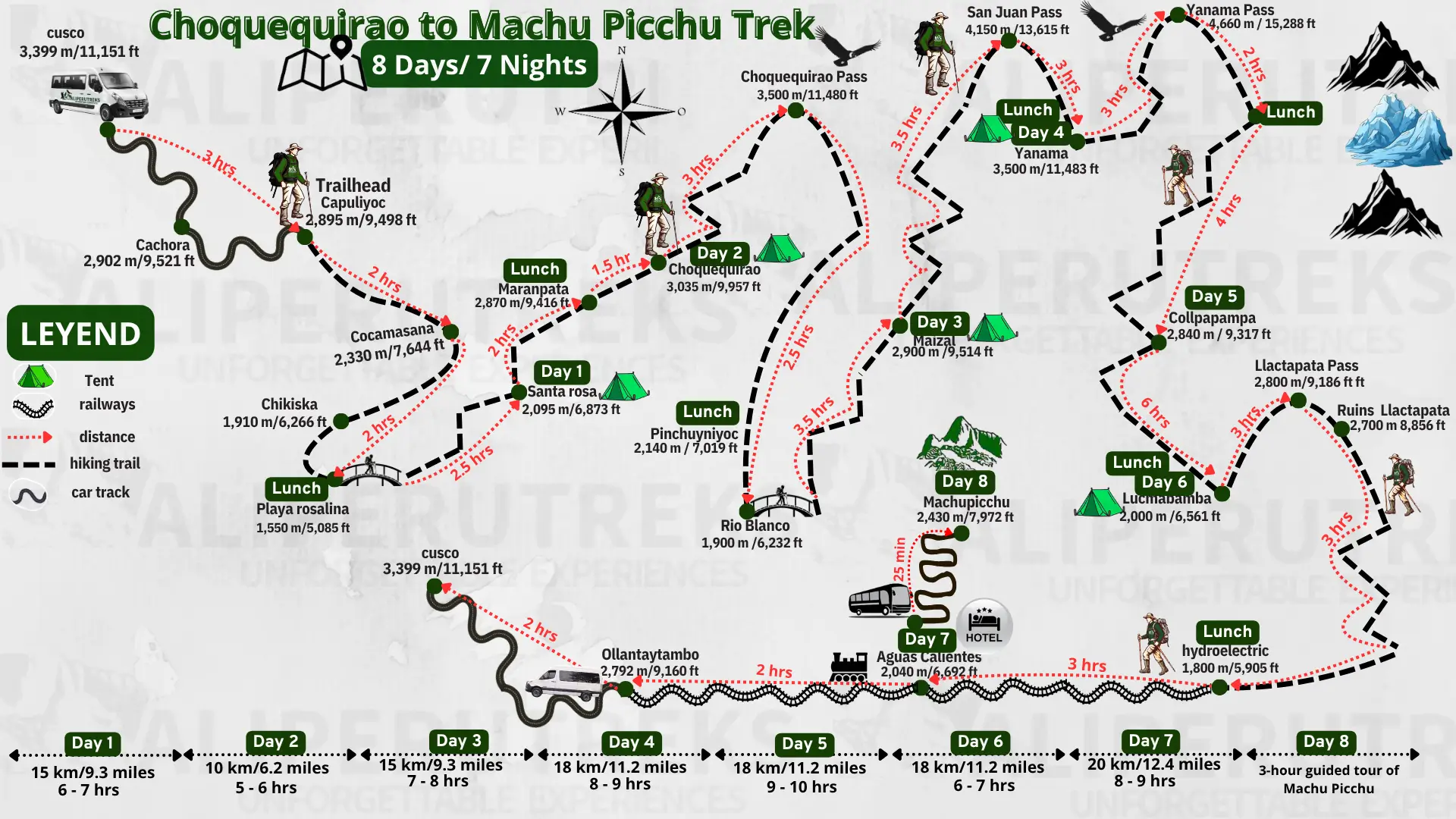
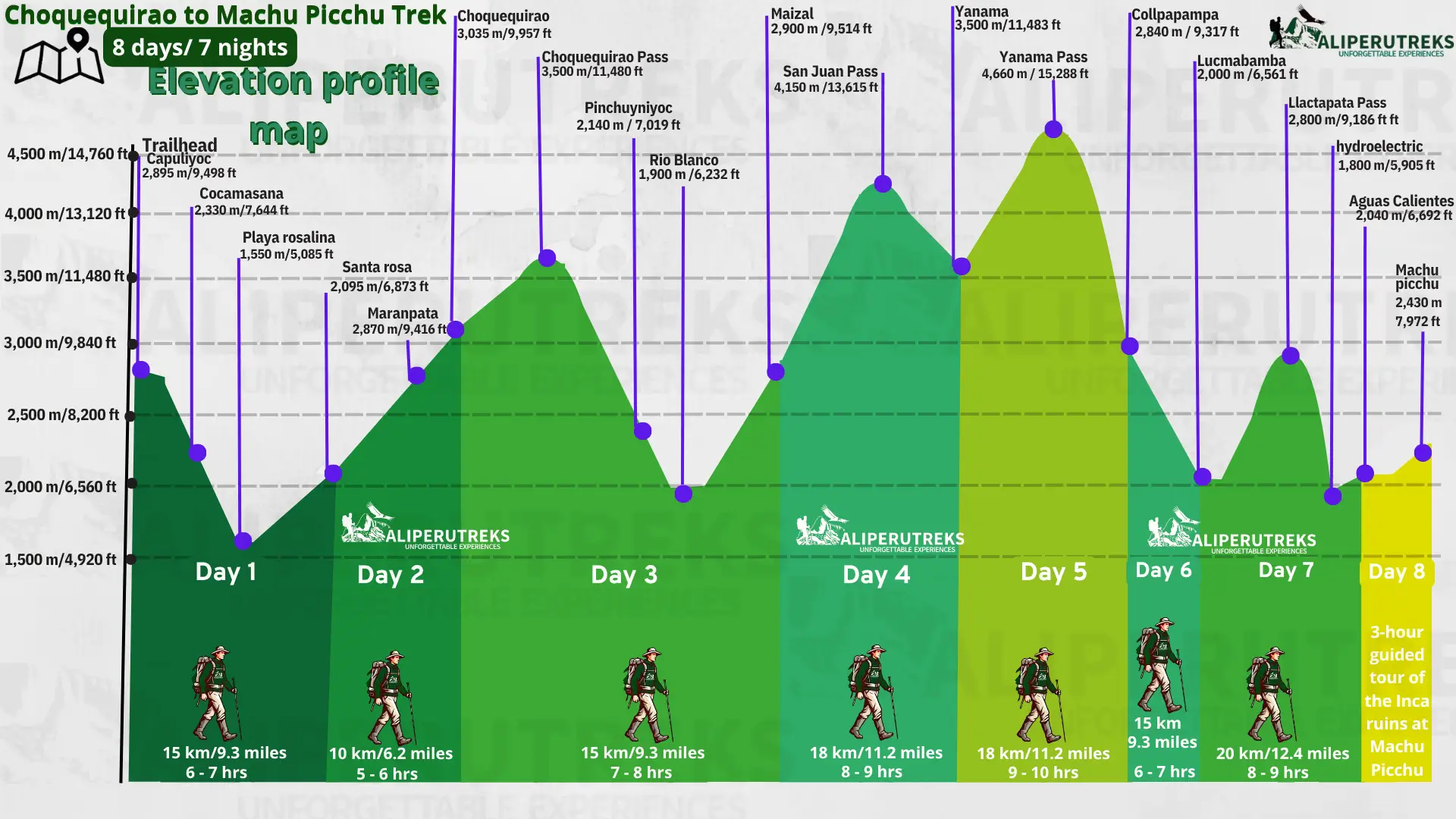
Choquequirao Trek 8 Days Map and Elevation Profile
The trek starts at Capuliyoc, above the village of Cachora, and descends the Apurímac Canyon to Playa Rosalina before climbing to Santa Rosa, Marampata and Choquequirao. From Choquequirao, the route crosses the Choquequirao Pass to Pinchiunuyoc and the Río Blanco, then climbs to Maizal.
It crosses the San Juan Pass to Yanama and the Yanama Pass to Totora and Colpapampa. From Colpapampa, the trail follows the Santa Teresa valley to Lucmabamba, climbs to Llactapata and descends to Hidroeléctrica, then continues along the railway to Aguas Calientes and Machu Picchu.


Price
Choquequirao Trek 8 Days Price
All prices are per person in US dollars and include the services listed under What’s Included.
| Service | Price per person |
| Shared group departure | US$1,100 |
| Private departure, 2–3 travelers | US$1,259 |
| Private departure, 4–5 travelers | US$1,200 |
| Private departure, 6–7 travelers | US$1,150 |
| Private departure, 8 or more travelers | US$1,100 |
Discounts and Extras
- Student and youth discount: US$20 off per person for university students with a valid physical student ID and for travelers aged 17 and under. Email a clear copy of the ID or passport to info@aliperutreks.com when you book.
- Sleeping bag rental: US$25
- Trekking poles: US$15
- Huayna Picchu or Machu Picchu Mountain: US$80 per person, subject to availability
Booking and Cancellation
Machu Picchu tickets and train seats are non-refundable once we buy them, so deposits are non-refundable. We strongly recommend travel insurance that covers trip cancellation. See our booking information page for payment terms, or contact us to check availability for your dates.
Faq
Choquequirao Trek 8 Days FAQs
It is very challenging. You combine steep canyon descents and climbs with two high passes, including the Yanama Pass at about 4,660 m (15,290 ft), and several days of eight or more hours of hiking. It is considerably harder than the Classic Inca Trail.
The Yanama Pass, also called the Mariano Llamoja Pass, at about 4,660 m (15,290 ft) on Day 5. That is higher than Dead Woman’s Pass on the Classic Inca Trail, about 4,215 m (13,830 ft), and slightly higher than the Salkantay Pass, about 4,630 m (15,190 ft).
The 6-day trek goes to Choquequirao and back the same way, then travels by road and train to Machu Picchu, and never goes above about 3,050 m. The 8-day trek continues on foot from Choquequirao over the San Juan and Yanama passes and via Llactapata, reaching Aguas Calientes on foot.
Usually seven to nine hours, and up to ten on Day 5. Day 6 is shorter, at five to six hours. The exact time depends on your group’s pace.
You don’t need a trekking permit like the Inca Trail’s, but you do need an entrance ticket to the Choquequirao archaeological park and a Machu Picchu ticket. Both are included and booked by us.
May to September, during the dry season. In the rainy season, landslides can damage the trails, and the Ministry of Culture has closed Choquequirao temporarily in recent years. Contact us before booking a trip between November and April.
Your guide watches for symptoms every day and carries emergency oxygen and a satellite phone. If symptoms don’t improve, the first response is to descend to a lower altitude.
We recommend a minimum age of 12. Travelers over 65 should have recent high-altitude trekking experience and good fitness.
Yes. Your insurance must cover trekking up to at least 5,000 m (16,400 ft) and emergency evacuation.
Circuit 2 (Machu Picchu Classic), with the classic view from the terraces and a walk through the main urban sector. We book it as soon as you confirm, subject to official availability. Read our guide to the Machu Picchu circuits to compare the options.
Yes, for US$80 per person, subject to availability. Each is a separate ticket type with its own route through the citadel, and both sell out months ahead in high season, so ask when you book.
Yes. Our cook boils and filters all drinking water, from lunch on Day 1 to breakfast on Day 7.
Yes. Small biting sandflies are common in the Apurímac Canyon and in the cloud forest. Bring a strong insect repellent and long sleeves.
Only your daypack. Our horses carry the camping equipment and your duffel bag with up to 7 kg (15 lb) of personal gear.
Fresh, hot meals prepared by our cook, with Peruvian dishes and ingredients such as quinoa and local vegetables. We cover vegetarian, vegan and gluten-free diets at no extra cost.
We set up a private toilet tent at the campsites. Some campsites have basic cold showers. Your hotel in Aguas Calientes has hot water.
Usually between about 7:00 and 8:30 PM, depending on your train time and traffic from Ollantaytambo.
Yes. Our private van meets you at Ollantaytambo station and takes you to your hotel in Cusco.
Yes. You can join a group departure or book a private trip. In a group, you may share a tent with another traveler of the same gender.
Tips are voluntary. Many travelers give about S/200 to S/300 per person for the cook and horsemen, plus a separate tip for the guide.
Deposits are non-refundable because we use them to buy Machu Picchu tickets and train seats, which are non-refundable. See our booking information page for the full terms.
Start at least four to six weeks before your trip with long hikes that include big climbs and descents, stair climbing and cardio training. Hiking with a daypack and trekking poles helps you prepare for the long downhill sections.
How many hours a day do you hike on the Choquequirao trek?
On average, you will hike 7 to 9 hours per day. However, the exact duration depends on the number of travelers in the group and their collective pace. Larger groups may take more time to ensure everyone stays together safely, while smaller groups may move more quickly. The most rigorous days are Day 4 and Day 5.
Is the drinking water safe on the Choquequirao trek?
Yes. We provide boiled and filtered water from Day 1 lunch onwards. We follow strict hygiene protocols to prevent any stomach issues.
What is the emergency evacuation plan on the Choquequirao trek?
Given the remoteness, evacuation is usually done by horse to the nearest road access and then by private vehicle to Cusco. In extreme cases, we coordinate with your insurance for helicopter evacuation.
Are there sandflies or mosquitoes on the Choquequirao trek?
Yes, especially in the Apurímac Canyon and the cloud forest. You will encounter “sandflies” (mosquitos) that are small but persistent. High-DEET repellent is a must.
Do I need to carry my own backpack on the Choquequirao trek?
No. You only carry a small daypack with essentials (water, camera, rain jacket). Our horses carry the rest of your gear (up to 7 kg / 15 lbs) in a duffel bag we provide.
What food is included on the Choquequirao trek?
We serve “Gourmet Mountain Cuisine.” Expect fresh, 3-course meals including Peruvian superfoods like quinoa, alpaca, and fresh local vegetables, prepared by a professional chef.
Are there bathrooms and showers on the Choquequirao trek?
We provide private, hygienic toilet tents at every campsite. Showers are only available at some campsites (cold) and in your hotel in Aguas Calientes on Day 7.
What camping equipment is used on the Choquequirao trek?
We provide professional 4-season tents designed for 4 people, but we only use them for 2 travelers to ensure maximum space and comfort for your gear.
What time do you arrive back in Cusco after the trek?
Usually between 7:00 PM and 8:30 PM, depending on your train schedule and traffic from the Ollantaytambo station.
Is the train station transfer back to Cusco private?
Yes. Ali Perú Treks provides private van service from the train station directly to your hotel door in Cusco.
How much should I tip on the Choquequirao trek?
It is not mandatory, but it is deeply appreciated by the staff. A general guideline is S/ 200 – 300 per hiker to be distributed among the chefs and muleteers.
Why book the Choquequirao trek with Ali Perú Treks?
Because we are local experts who specialize in high-intensity, remote routes. We prioritize porter welfare, gourmet nutrition, and premium safety equipment, ensuring you have a life-changing experience, not just a hike.
How do I train for the Choquequirao trek?
Because this is considered the most physically demanding trek in the Cusco region, most operators recommend a structured training plan in the 6–8 weeks before departure, combining cardio, hill training, and altitude acclimatization in Cusco itself.
| Timeframe | Focus |
|---|---|
| 8–4 weeks before | Cardio: hiking, running, cycling, 3–4x per week |
| 4–2 weeks before | Hill/stair training with a loaded daypack |
| Arrival in Cusco | 2–3 days of acclimatization before starting |
Is the Choquequirao trek harder than the Salkantay trek?
Yes. The Choquequirao trek involves deeper canyon descents, a higher maximum altitude (4,660 m vs. 4,650 m on Salkantay), and significantly more cumulative elevation gain and loss over 8 days, making it more physically demanding overall than the 5-day Salkantay trek.
What is not included in the Choquequirao trek price?
Knowing exclusions upfront reduces pre-booking questions and matches “what’s not included” as a common query pattern across tour-booking searches.
- Sleeping bag rental ($25) and trekking pole rental ($15)
- Huayna Picchu or Machu Picchu Mountain tickets ($80 per person)
- Lunch in Aguas Calientes on the final day
- Tips for guides, cooks, and muleteers
- Travel insurance
Featured Tours & Treks
Discover hand-picked tours and treks to Machu Picchu and Peru’s most unforgettable destinations.
What Our Travelers Say About Ali Perú Treks
Discover the experiences of travelers who have explored Peru with Ali Perú Treks. From the legendary Inca Trail to the breathtaking landscapes of the Andes and the wonders of Machu Picchu, our guests share their stories, honest feedback, and unforgettable moments. Their reviews reflect our commitment to personalized service, knowledgeable local guides, and meaningful adventures crafted with care from start to finish.
Our Blogs
Blogs that provide information and tips for planning the perfect trip to Peru and Machu Picchu.