

Ancascocha Trek 4 vs. 5 Days: Itinerary, Price, Difficulty & Key Differences
The core difference between the 4-day and 5-day Ancascocha Trek is pacing, not scenery: both versions cover the same route, cross the same two mountain passes, and end at Machu Picchu — the 4-day version just compresses that same terrain into one fewer day, which makes its two toughest days significantly harder. The 5-day version costs about $90 more and spreads the climbing across an extra day.
Here’s the itinerary, pricing, and difficulty breakdown to help you decide which fits your trip.
Quick Comparison Table
| Factor | 4 Days / 3 Nights | 5 Days / 4 Nights |
|---|---|---|
| Price (Ali Peru Treks, per person) | From $640 | From $730 |
| Deposit | $200 | $200 |
| Toughest single day | Day 2: 18 km (11.2 mi), 9–10 hours, rated “High Challenge / Technical” | Split across Days 2 and 3, each shorter and rated “Challenging” individually |
| Max altitude | 4,650 m (15,255 ft) — Huayanay Pass | Same: 4,650 m (15,255 ft) |
| Number of high passes crossed per day | Both Kuychiccasa (4,500 m) and Huayanay (4,650 m) passes fall on two consecutive demanding days | Same two passes, but spread across three separate days |
| Accommodation | Camping, with a final night in a hotel in Aguas Calientes | Camping, with a final night in a hotel in Aguas Calientes |
| Group size | Small group | Small group |
| Best for | Trekkers with limited vacation time and strong fitness | Trekkers who want a gentler pace or extra acclimatization buffer |
Day-by-Day Itinerary: 4-Day Version
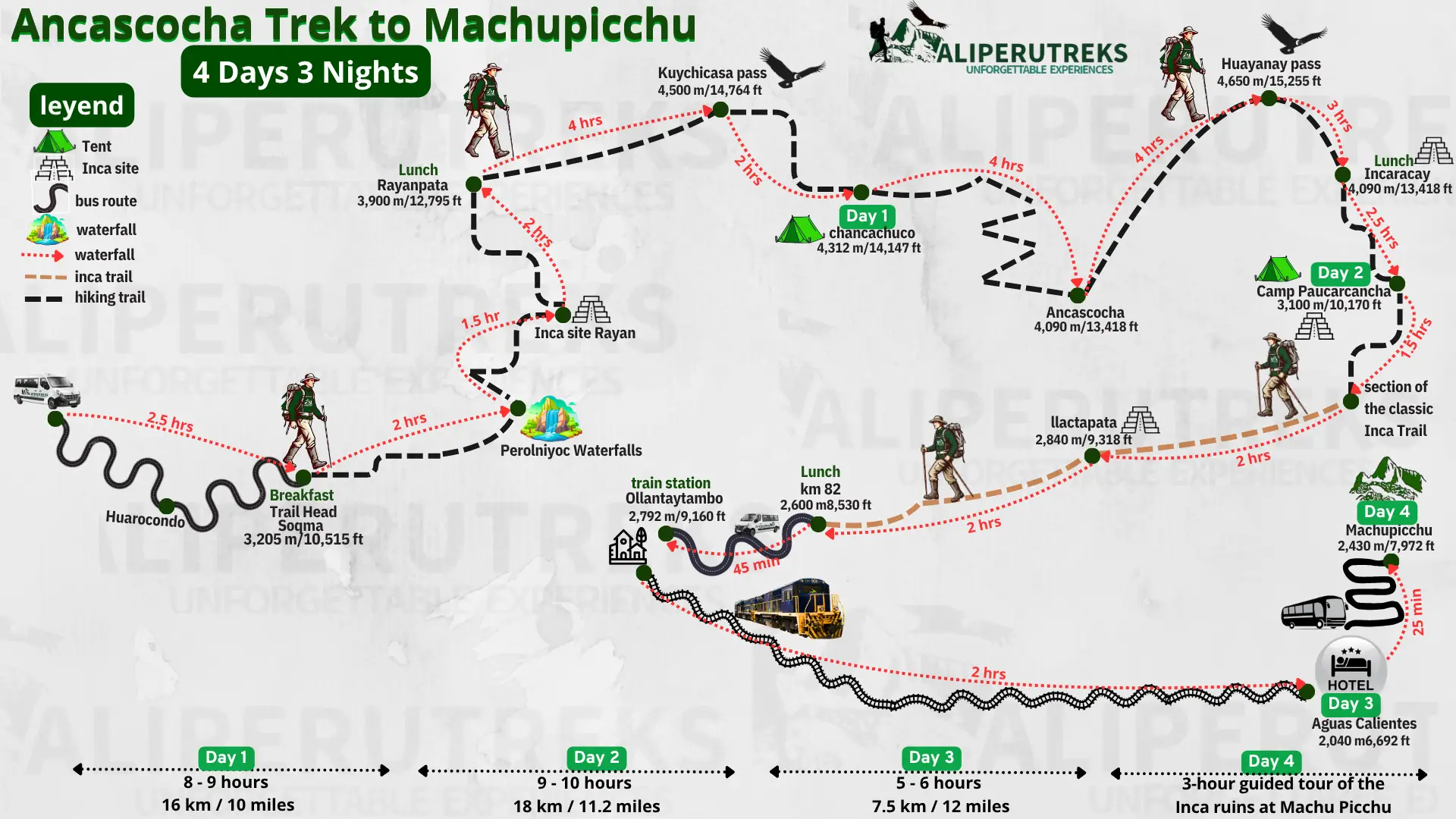
- Cusco – Soqma – Perolniyoc – Kuychiccasa Pass – Chancachuco Valley. Roughly 16 km (9.9 mi) over 9–10 hours, rated Challenging. This route crosses Kuychiccasa Pass (4,500 m / 14,764 ft) on the very first day — a demanding start with essentially no easing-in period.
- Chancachuco – Ancascocha – Huayanay Pass – Paucarcancha. Roughly 18 km (11.2 mi) over 9–10 hours. Ali Peru Treks’ own materials describe this as the most demanding day of the trip, crossing Huayanay Pass at 4,650 m (15,255 ft).
- Paucarcancha – Ollantaytambo – Aguas Calientes. Mostly descent, rated Easy to Moderate. The trail merges with the Classic Inca Trail near Paucarcancha before continuing toward Aguas Calientes.
- Machu Picchu – Ollantaytambo – Cusco. Guided visit to the citadel, then return transport.
Day-by-Day Itinerary: 5-Day Version
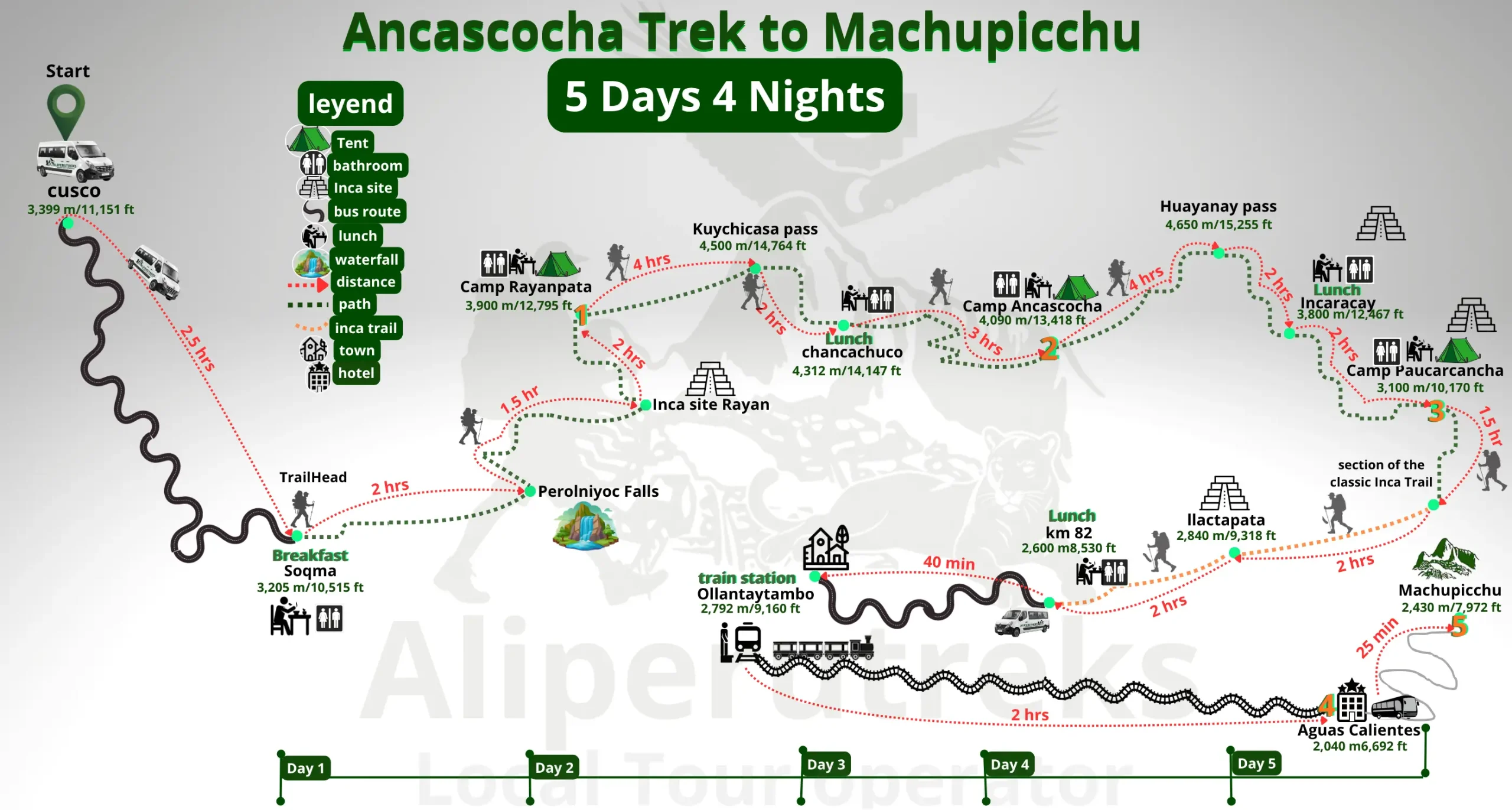
- Cusco – Soqma – Rayan Community. Roughly 9 km (5.6 mi) over 6 hours, rated Moderate (a steady ascent). Highlights include Perolniyoc Waterfall and the Rayan Pata Inca site.
- Rayan – Kuychiccasa Pass – Ancascocha. Roughly 14 km (8.7 mi) over 8–9 hours, rated Challenging. From the pass summit, you get views toward the Verónica Glacier (5,893 m / 19,334 ft).
- Ancascocha – Huayanay Pass – Paucarcancha. Crosses the trek’s highest point, 4,650 m (15,255 ft), also rated Challenging.
- Paucarcancha – Aguas Calientes. Descent toward the train, rated Moderate.
- Machu Picchu – return to Cusco. Guided citadel visit, then return.
Laid out this way, the difference is clear: the 5-day version puts one pass on Day 2 and the other on Day 3, giving your body a transition day between them. The 4-day version puts both passes on Days 1 and 2 back to back, with no easier day in between.
Is the Extra $90 Worth It?
That’s a genuinely subjective call, but here’s what the $90 (roughly a 14% price difference) actually buys you: one additional camping night and a full extra day to spread the same total distance and elevation gain across. It does not buy different scenery, a different endpoint, or a shorter overall route — both versions cover essentially the same terrain and reach Machu Picchu the same way.
For trekkers who are confident in their fitness, already well-acclimatized, and tight on vacation days, the 4-day version delivers the same trek for less money and one less day off work. For trekkers who are newer to multi-day high-altitude hiking, traveling with a mixed-ability group, or simply prefer not to stack two of the hardest hiking days of their life back to back, the extra day and the extra $90 buy real physical breathing room.
Difficulty Comparison: Why the 4-Day Version Hits Harder
Both versions reach the same maximum altitude (4,650 m at Huayanay Pass) and are officially rated “moderate to challenging” by most operators — but that shared label hides a real difference in daily intensity. On the 4-day version, Day 2 alone (18 km, 9–10 hours, crossing a 4,650 m pass) is longer and more sustained than any single day on the 5-day version. Combine that with Day 1’s own demanding 16 km crossing of Kuychiccasa Pass, and the 4-day itinerary essentially asks you to complete two of the hardest hiking days most trekkers will ever attempt, on consecutive days, with only one night’s rest between them.
This matters more than it might seem on paper, because altitude-related fatigue compounds. Feeling strong after Day 1 of the 4-day version doesn’t guarantee the same on Day 2, since your body has had less recovery time at altitude compared to the 5-day pacing. If altitude sickness is a concern for you specifically — and it’s worth reading up on regardless of which version you choose — the 5-day version’s more gradual pacing is the safer default.
Who Should Choose Which Version
Choose the 4-day version if:
- You have limited vacation time and can’t add an extra day to your Cusco itinerary
- You’ve done multi-day, high-altitude treks before and know how your body handles sustained exertion above 4,000 m
- You’re already well-acclimatized (3+ days in Cusco or the Sacred Valley) before starting
- Budget matters and the $90 difference is meaningful to your trip
Choose the 5-day version if:
- This is your first high-altitude multi-day trek
- You’re traveling with a group of mixed fitness levels
- You’d rather not stack two of the hardest days of hiking back to back
- You have the extra day available and prefer a buffer over saving $90

How These Compare to Other Ancascocha Combinations
Both the 4-day and 5-day standalone versions are separate from the combined itineraries that link Ancascocha with a section of the Inca Trail — those add days rather than compress them. The Ancascocha & Short Inca Trail 5 Days and the longer Ancascocha + Classic Inca Trail 7 Days both let you experience Ancascocha’s remoteness and still walk through the Sun Gate on the Inca Trail’s final stretch, at a more relaxed overall pace than either standalone option. A luxury version of the 5-day itinerary is also available for travelers who want the same route with upgraded camp comforts.
If you’re still weighing Ancascocha against a different route entirely rather than just its own duration options, the existing comparisons against Salkantay and the Classic Inca Trail go into permits, crowd levels, and included amenities in more depth. And if the trek’s broader recognition is part of what drew you to it, it’s worth knowing why it’s been cited among National Geographic’s best hikes in the first place.
FAQ: Ancascocha Trek 4 vs. 5 Days
Yes, by about $90 per person based on Ali Peru Treks’ published pricing ($640 vs. $730), which reflects one fewer camping night and day of guiding and logistics.
Neither — both versions cross the same two passes and reach the same maximum altitude of 4,650 m (15,255 ft) at Huayanay Pass. The difference is pacing, not elevation.
It’s not impossible, but it’s a demanding choice for a first multi-day high-altitude trek, since it stacks two of the route’s hardest days back to back with minimal recovery time between them. First-timers are generally better served by the 5-day version.
Both follow the same general pattern of camping through the mountain sections with a final hotel night in Aguas Calientes before visiting Machu Picchu; the 5-day version simply adds one additional camping night along the route.
That depends on availability and timing — check directly with Ali Peru Treks before your trip if you’re unsure which pacing suits you, since itineraries, group logistics, and permits for any combined sections need to be arranged in advance.