
Ausangate Treks Compared: 2, 4 or 5 Days, Llama Trek or Machu Picchu Finish
The right Ausangate trek depends on how many days you have and where you want to finish. The 2-day trek is a camping shortcut to Rainbow Mountain, the 4-day llama trek covers the main passes and returns to Cusco, and the 4-day and 5-day treks end at Machu Picchu. If altitude is your main concern, the 5-day route gives your body the most time to adjust.
What Is the Ausangate Trek?
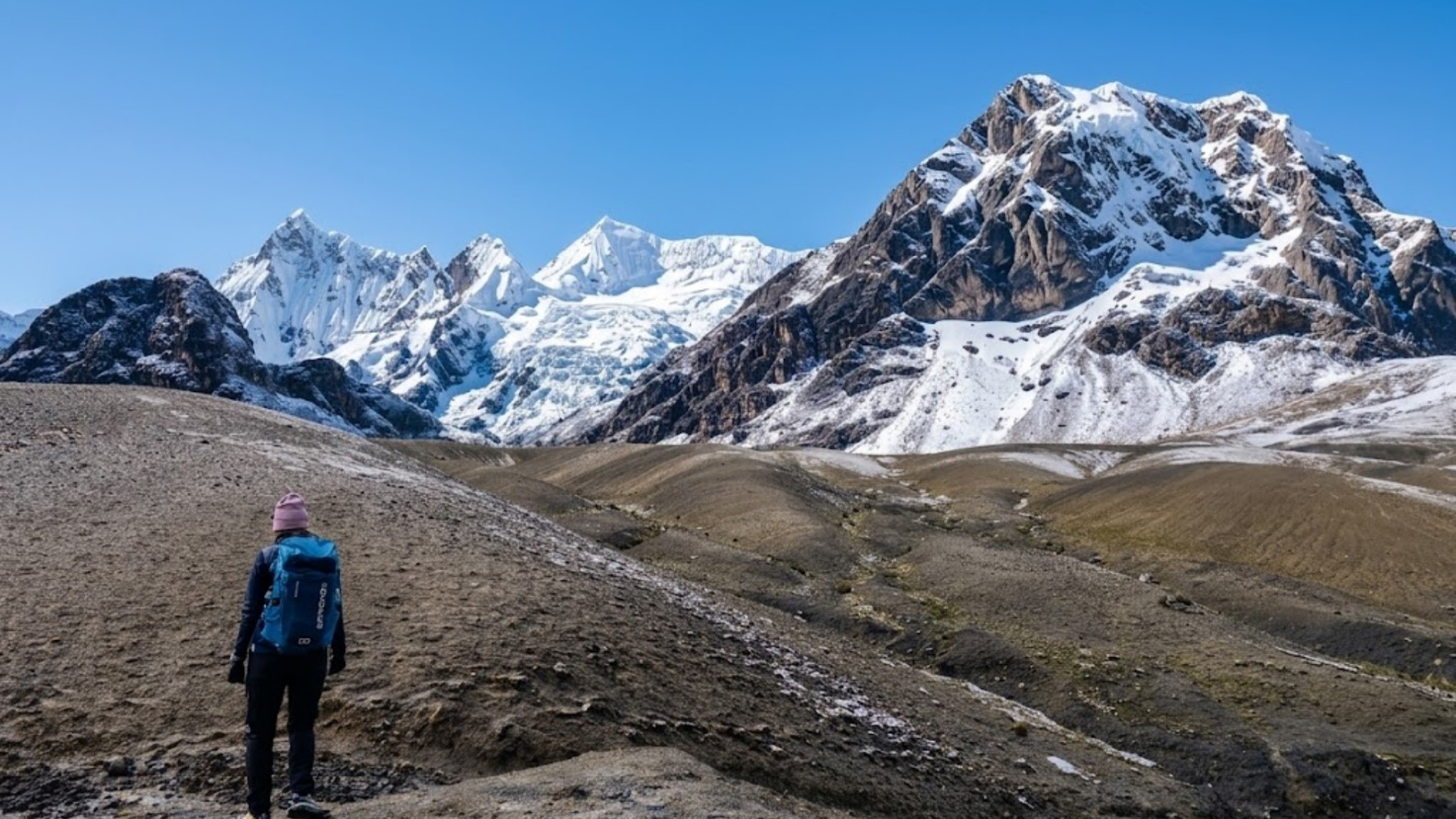
Ausangate is a glaciated peak of about 6,384 m (20,945 ft), the highest in the Cusco region and a sacred apu (mountain spirit) for Quechua communities. The treks described here do not climb it. They follow high trails around its base, crossing passes close to 5,000 m, passing turquoise glacial lakes, and ending at Rainbow Mountain (Vinicunca) at about 5,036 m (16,522 ft).
Most of the route stays above 4,000 m, which is why all of these treks are physically demanding even though the terrain is not technical. If you only want a one-day taste of the area, the Ausangate 7 Lakes day hike tops out lower, at about 4,850 m, with far fewer people. For background on the mountain itself, see our general Ausangate trekking guide.
Ausangate Treks at a Glance
Distances below are the sums of the day-by-day figures. Prices are the “from” rates per person for small groups, listed at the time of writing, and private departures cost more for small parties.
| 2-Day Trek | 4-Day Llama Trek | 4-Day to Machu Picchu | 5-Day to Machu Picchu | |
|---|---|---|---|---|
| Ends at | Cusco | Cusco | Machu Picchu, then Cusco | Machu Picchu, then Cusco |
| Hiking distance | About 21 km | About 38 km | About 34 km | About 38 km |
| Nights | 1 camp | 3 camps | 2 camps, 1 hotel | 3 camps, 1 hotel |
| Reach Rainbow Mountain | Day 2 | Day 4 | Day 1 | Day 4 |
| Highest point | 5,036 m | 5,036 m | 5,036 m | 5,036 m |
| Gear carried by | Horses | Llamas | Horses | Llamas and horses |
| Max group size | 8 | 8 | 12 | 12 |
| Our difficulty rating | Moderate to challenging | Challenging | Challenging | Challenging |
| From price | $260 | $480 | $720 | $730 |
Ausangate Trek 2 Days: The Short Option
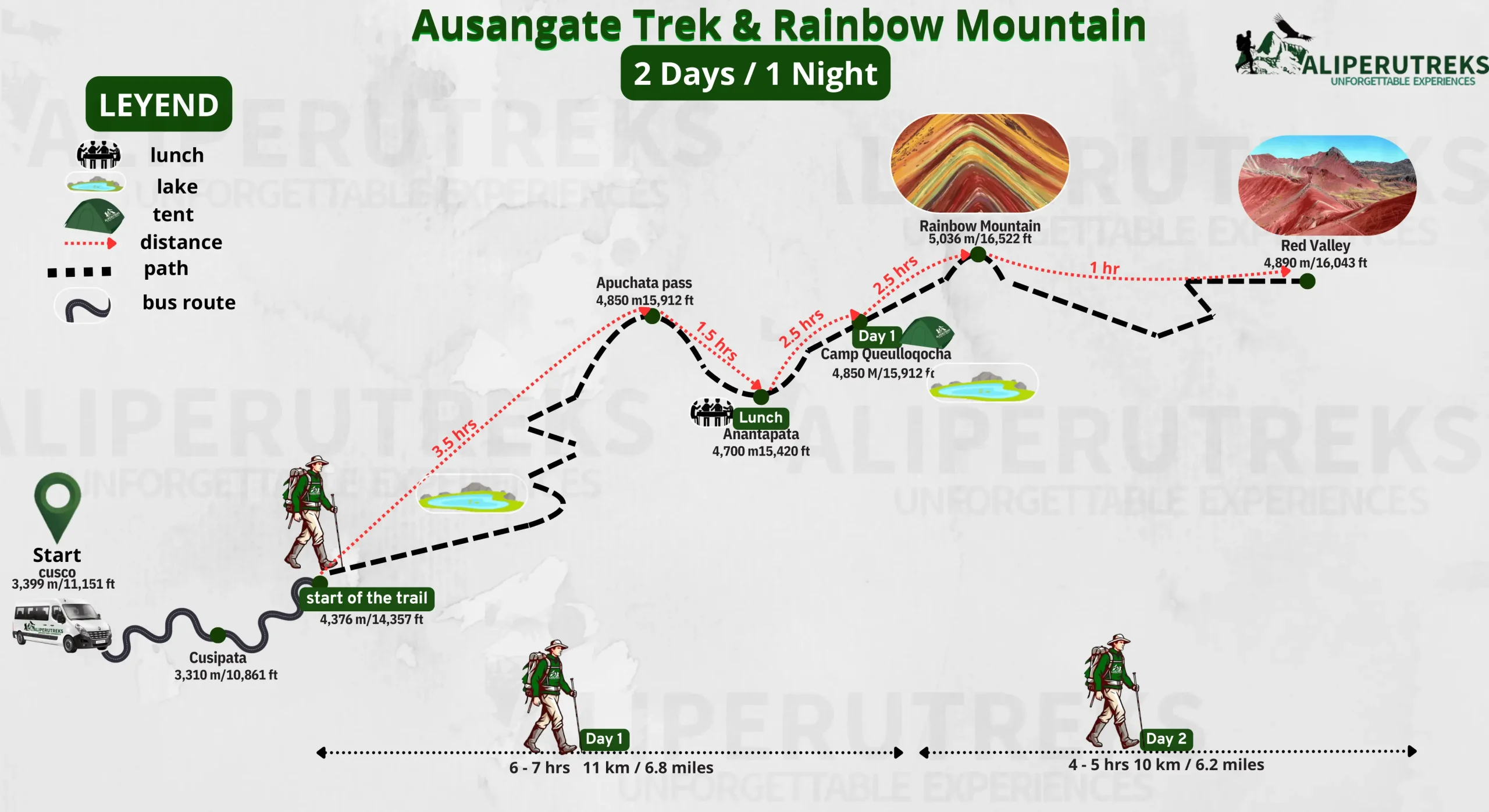
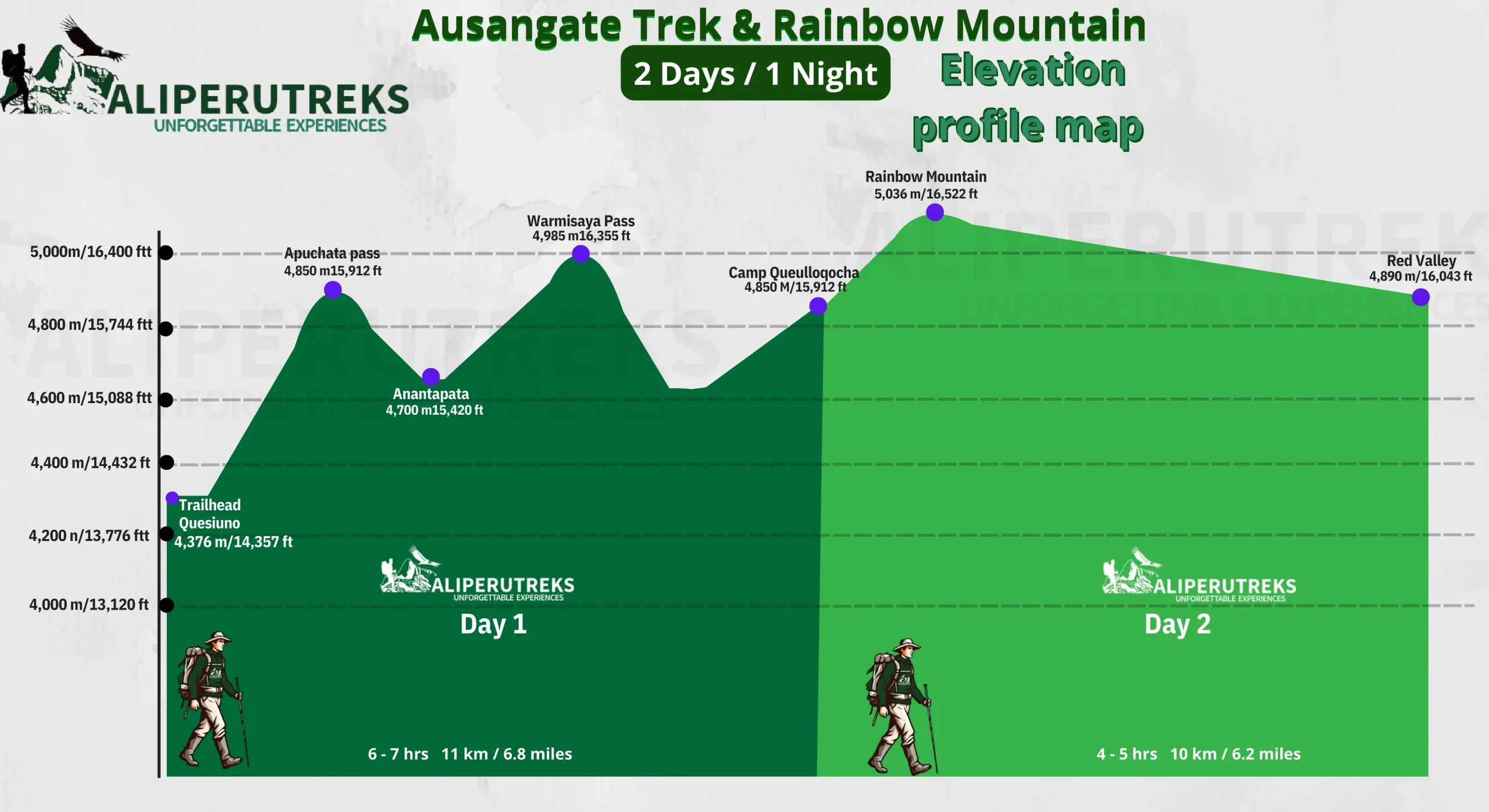
The 2-day Ausangate trek starts with a drive of about 3.5 hours to the Quesiuno trailhead (4,376 m). Day 1 is roughly 11 km over Warmisaya Pass (about 4,985 m) to a camp at Surineqocha Lake (about 4,800 m). On Day 2 you reach Rainbow Mountain early, walk down through the Red Valley, and are back at your Cusco hotel around 5:30 PM.
Pros: It is the cheapest and shortest option, and because you sleep close to the summit you reach Rainbow Mountain before most day-tour groups arrive.
Cons: You spend your only night at about 4,800 m, the highest camp of any of these treks, after a 4:00 AM start from Cusco. There is no Machu Picchu component. And if Rainbow Mountain is all you want, the Rainbow Mountain and Red Valley day tour costs less and involves a 3 to 4 hour hike, though with larger crowds. Our Rainbow Mountain hiking guide explains what that day looks like.
Ausangate Llama Trek (4 Days): Full Route, Back to Cusco
The 4-day Ausangate and Rainbow Mountain llama trek follows the classic order. You start at Upis (about 4,400 m), cross Arapa Pass (about 4,850 m) on Day 2, and cross two passes on Day 3, ending at Warmisaya Pass (about 4,980 m). On Day 4 you start early to reach Rainbow Mountain, hike the Red Valley, and drive back to Cusco. A llama caravan led by local herders carries the camping gear and your duffel bag (up to 8 kg), and an emergency horse travels with the group.
Pros: It is the lowest-priced multi-day option, groups are capped at 8, and Rainbow Mountain comes last, after three days of adjusting to altitude.
Cons: Day 3 is the hardest, at 7 to 8 hours with two passes. The trek does not include Machu Picchu, so you would need to plan that separately. Travelers over 60 need a doctor’s letter, and the minimum age is 14.


Ausangate to Machu Picchu in 4 Days
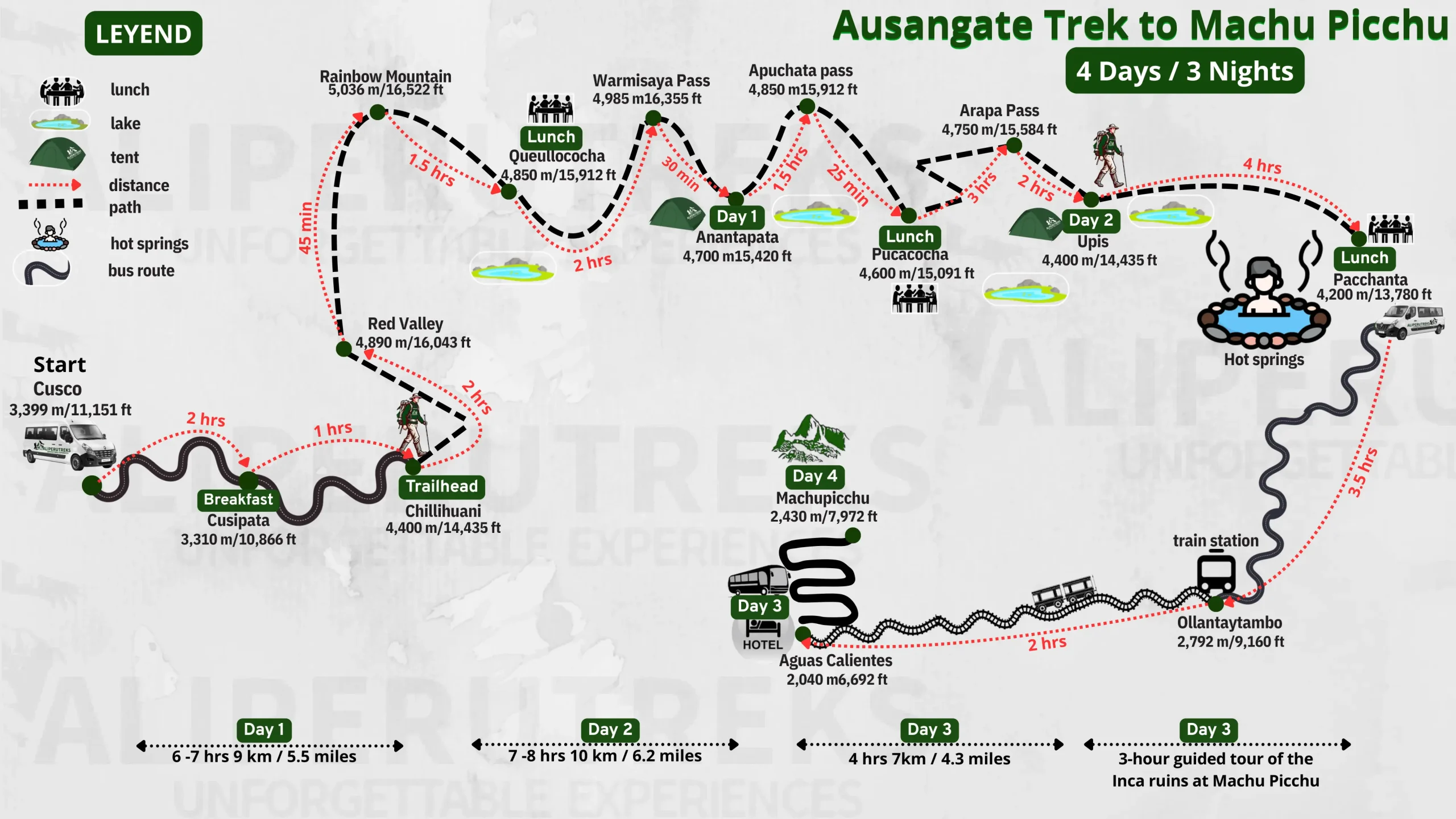
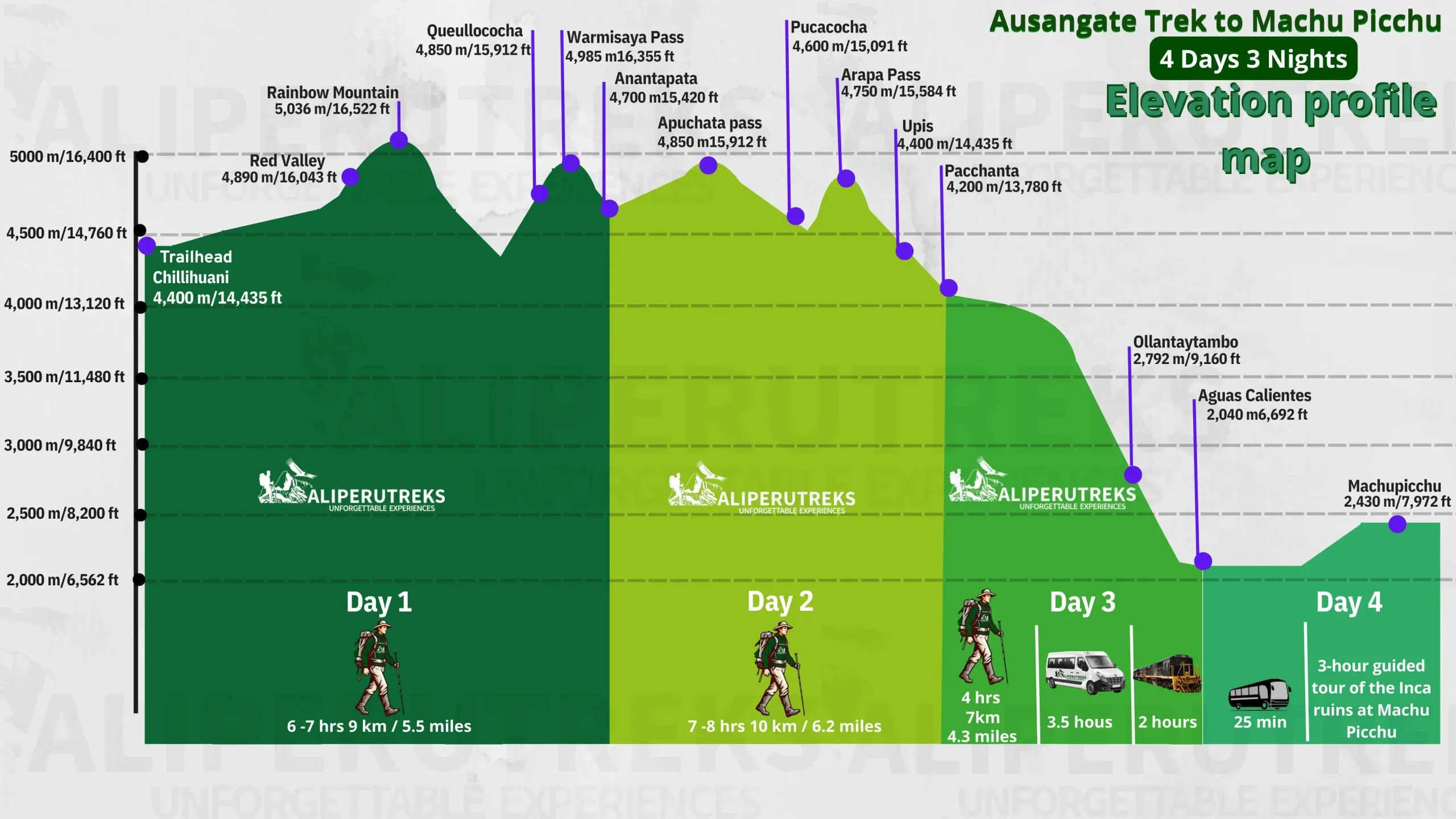
The 4-day Ausangate trek to Machu Picchu runs in a different order. Day 1 goes straight to Rainbow Mountain (5,036 m) and the Red Valley, then to a camp at Anantapata (about 4,750 m). Day 2 crosses Pucacocha Pass (about 4,900 m) and descends to Upis (about 4,400 m). On Day 3 you hike down to the Pacchanta hot springs, then take a transfer of about 4 hours to Ollantaytambo and a train to Aguas Calientes. Day 4 is a guided Circuit 2 tour of Machu Picchu, followed by the train and a private transfer to Cusco.
Pros: You finish at Machu Picchu in four days, and each camp is lower than the last. The price includes the Circuit 2 ticket, round-trip train tickets, and a night in a 3-star hotel.
Cons: You reach the highest point of the trek on Day 1, which is demanding if you are not well acclimatized. The hiking is shorter than on the 5-day route, and Day 3 is mostly logistics. Dinner on Day 3 and lunch on Day 4 are not included. We also suggest prior multi-day, high-altitude experience; first-timers often do better starting with the Salkantay Trek or the Lares Trek.
Ausangate to Machu Picchu in 5 Days
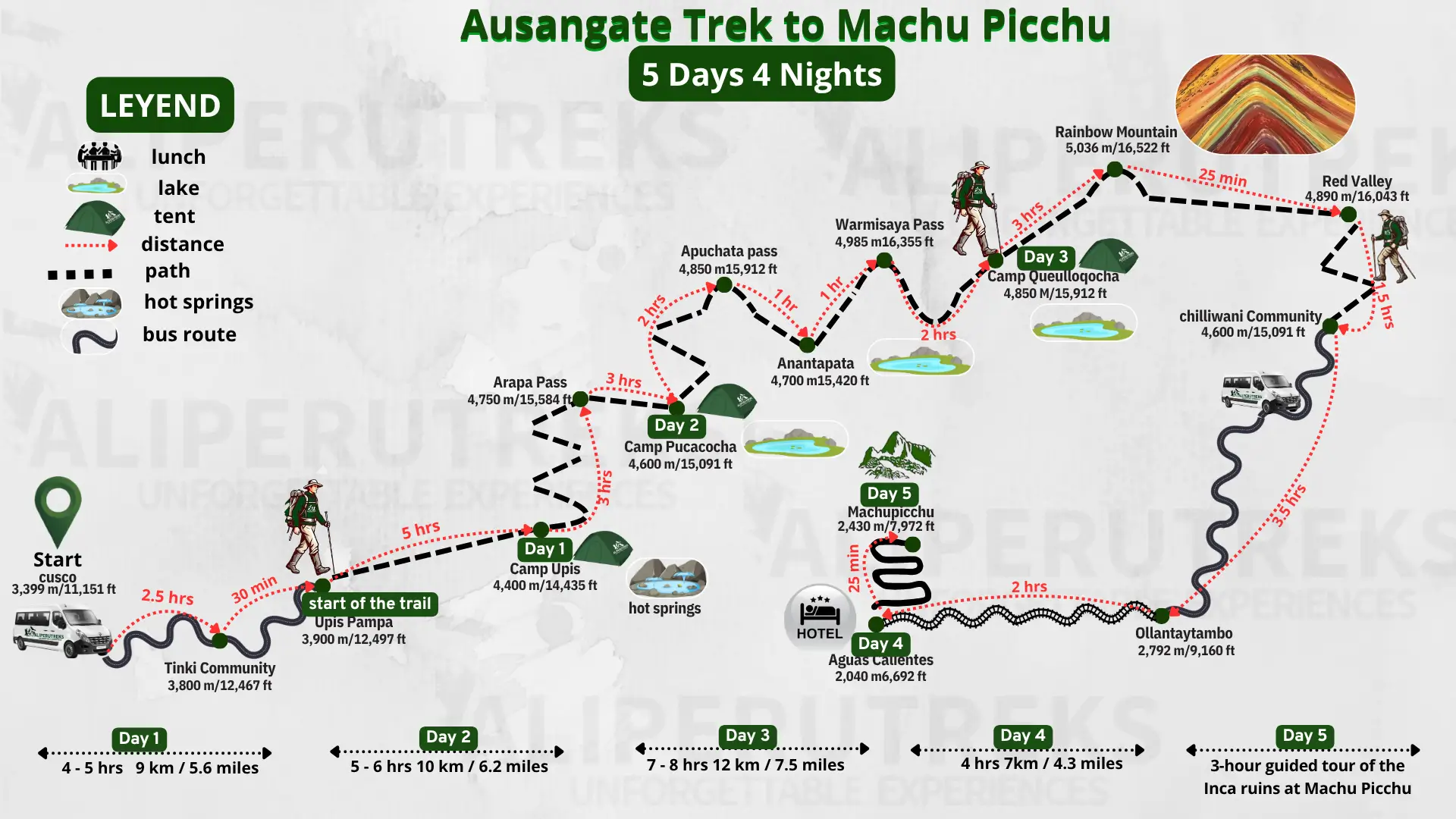
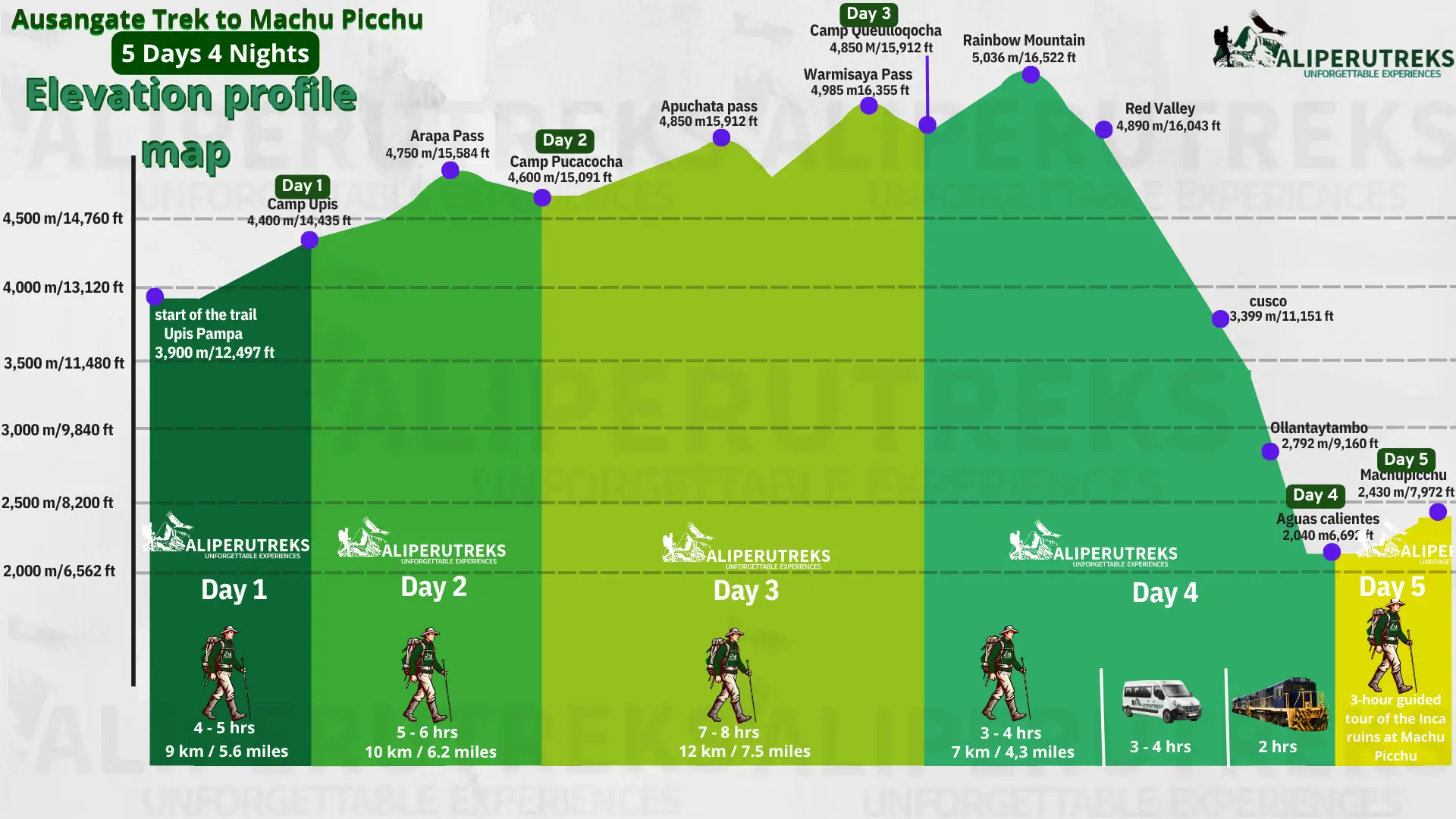
The 5-day Ausangate trek to Machu Picchu uses the same order as the llama trek, with Machu Picchu added at the end. Day 1 is a short hike to Upis (about 4,400 m). Day 2 crosses Arapa Pass (about 4,850 m), and Day 3 crosses Apuchata (about 4,900 m) and Warmisaya (about 4,980 m) before camping at Queulla Ccocha (about 4,850 m). On Day 4 you reach Rainbow Mountain around 6:30 AM, walk the Red Valley, then drive to Ollantaytambo and take the train to Aguas Calientes. Day 5 is Machu Picchu and the return to Cusco.
Pros: The altitude gain is gradual, and Rainbow Mountain comes after three nights in the mountains. The trek uses a llama caravan with horse support, and the price includes the Circuit 2 ticket, trains, and a hotel night.
Cons: Queulla Ccocha is a high camp at about 4,850 m, and Day 4 is long, combining an early summit with a drive and a train. Lunch on Day 5 is not included. Machu Picchu tickets can sell out in high season, so book early.
Llama Trek or Machu Picchu Finish?
On listed group prices, the 4-day llama trek ($480) is $240 cheaper than the 4-day Machu Picchu trek ($720). That difference reflects the Machu Picchu entrance, the train, the hotel night, and the bus tickets. By contrast, the 4-day and 5-day Machu Picchu treks differ by only $10 ($720 vs. $730), so choosing between them is about pace rather than budget.
A simple way to decide:
- Choose the llama trek if Machu Picchu is already on your itinerary through another route, or if you want the full Ausangate experience at the lowest cost.
- Choose the 4-day Machu Picchu trek if you have limited time, are acclimatized, and can handle reaching 5,036 m on Day 1.
- Choose the 5-day Machu Picchu trek if you want the slowest altitude build-up and a finish at the citadel.
Altitude and Fitness
Cusco sits at 3,399 m, and every Ausangate route climbs well above it. Our acclimatization guide recommends at least three full days in Cusco before a Rainbow Mountain route, and our altitude sickness guide covers symptoms and when to see a doctor. If you are considering medication such as Diamox, talk to your doctor before you travel.
Guides carry emergency oxygen and pulse oximeters on these treks. You should be comfortable hiking 6 to 8 hours on a hard day at altitude, and the 5-day route is the most forgiving for acclimatization.
Best Time to Trek Ausangate
The dry season runs roughly May through October. June and July have the clearest skies and the coldest nights; at the highest camps temperatures can fall to around -10°C (14°F). April and October are shoulder months, and November through March is rainy, with a higher chance of snow above about 4,800 m. We advise against January and February for a first multi-day trek. Our Ausangate weather guide has a month-by-month breakdown.
Sleeping bags are not included on these treks, but you can rent one for $20, and trekking poles for $15 a pair. Our trekking equipment checklist lists what else to bring, and the Ausangate to Rainbow Mountain packing guide covers the llama trek in more detail.
Which Ausangate Trek Fits You?
| Your situation | Best fit |
|---|---|
| Two days free, want Rainbow Mountain without day-tour crowds | 2-day trek |
| Want the full route at the lowest price, Machu Picchu planned separately | 4-day llama trek |
| Want Machu Picchu in four days and are already acclimatized | 4-day Machu Picchu trek |
| Want Machu Picchu and the gentlest altitude progression | 5-day Machu Picchu trek |
| Only want to see Rainbow Mountain | Rainbow Mountain day tour |
Frequently Asked Questions
We rate the llama trek and both Machu Picchu versions as challenging. The terrain is not technical, but you hike above 4,000 m for most of the route, with passes between about 4,850 m and 4,980 m. The 2-day trek is rated moderate to challenging.
Listed group prices start at $260 for the 2-day trek, $480 for the 4-day llama trek, $720 for the 4-day Machu Picchu trek, and $730 for the 5-day Machu Picchu trek. Private departures cost more for small groups, so confirm current rates before booking.
The 4-day and 5-day Ausangate treks to Machu Picchu. The 2-day trek and the 4-day llama trek both return to Cusco.
May through October is the dry season, with June to August the most stable. April and October can work well, but expect more weather variation.
Yes, on the 4-day llama trek, where a llama caravan carries camping equipment and a duffel bag of up to 8 kg. The 5-day trek uses llamas with horse support, while the 2-day and 4-day Machu Picchu treks use horses.