

There is no official or verified count of the steps on the Inca Trail. Numbers online range from “over 2,000” for the climb to Dead Woman’s Pass to totals in the tens of thousands, and none we found cite a counting method. What can be verified is where the stairs are and how much elevation you climb and descend: roughly 915 m up to Dead Woman’s Pass on Day 2 and a descent of about 1,030 m on Day 3, much of it on original Inca stonework.
This guide separates what’s documented from what’s repeated without a source, shows where the hardest stairs are, and explains how to handle them.
So, How Many Steps Is It Really?
Short answer: nobody has published a counting method you can rely on. Here’s what we found when checking sources:
| Claim you may see | What we could verify |
|---|---|
| “Over 2,000 steps” to Dead Woman’s Pass | One trekking blog gives this as a rough estimate based on an assumed half-meter per step, not a count. |
| A total of tens of thousands of steps | One site states a five-figure total but says it is unverified and cites no source; we could not trace it |
| “3,000 steps” on a single section | Repeated informally; we found no source that explains how it was counted. |
| Exact numbers per day | None were found in the operator and guide pages we checked. |
The reason is practical: the trail mixes long stone staircases, uneven paving, dirt paths, and gentle ramps; steps are irregular in height and spacing; and routes vary slightly. Instead of a step number, elevation gain and descent are a more honest measure of effort.
Elevation Gain and Descent: The Numbers You Can Rely On
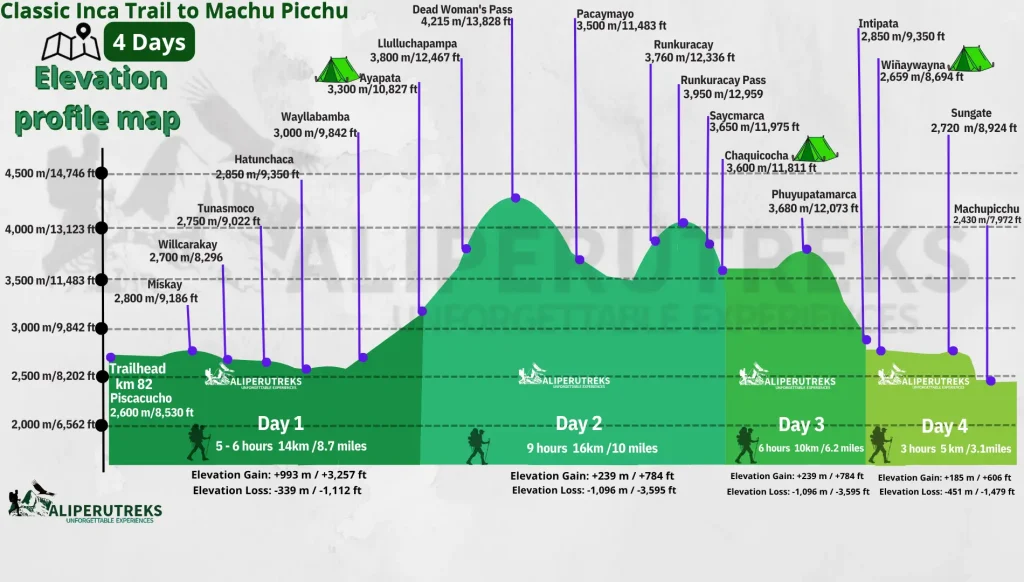
These figures come from our 4-day Classic Inca Trail itinerary:
| Day | Route | Distance | Key altitude data |
|---|---|---|---|
| 1 | Km 82 to Ayapata | About 12 km | Starts at 2,720 m; camp at 3,300 m (gain of 580 m) |
| 2 | Ayapata to Chaquicocha | 15 km | Gain of 915 m to Dead Woman’s Pass (4,215 m); Runkurakay Pass at 4,000 m; camp at 3,600 m |
| 3 | Chaquicocha to Wiñay Wayna | 10 km | Phuyupatamarca at 3,680 m; descent of 1,030 m to 2,650 m |
| 4 | Wiñay Wayna to Sun Gate to Machu Picchu | 6 km | Sun Gate at 2,730 m; Machu Picchu at 2,430 m |
For more detail on the climbing, see our Inca Trail elevation gain guide.
Where the Stairs Are, Day by Day
Day 1: the easiest day. It’s the shortest climb (580 m over about 12 km). We found no source describing major staircases on this section, so expect the stone steps to become a bigger part of the trek from Day 2.
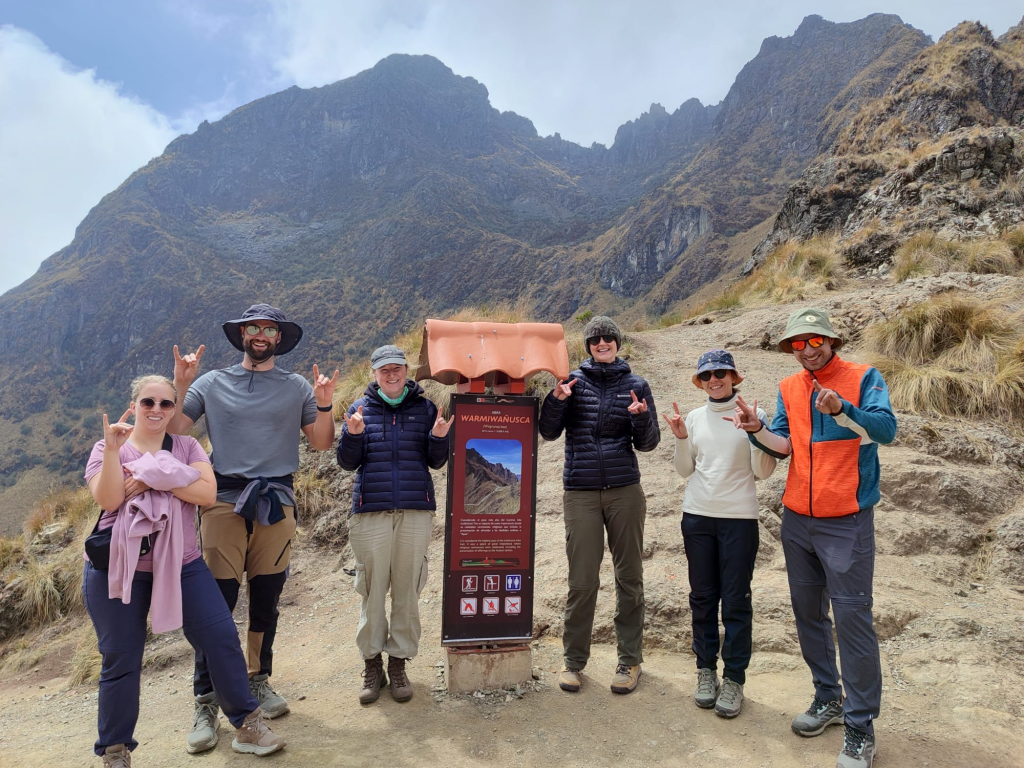
Day 2: the long climb. The ascent to Dead Woman’s Pass at 4,215 m is the hardest stretch. It includes stone steps, and above 3,800 m the effort comes as much from the thin air as from the steps themselves. After the pass, there’s a steep descent to the next valley and a second climb to Runkurakay Pass at 4,000 m. See our Dead Woman’s Pass guide for the full day.
Day 3: the knee-testing descent. After Phuyupatamarca (3,680 m), the trail drops 1,030 m, much of it down steep stone staircases toward Wiñay Wayna, passing an Inca tunnel and the Intipata terraces. One trekking operator notes that this descent, rather than the climb, causes more minor injuries.
Day 4: one last staircase. According to one operator’s description, about an hour past Wiñay Wayna, just before the Sun Gate, comes a short but very steep staircase that many trekkers climb using their hands.
The “Gringo Killer” Stairs
“Gringo Killer” is the nickname for the steepest stone staircases. One operator describes six sections along the trail, including steep, narrow stairs at Sayacmarca, a descent from Phuyupatamarca, a pair of steps cut from one solid rock about 500 m past it (slippery when wet), the Intipata descent toward the Wiñay Wayna campsite, and the final staircase before the Sun Gate. That list counts sections, not steps, and other guides name different spots, so treat the nickname as a general warning rather than a single location.
How to Judge the Effort Without a Step Count
If you want a number to train against, use vertical gain and descent, not steps. The two big blocks are the 915 m climb to Dead Woman’s Pass on Day 2 and the 1,030 m descent on Day 3. A practical way to prepare is to find a long staircase or steep hill near home and practice a few hundred meters of climbing in one session, then the same amount of downhill, since descending works different muscles. Ask your operator which days they consider the most demanding, and compare that with the Inca Trail itinerary before you book.
Why the Stairs Are Hard
- Altitude. At 4,000 m, each step takes more effort than at sea level. Our altitude sickness guide explains acclimatization.
- Irregular steps. Original Inca stones vary in height and spacing, so you can’t settle into a rhythm.
- Wet stone. Steps become slippery in rain; see Inca Trail weather.
- Descending. Going down repeatedly loads knees and quads.
How to Handle the Stairs
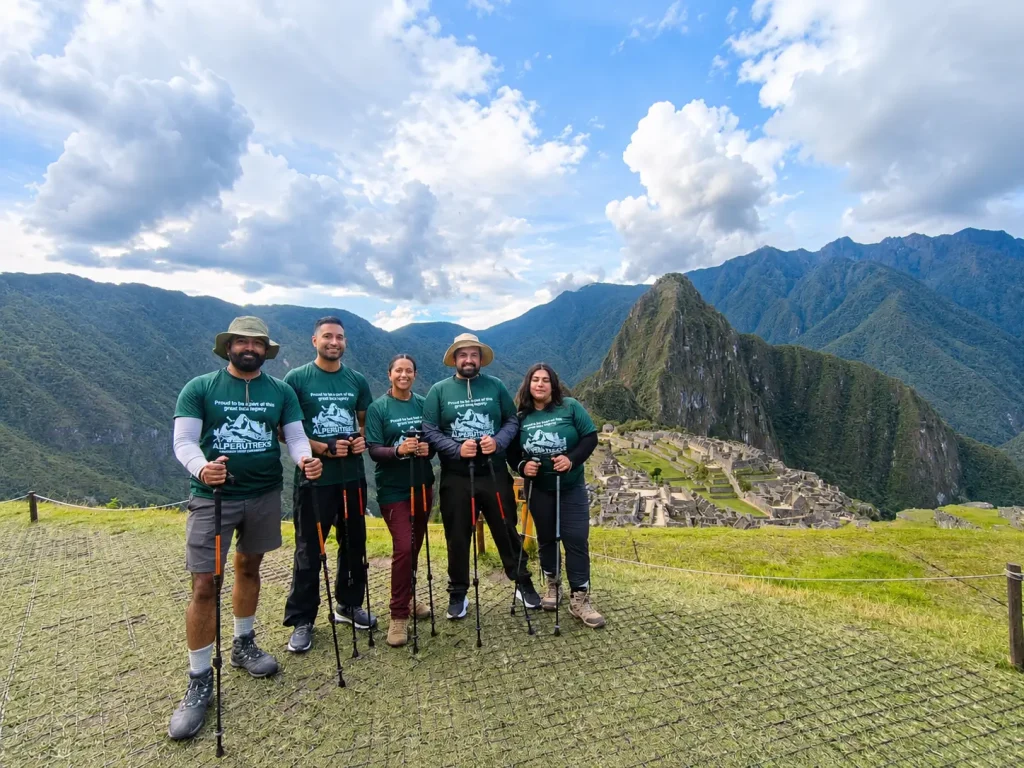
- Use trekking poles with rubber tips. Bare metal tips are not allowed because they damage the ancient paving. Poles ease the load on knees on descents.
- Pace yourself. Take short, steady steps rather than long strides on the way up.
- Wear broken-in boots with traction. Wet stone is slippery.
- Train with stairs. Stair-climbing and downhill walking before your trip prepare the muscles you’ll use most.
- Pack light. Keep your daypack manageable and stay within the duffel allowance; our Inca Trail packing list explains how.
- Rent poles if you don’t own them. We offer them for $15 per pair, and sleeping bags for $20.
Is There a Route with Fewer Steps?
The Short Inca Trail covers only the final stretch to the Sun Gate, so it has far less climbing than the 4-day version, though check the day-by-day detail with your operator, since some stone stairs near the Sun Gate are part of the finish. For context on who built the road, see our Inca Trail history guide.
FAQ: Steps on the Inca Trail
There’s no verified official count. Online figures range from “over 2,000” for the climb to Dead Woman’s Pass to much larger totals, but none cite a counting method.
Day 2 has the long climb to Dead Woman’s Pass, while Day 3 has a steep staircase descent toward Wiñay Wayna. Many hikers find the Day 3 descent harder on the knees.
It’s a nickname for the steepest stone staircases on the trail, with the best known near the Sun Gate and on the descent to Wiñay Wayna.
Yes, but only with rubber tips, because metal tips damage the stone paving.
The descents can be, especially Day 3. Poles, broken-in boots, and a steady pace help.