Home » Blog » Machu Picchu Day Trip vs Overnight in Aguas Calientes: Which Is Better?
Machu Picchu Day Trip vs Overnight in Aguas Calientes: Which Is Better?
Ali Peru Treks
9 min read
Nov 20, 2026
4 views
Most first-time visitors end up choosing between two plans. You can leave Cusco before dawn, see Machu Picchu and be back in your hotel the same night. Or you can sleep in Aguas Calientes (the town at the foot of the citadel) and visit the next morning. Neither plan is better in every case. The right one depends on your budget, your tolerance for long days, the season and how much time you want inside the site.
Choose the day trip if you are on a tight schedule or budget, you are comfortable with a very early start, and you want the simplest logistics. Choose the overnight if you want a less rushed visit, an earlier entry slot without a 3:30 AM alarm, and time to rest between the train and the citadel.
Day trip
Overnight in Aguas Calientes
Total time away from Cusco
About 13–14 hours
About 2 days
Typical entry slot
Set by train timetable
Often an early morning slot
Time at Machu Picchu
Guided visit of 2.5–3 hours
Guided visit of about 2 hours, plus free time if your ticket allows
Hotel needed
No
Yes, one night
Typical cost
$250–450
$400–650
Main strength
Cheaper, one day
Calmer pace, flexible morning
Main weakness
Long, tiring day
Higher cost, extra day
How a Day Trip Works
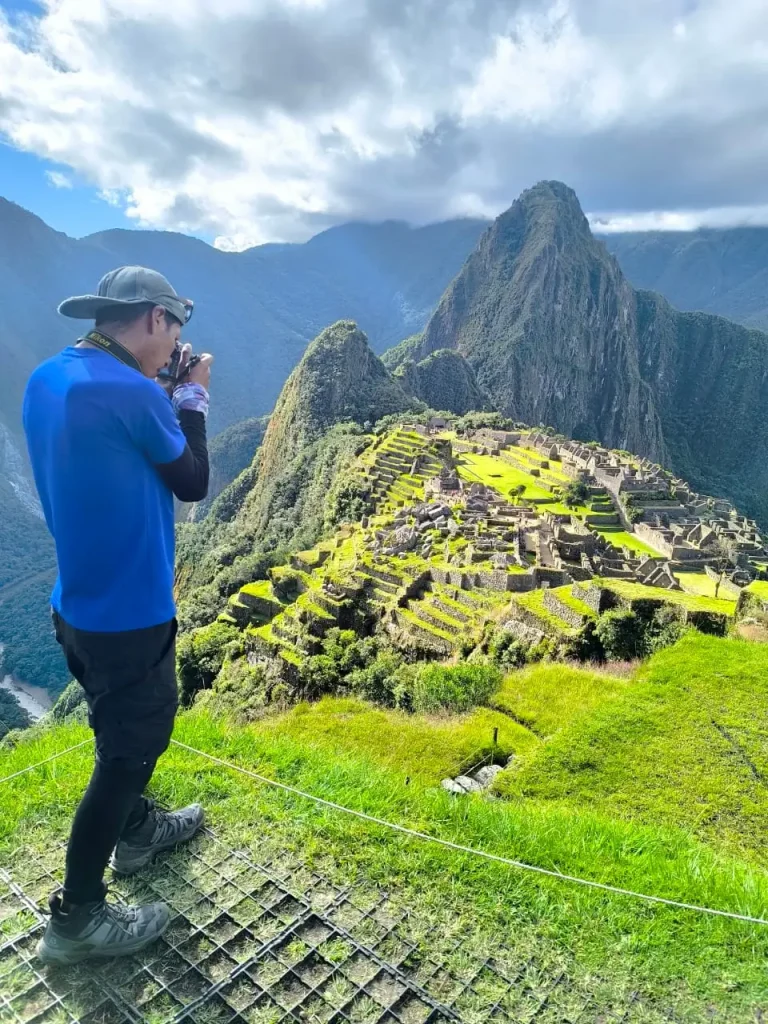
A day trip is a single long loop from Cusco. A typicalMachu Picchu full-day tour from Cusco runs about 13–14 hours door to door. You are picked up very early, usually between 3:30 and 5:00 AM. Transfer to the train station in Ollantaytambo takes you through the Sacred Valley. The train to Aguas Calientes takes roughly 1 hour 20 minutes to 1 hour 50 minutes depending on the service. Then a shuttle bus climbs to the entrance in about 25 minutes. Your guide takes you through the citadel for 2.5 to 3 hours, and you return the same way.
On our shared full-day tour, the price is $290 per person for groups of up to 8. It uses the Expedition or Voyager train and the Consettur bus. Meals and hotel are not included. Private departures cost $420, $390, $360 or $290 per person depending on group size.
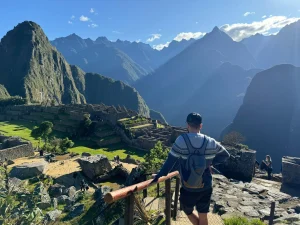
Machu Picchu Day TripMachu Picchu dry season
Pros of the day trip
Lowest total cost. There is no hotel night, and you skip a second day of transport.
Only one day. If you have a short itinerary, this saves a whole day for something else.
Simple logistics. One pickup, one return, and the guide handles the timing.
Fewer things to manage. You carry only a daypack.
Cons of the day trip
Very long day. More than half of it is spent in vehicles and on the train.
Altitude and fatigue. Cusco sits at about 3,400 m. Machu Picchu is lower, at about 2,430 m, which most people find easier, but a 13–14 hour day still wears you out. Our guides on altitude sickness in Cusco explain how to prepare.
Little flexibility. You depend on fixed train times. If the weather turns, there is no second chance.
Timing pressure. Most day-trippers take the bus down well before their evening train, so you cannot linger.
How an Overnight Works
An overnight splits the experience in two. Day 1 usually covers the Sacred Valley and the train to Aguas Calientes. You sleep in town, then visit Machu Picchu the next morning and return to Cusco in the afternoon or evening.
Our 2-day Sacred Valley and Machu Picchu tour follows this pattern. It costs $490 per person in a group (private departures run $650, $600, $550 or $490). Pickup is at 7:30 AM, you stay at Hatun Inti Classic or a similar hotel with breakfast, and Circuit 2 is guaranteed. The guided tour lasts about 2 hours, and you are back in Cusco at around 7:30 PM on day 2.
Compare that with a day trip: the pickup is about three to four hours later, and you see the Sacred Valley in daylight instead of in the dark.
Pros of the overnight
A much gentler start. You are not leaving at 3:30 AM.
Better chance of an early entry. The gate opens at 6:00 AM, and the first shuttle leaves Aguas Calientes at 5:30 AM. Sleeping in town puts you at the front of that line instead of arriving by train.
More buffer for weather. One night in town lets you watch the morning and adjust your plan.
Time to rest. You can eat dinner, sleep at lower altitude than Cusco and arrive fresher.
Cons of the overnight
Higher cost. Our cost guide shows a day trip at $250–450 and a 2-day option at $400–650. Hotels in Aguas Calientes also run about 15–20% above comparable Cusco prices. See how much it costs to visit Machu Picchu for a full breakdown.
An extra day. If you only have a few days in Peru, this matters.
Aguas Calientes is a tourist town. It is functional rather than charming, and restaurants are priced for captive customers.
Early queues anyway. In peak season, bus lines at Aguas Calientes can start around 4:30 AM.
The Sunrise Question
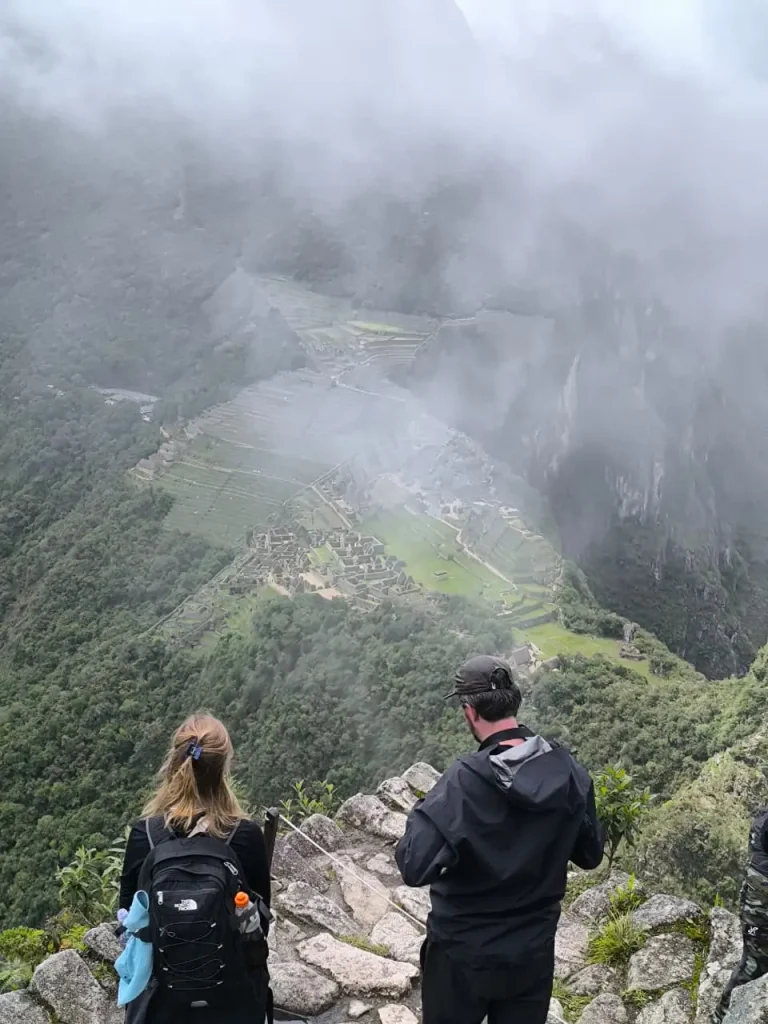
Many travelers choose the overnight to “see the sunrise.” Be realistic about this. Machu Picchu sits in cloud forest without a clean horizon, so the sun brightens the sky gradually instead of rising dramatically over a ridge. In the wet season (November to April), the citadel is often obscured until mid-morning. We cover this in more detail in our post on why you should not chase the Machu Picchu sunrise.
What an early slot does give you is cooler air, softer light and a quieter site before the main crowds arrive. That is a real benefit, but it is not the same as a guaranteed sunrise.
Tickets, Circuits and Time Limits
Whichever plan you choose, the same ticket rules apply. Machu Picchu uses a circuit system with set routes, and each circuit has a maximum visit time. Most standard circuits allow roughly 2.5 to 4 hours. Re-entry is not allowed once you leave, so you cannot step out and return on the same ticket.
This changes how you should think about the two options:
Day trip: your entry time follows your train. You have little control over the slot.
Overnight: you can usually target an earlier or later slot, because you are already in town.
Tickets for popular morning slots sell out months ahead in peak season (May to September). Read our guides on how to buy Machu Picchu tickets and the new Machu Picchu circuits before you pick a date. If you add a climb, a Huayna Picchu or Machu Picchu Mountain add-on is $80 on our full-day tour, and the two options are compared in a separate guide.
Huayna Picchu MountainSun gate route Machu Picchu
Who Should Choose Which
The day trip suits you if:
You have only one free day, or a short trip overall.
Your budget is limited.
You are acclimatized and in good health.
You are happy with a very early alarm.
The overnight suits you if:
You want a calmer pace and an earlier or more flexible entry time.
You are traveling with children or older relatives.
You prefer to photograph the site in morning light.
You can afford the extra day.
Consider a longer option if you want more time on the ground. A short Inca Trail of 2 days ends with an arrival through the Sun Gate and an overnight in Aguas Calientes. For a four-day plan that covers Cusco, the Sacred Valley and Machu Picchu together, see our 4-day Cusco and Machu Picchu tour.
Practical Tips for Either Plan
Book the train and entry first. Both sell out before hotels do in busy months.
Plan your return carefully. The last buses leave the site by about 5:30 PM, and visitors must exit by closing time. Build in a margin before your train.
Check the season. Dry months (May to September) give clearer views, but crowds are largest. Our guide to thebest time to visit Machu Picchu covers each month.
Acclimatize first. Spend at least a day or two in Cusco before a long Machu Picchu day. Our guide onhow to acclimatize in Cuscohas a simple plan.
Pack light. Large bags are not allowed inside the site, so leave luggage at your hotel.
Frequently Asked Questions
Is a Machu Picchu day trip worth it?
Yes, for many travelers. You see the full citadel with a guide and return to Cusco the same night. The tradeoff is a long, tiring day of 13–14 hours with fixed train times.
Is it worth staying overnight in Aguas Calientes?
It is worth it if you value a slower pace, an earlier entry and a buffer for bad weather. It costs more and takes an extra day, so it is less useful on a tight budget or schedule.
Can I see the sunrise at Machu Picchu?
Not reliably. The site has no clean horizon, and in the wet season it can be hidden by cloud until mid-morning. An early entry still gives you cooler air and fewer people, but you should not plan the trip around the sunrise itself.
How long can I stay inside Machu Picchu?
It depends on your circuit. Most standard routes allow roughly 2.5 to 4 hours. Re-entry is not permitted, so plan your time before you go in.
Which is cheaper, a day trip or an overnight?
The day trip is cheaper. Our current prices are $290 per person for a shared full-day tour and $490 per person for a shared 2-day tour. Costs for a self-planned trip vary with train class and hotel choice.
Final Thoughts
If your priority is cost and simplicity, the day trip works well and covers the whole citadel. If your priority is comfort, flexibility and a calmer morning, one night in Aguas Calientes is the better choice. Neither guarantees perfect weather, so choose the plan that fits your schedule and energy, then book tickets and trains as early as you can.
No, not automatically. We know of no official upper age limit for the Inca Trail, and the oldest reported finisher was 86. What decides whether the trek is realistic is your fitness, how your body handles 4,215 m (13,828 ft), the condition of your knees, and any heart or lung condition. The hardest stretches are…
The best weather for the Salkantay Trek falls between May and September, when the dry season brings clear skies, stable trails, and the clearest views of Nevado Salkantay — at the cost of freezing nights at high camp. April and October are solid shoulder-season picks, while November through March brings rain, mud, and occasional closures.…
For most trekkers, the 5-day Salkantay trek is the safest choice: it spreads the Salkantay Pass over a full day, adds a gentler first day, and costs $650. Pick the 4-day trek ($580) if you are fit, well acclimatized and short on time. Pick the 6-day ($900) or 7-day ($1,000) if you want to walk…
Choose Huayna Picchu if you are comfortable on narrow, exposed stone steps and want a shorter, steeper climb (roughly 2 to 3 hours round trip) that looks straight down on the ruins. Choose Machu Picchu Mountain if you want a longer, steadier climb (roughly 3 to 4 hours round trip), more height gain and a…
The Ancascocha Trek passes four main Inca sites on its way to Machu Picchu. Perolniyoc (also called Raqaypata) sits on a cliff above a waterfall at about 3,550 m, Rayan Pata is a ceremonial site at about 3,800 m, Paucarcancha guards the junction of two valleys at about 3,100 m, and Patallacta (also called Llactapata)…
Moray and the Maras Salt Mines are two neighboring sites on the high plateau above the Sacred Valley, about 50 km from Cusco, and most travelers visit them together in half a day. Moray is a set of circular Inca terraces, and Maras is a hillside of thousands of salt pans still worked by local…
Plan at least three days in Cusco if you want to see the city and visit Machu Picchu, and four to five days if you also want the Sacred Valley or a high-altitude hike like Rainbow Mountain. Three days is the practical minimum because Cusco sits at 3,399 m (11,152 ft), and your first day…
Yanama Pass, at about 4,660 m (15,290 ft), is the highest point on the trek from Choquequirao to Machu Picchu. It sits in the Vilcabamba range, between the village of Yanama (about 3,500 m) and the Totora valley, and crossing it is usually the longest day of the route: 8 to 10 hours, with a…
The Choquequirao cable car is a planned public-private project that would link the Inca site of Choquequirao with the Apurímac and Cusco sides of the canyon, cutting a journey that now takes about two days on foot to roughly 20 minutes. As of November 2026, it has not been built. The project is still in…
The Choquequirao trek starts at Capuliyoc (about 2,950 m), drops to the Apurímac River at Playa Rosalina (about 1,550 m), and climbs back up through Santa Rosa and Marampata to the ruins at about 3,050 m. That means a descent of roughly 1,400 m followed by a climb of about 1,500 m, each way. This…