
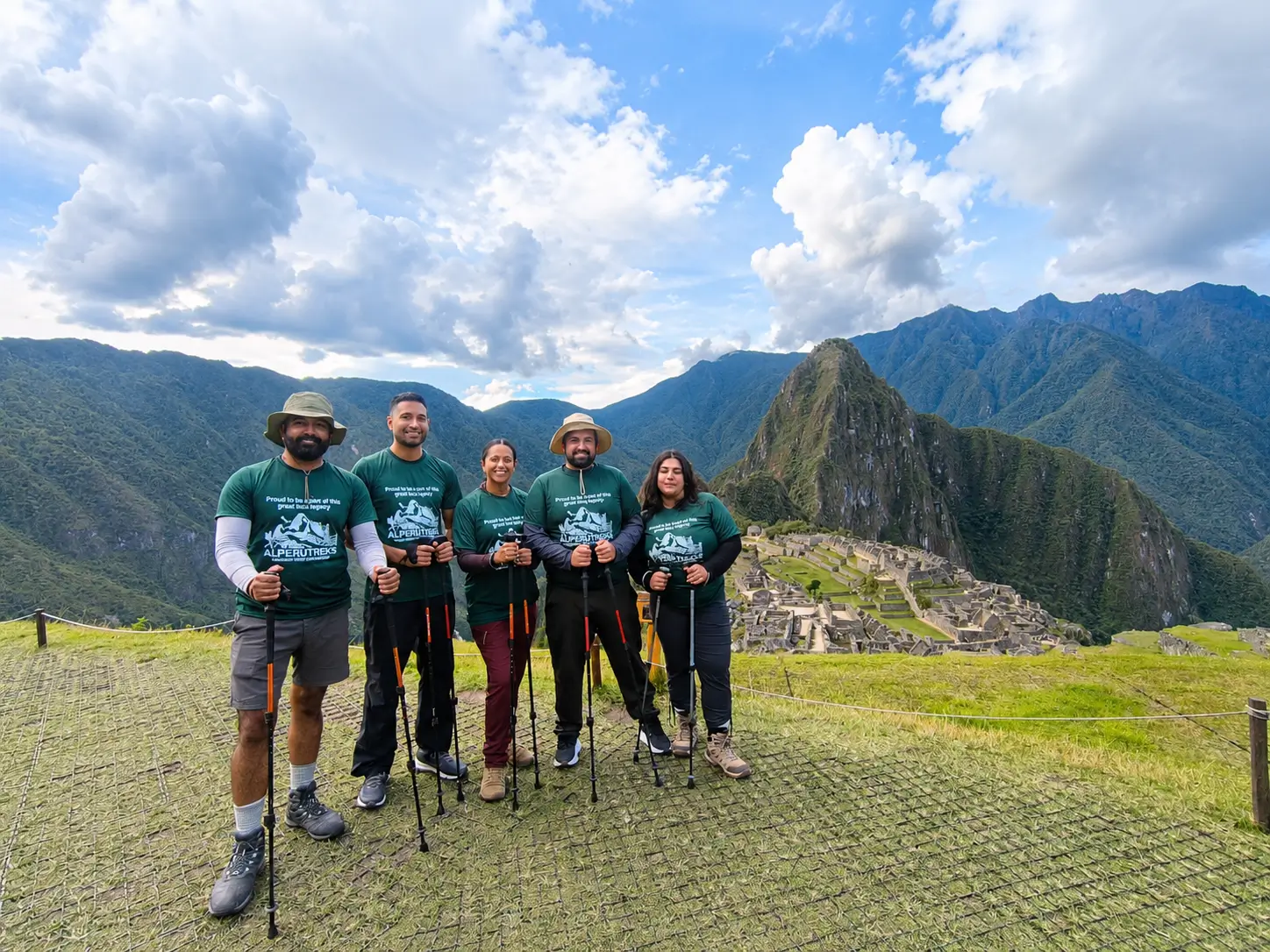

The Ancascocha Trek route runs from the community of Soqma in the Sacred Valley, climbs through two mountain passes above 4,500 m, passes the lake and village the trek is named after, and descends to join the final stretch toward Machu Picchu. The exact map and elevation profile differ depending on which itinerary you book — the standalone 4-day and 5-day versions follow a shorter path than the combined itineraries that link up with the Classic or Short Inca Trail. Below is the route breakdown for each version currently offered.
Regardless of which specific itinerary you choose, every Ancascocha Trek variant shares the same core geography:
| Waypoint | Approximate Elevation | Notes |
|---|---|---|
| Cusco (starting point) | 3,399 m (11,152 ft) | Where most trekkers acclimatize before departure |
| Soqma (trailhead) | 3,205 m (10,515 ft) | Trek begins here after a private transfer from Cusco |
| Perolniyoc Waterfall | 3,460 m (11,351 ft) | Early highlight on Day 1 of most itineraries |
| Kuychiccasa Pass | 4,500 m (14,764 ft) | First of the two major passes |
| Ancascocha (lake and village) | 3,700–3,900 m (12,140–12,795 ft) | The trek’s namesake landmark |
| Huayanay Pass | 4,650 m (15,255 ft) | The trek’s highest point |
| Paucarcancha | 3,120 m (10,236 ft) | Where the Ancascocha route meets the Classic Inca Trail corridor |
| Aguas Calientes | 2,000 m (6,560 ft) | Final overnight stop before Machu Picchu |
| Machu Picchu | 2,430 m (7,972 ft) | Final destination |
From here, the route and elevation profile diverge depending on the specific itinerary. Below is each one, in the order they’re offered.
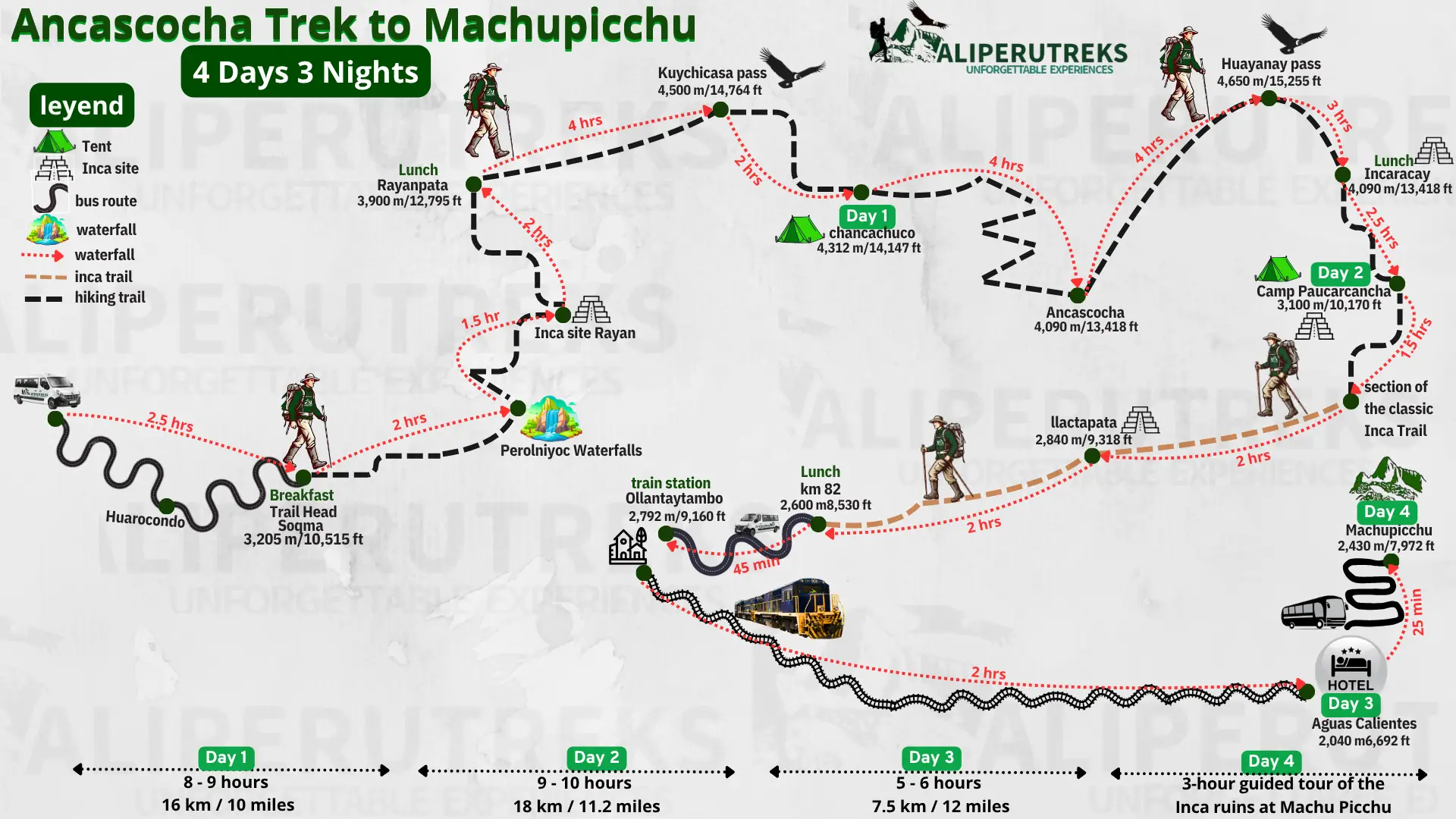
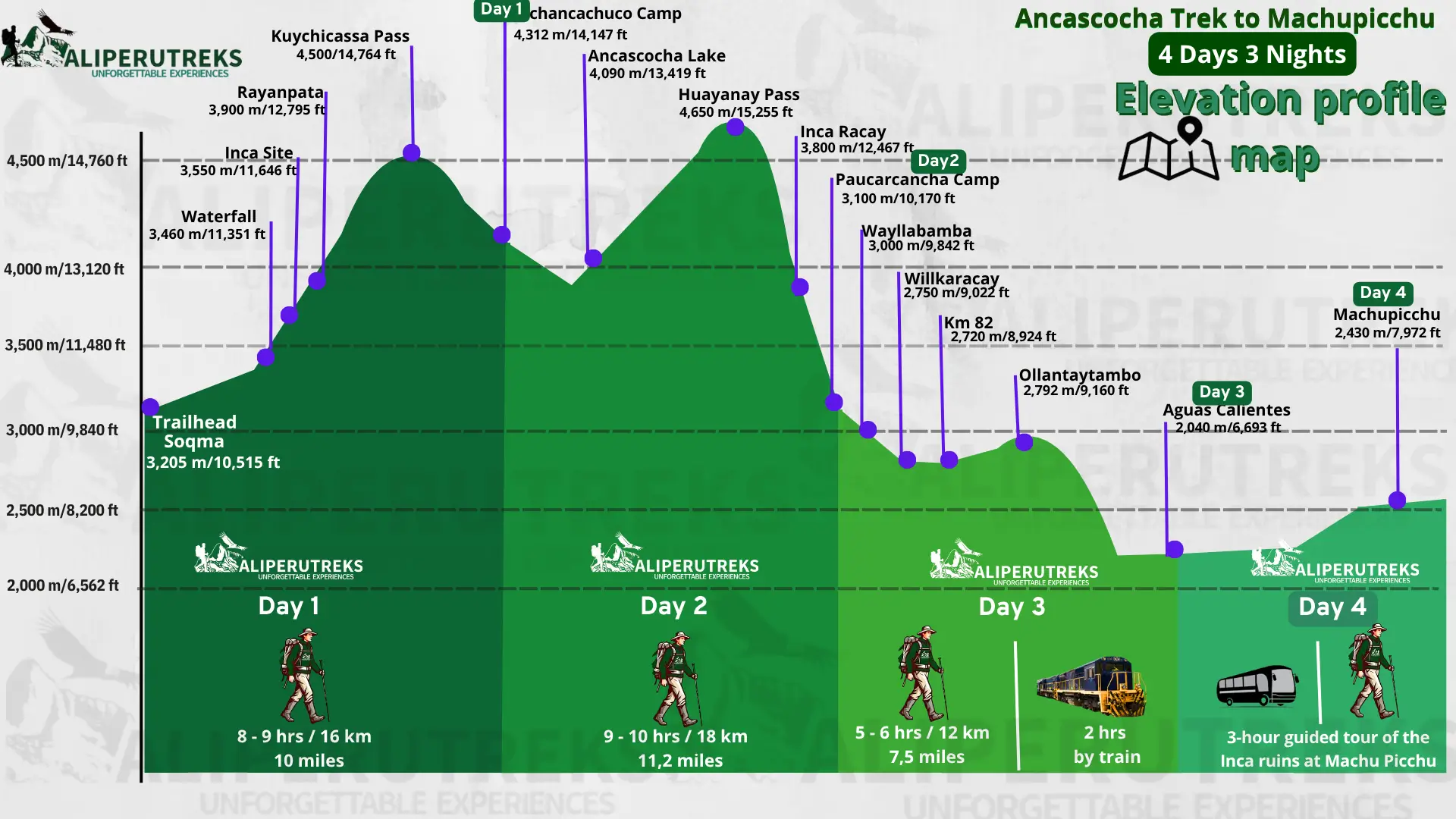
1. Ancascocha Trek – 4 Days / 3 Nights
The 4-day version compresses the full route into three hiking days, crossing both high passes within the first two days.
- Day 1: Cusco – Soqma – Perolniyoc – Kuychiccasa Pass (4,500 m) – Chancachuco Valley
- Day 2: Chancachuco – Ancascocha – Huayanay Pass (4,650 m) – Paucarcancha
- Day 3: Paucarcancha – Ollantaytambo – Aguas Calientes
- Day 4: Machu Picchu – return to Cusco
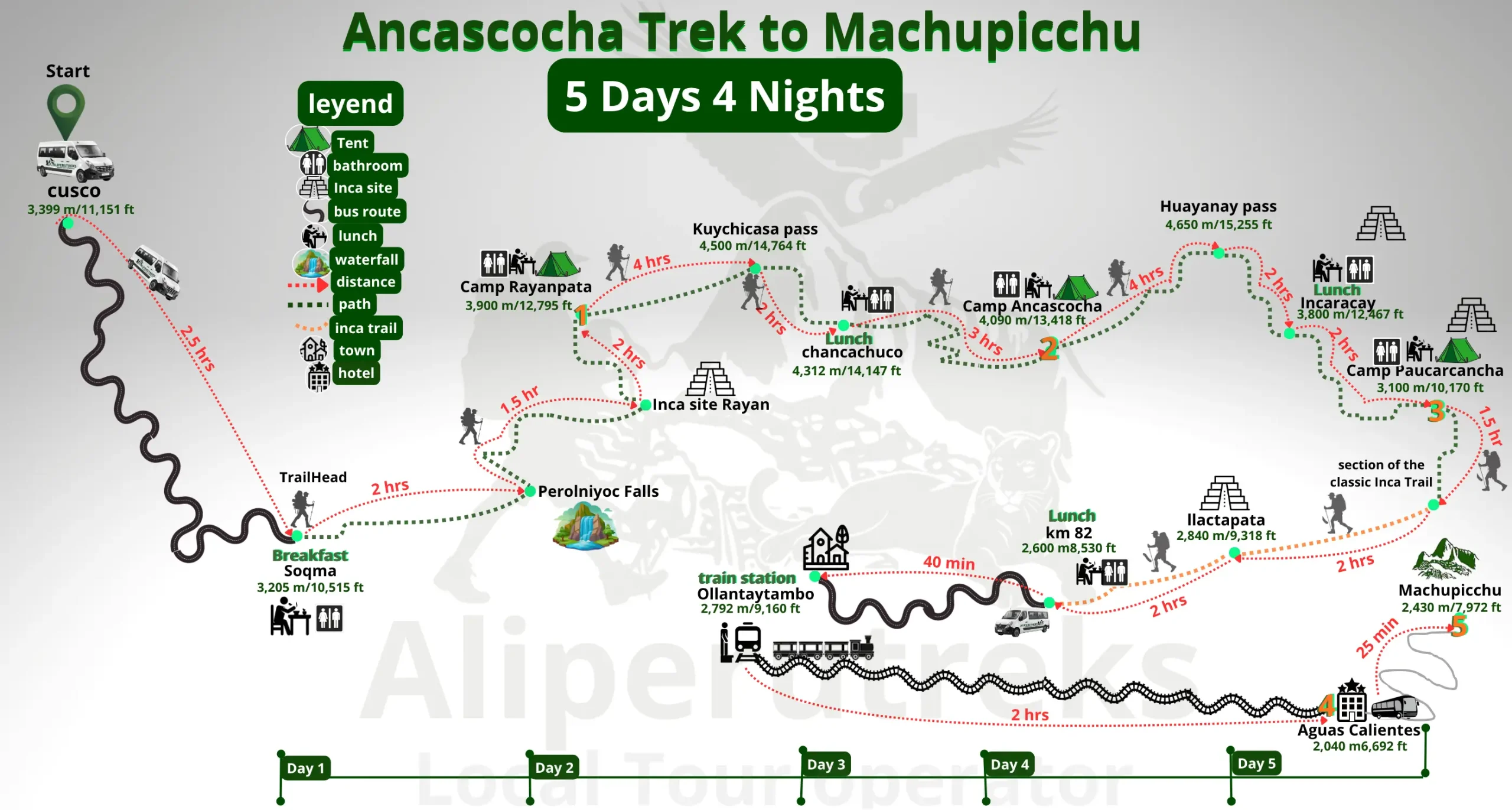
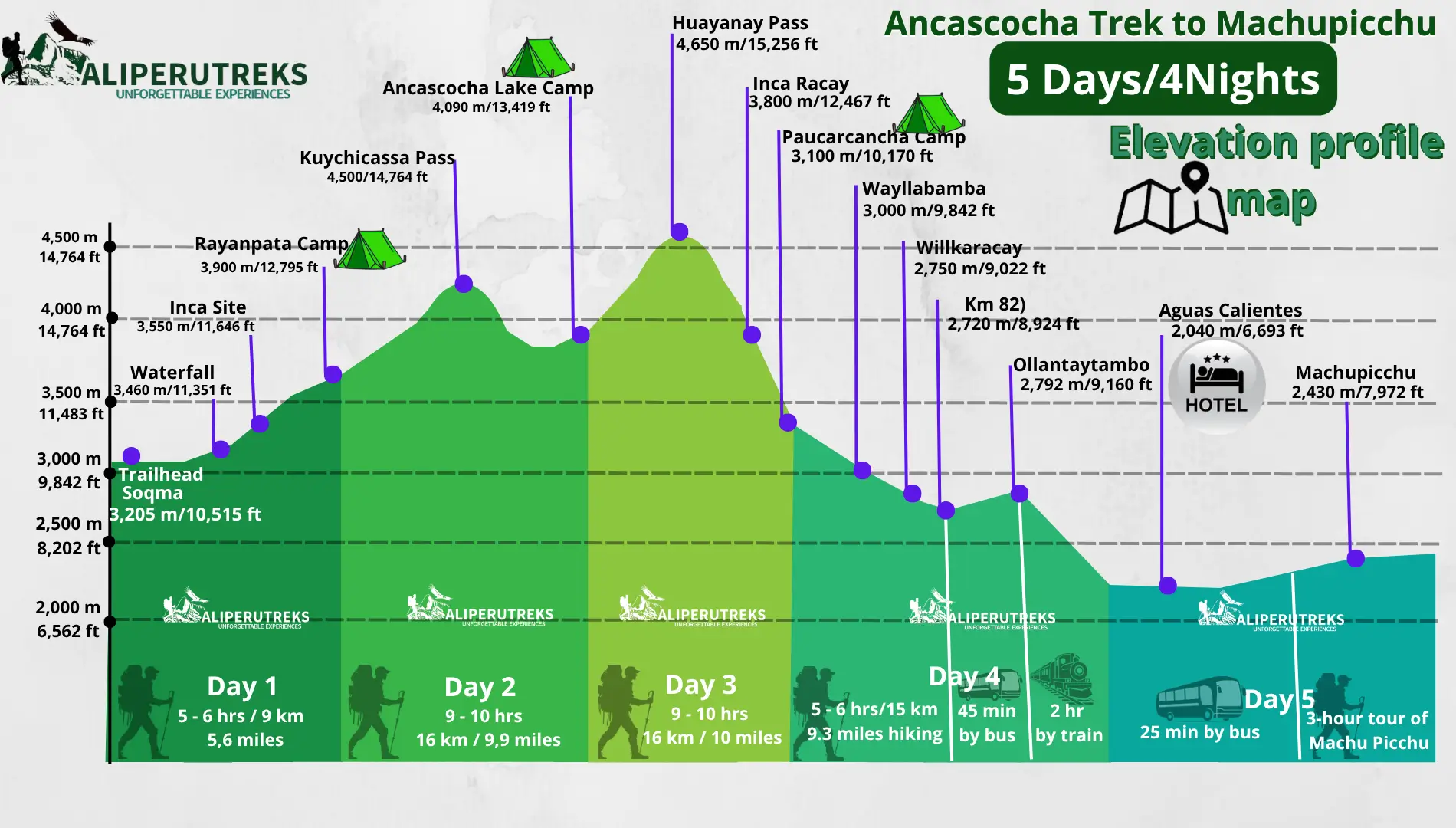
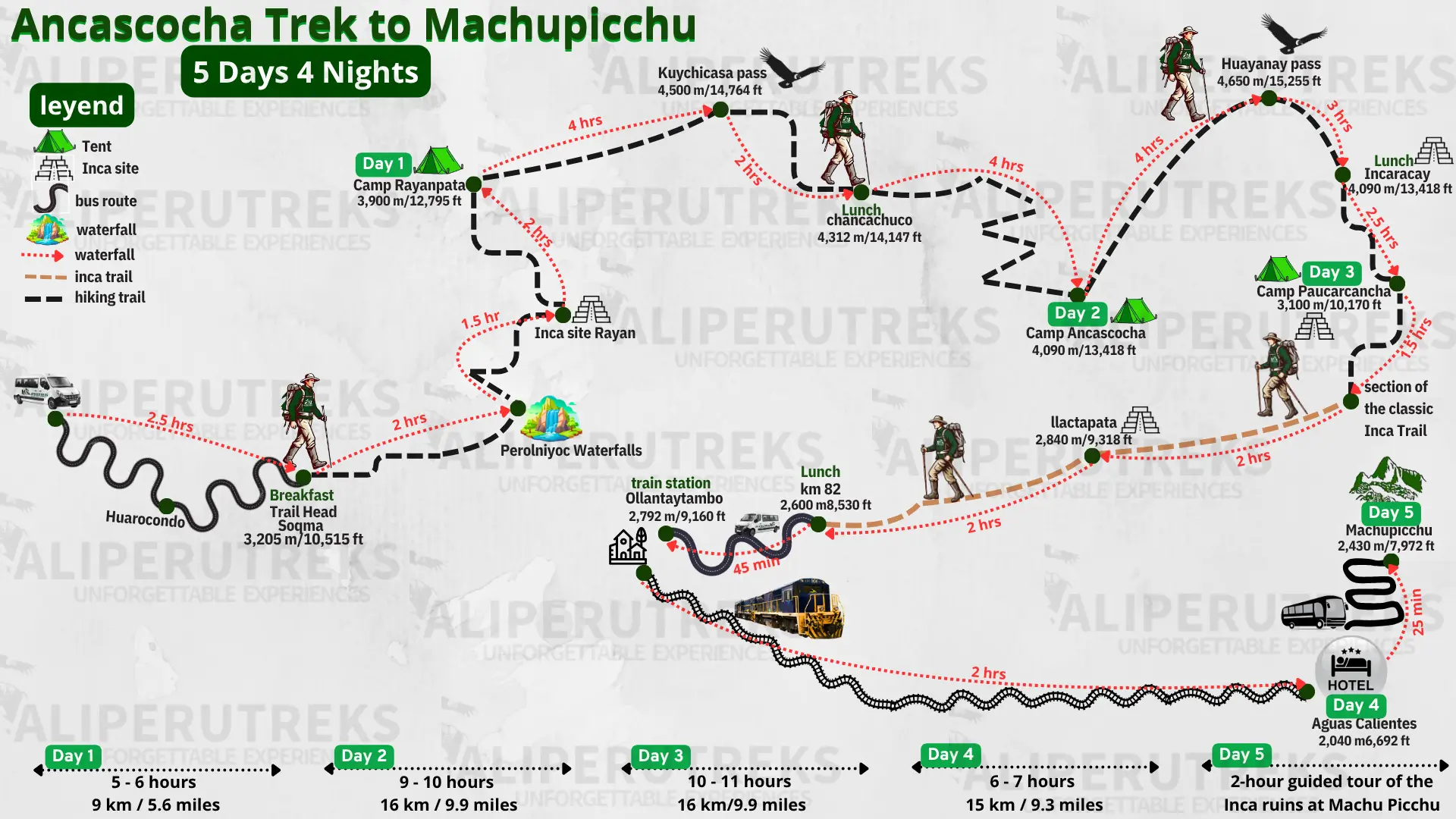
2. Ancascocha Trek to Machu Picchu – 5 Days / 4 Nights (Best Seller)
The 5-day standalone version covers the same terrain as the 4-day version but spreads the two passes across separate days, giving a gentler elevation curve.
- Day 1: Cusco – Soqma – Rayan Community (3,900 m)
- Day 2: Rayan – Kuychiccasa Pass (4,500 m) – Ancascocha
- Day 3: Ancascocha – Huayanay Pass (4,650 m) – Paucarcancha
- Day 4: Paucarcancha – Aguas Calientes
- Day 5: Machu Picchu – return to Cusco
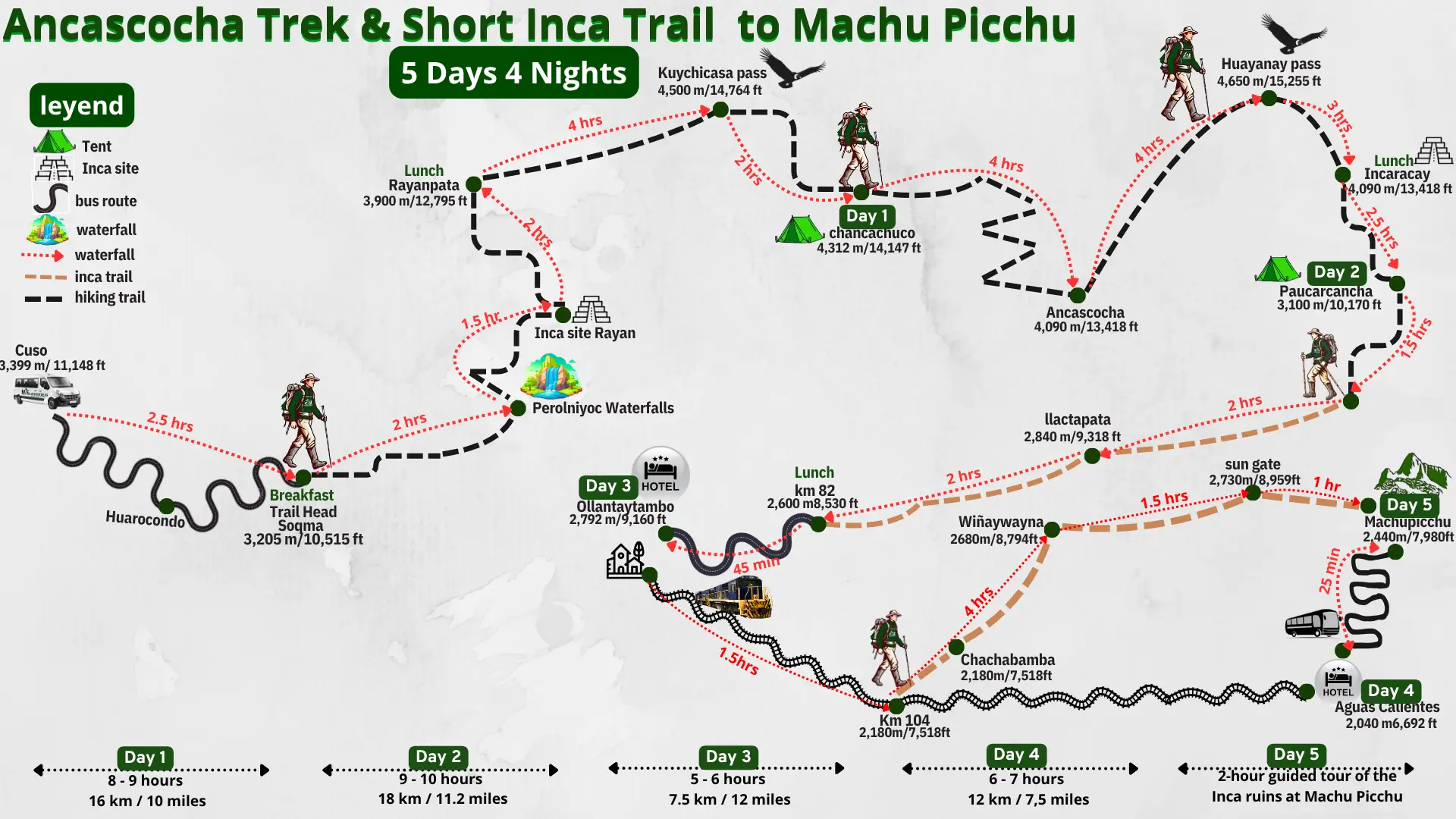
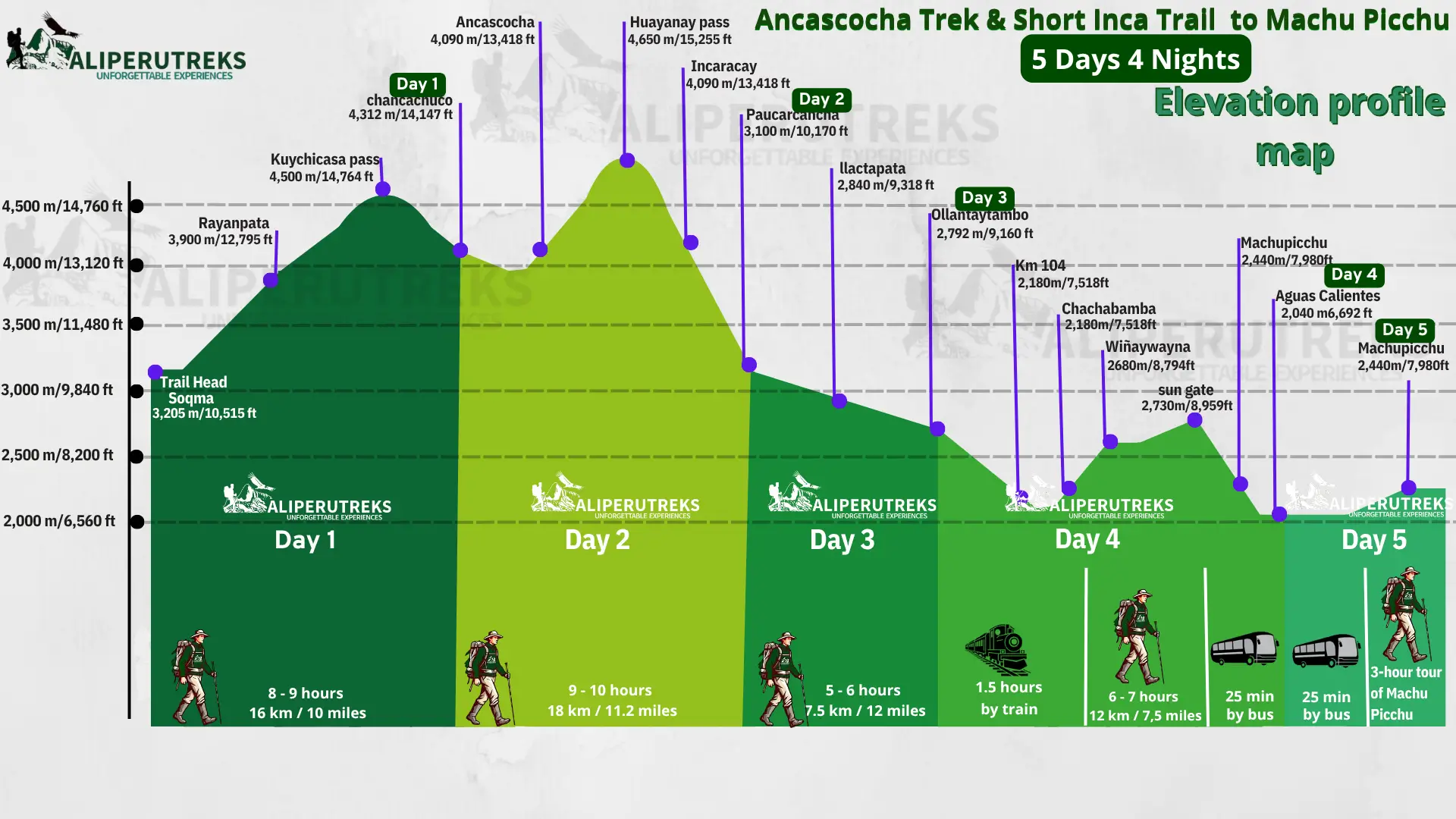
3. Ancascocha & Short Inca Trail – 5 Days / 4 Nights
This combined itinerary follows the same Ancascocha route through both passes, but instead of descending directly to Aguas Calientes from Paucarcancha, it continues along a stretch of the Classic Inca Trail corridor — passing Wiñay Wayna and finishing through the Sun Gate before descending to Machu Picchu on foot rather than by train.
- Days 1–3: Same route as the standalone Ancascocha Trek through Huayanay Pass to Paucarcancha
- Day 4: Paucarcancha area – Wiñay Wayna – Inti Punku (Sun Gate) – Machu Picchu (on foot)
- Day 5: Full Machu Picchu visit – return to Cusco
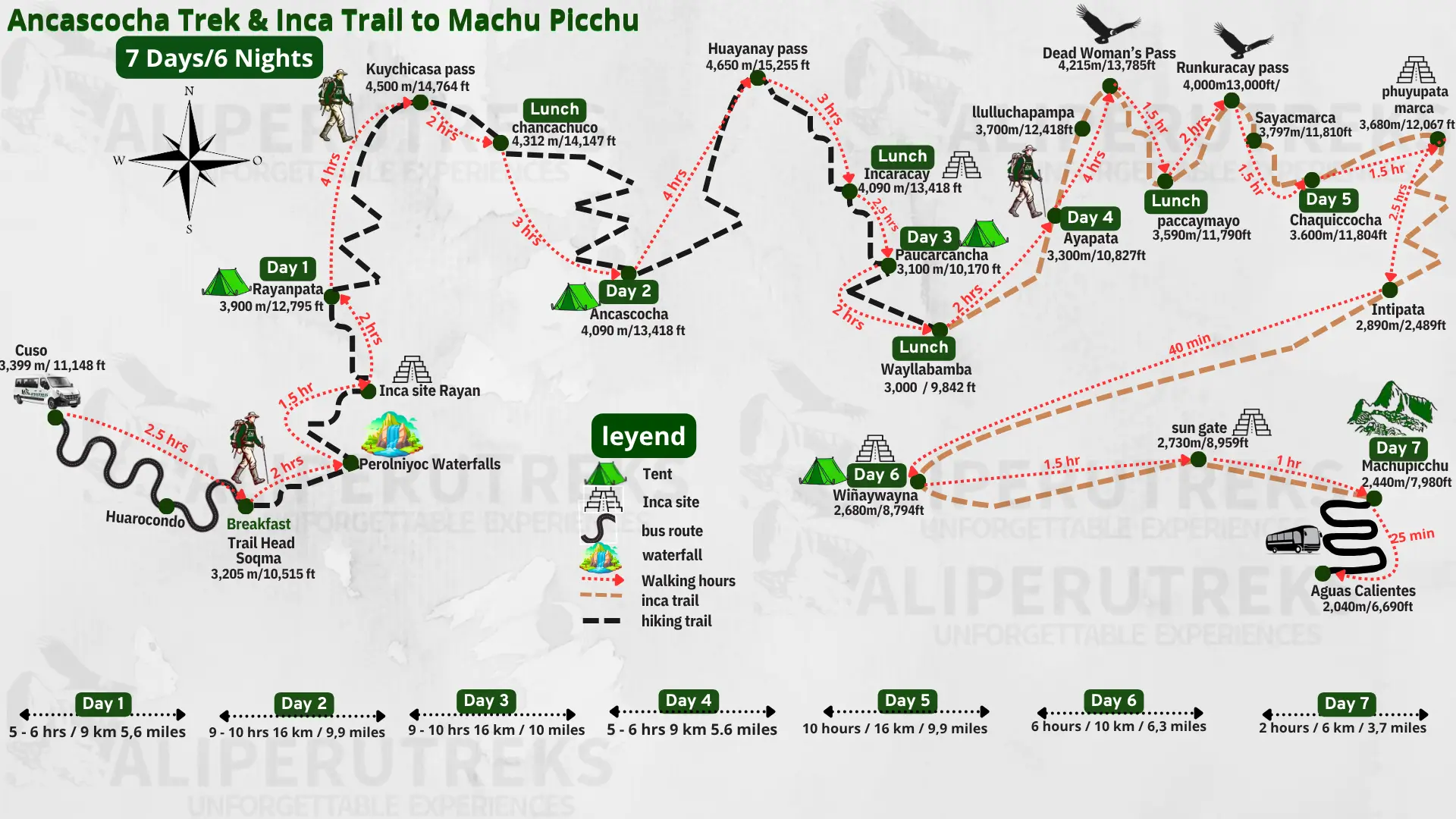
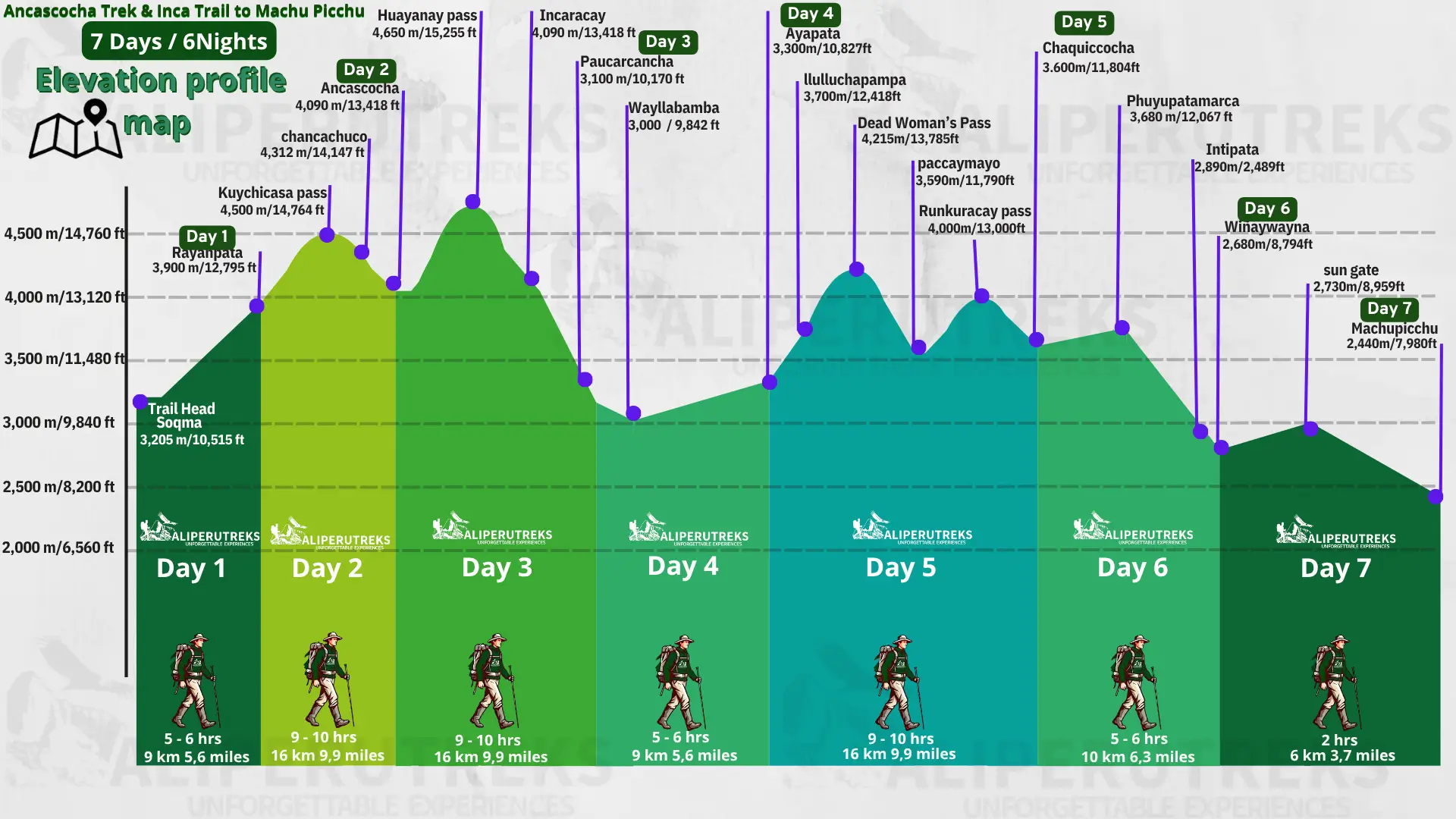
4. Ancascocha + Classic Inca Trail – 7 Days / 6 Nights
The longest and most complete combination, this 7-day itinerary links the full Ancascocha route with the entire Classic Inca Trail, including Dead Woman’s Pass (4,215 m) — meaning this version crosses three major passes in total rather than two.
- Days 1–3: Ancascocha route through Kuychiccasa Pass and Huayanay Pass to the Paucarcancha area
- Days 4–6: Full Classic Inca Trail sequence, including Dead Woman’s Pass (4,215 m), Runkurakay, Sayacmarca, Phuyupatamarca, and Wiñay Wayna
- Day 7: Machu Picchu visit – return to Cusco
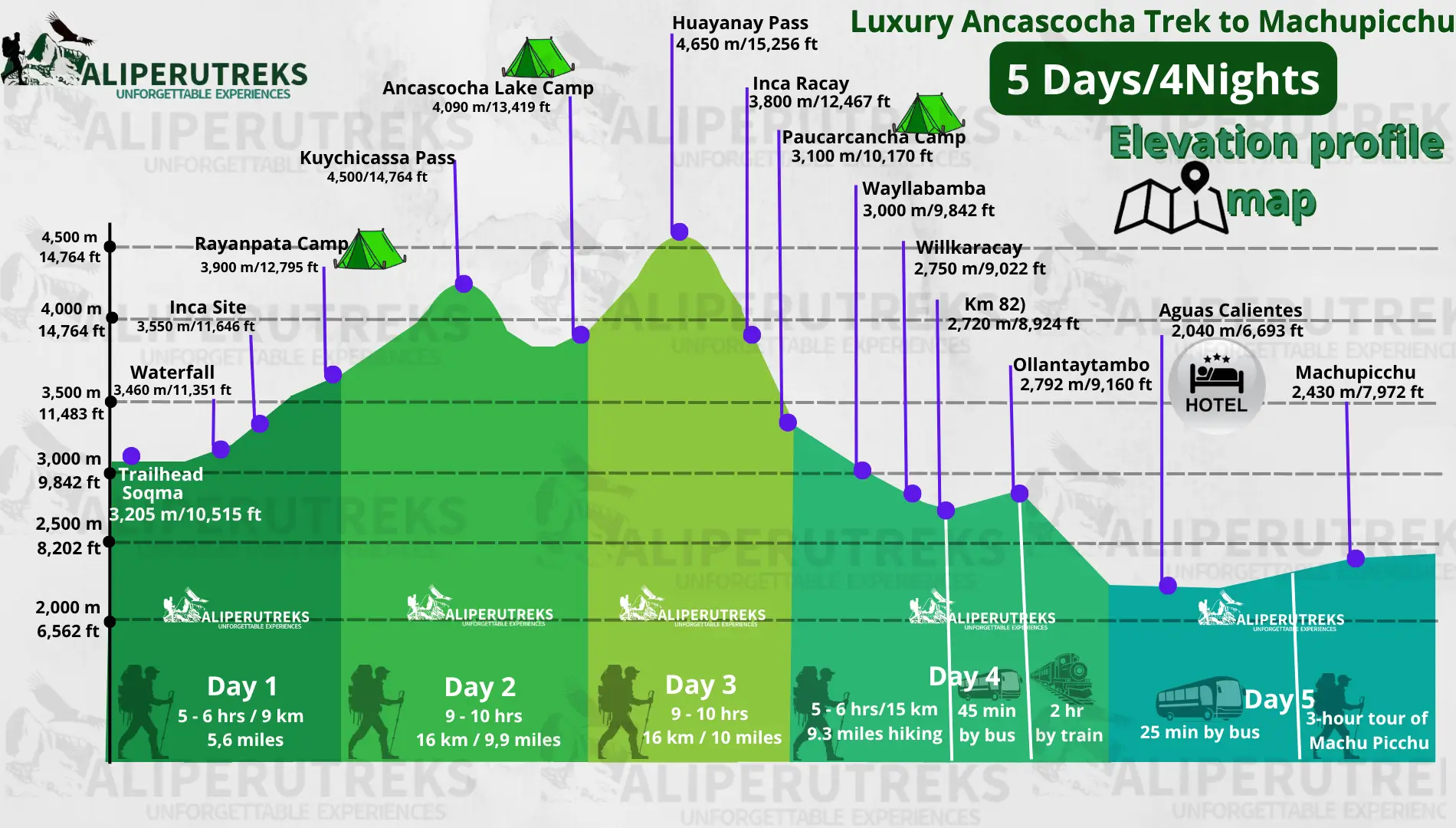
5. Luxury Ancascocha Trek – 5 Days / 4 Nights
The luxury version follows the identical route and elevation profile as the standard 5-day itinerary above — the difference is camp comfort and service level, not the path itself. The map and elevation profile for this version are the same as the standard 5-day trek.
Reading the Elevation Profile: What the Numbers Mean
A few things worth understanding when looking at any of these elevation profiles:
- The steepest sustained climbs happen approaching each pass, not gradually throughout the day — expect a few hours of concentrated ascent rather than a steady incline across the full day.
- Huayanay Pass (4,650 m) is the highest point on every Ancascocha itinerary, including the combined versions — higher than Dead Woman’s Pass (4,215 m) on the Classic Inca Trail portion of the 7-day combo.
- The descent to Aguas Calientes drops over 2,000 vertical meters from the trek’s highest points, which is part of why the final days of any itinerary feel comparatively easier despite covering real distance.
Because every version of this trek spends multiple days above 3,800–4,000 m, it’s worth reviewing altitude sickness prevention regardless of which map above matches your booked itinerary. For context on how this route’s elevation profile compares to a well-known alternative, the existing Ancascocha vs. Salkantay comparison covers that in more detail, and the trek’s broader recognition is covered in the National Geographic feature on the route.
FAQ: Ancascocha Trek Map and Elevation
Huayanay Pass, at 4,650 m (15,255 ft), is the highest point on every Ancascocha itinerary, including the combined versions with the Inca Trail.
The overall route and endpoints are the same, but the daily breakdown differs: the 4-day version crosses both high passes within the first two days, while the 5-day version spreads them across separate days for a gentler elevation curve.
It’s the only version that adds the complete Classic Inca Trail, including Dead Woman’s Pass (4,215 m) — meaning it crosses three major passes total instead of two.
No. The luxury and standard 5-day versions follow the identical route and elevation profile; the difference is exclusively in camp comfort and service.
Near Paucarcancha, where the Ancascocha trail meets the established Inca Trail corridor — this junction point appears in both the Short Inca Trail combo and the full 7-day Classic Inca Trail combo.